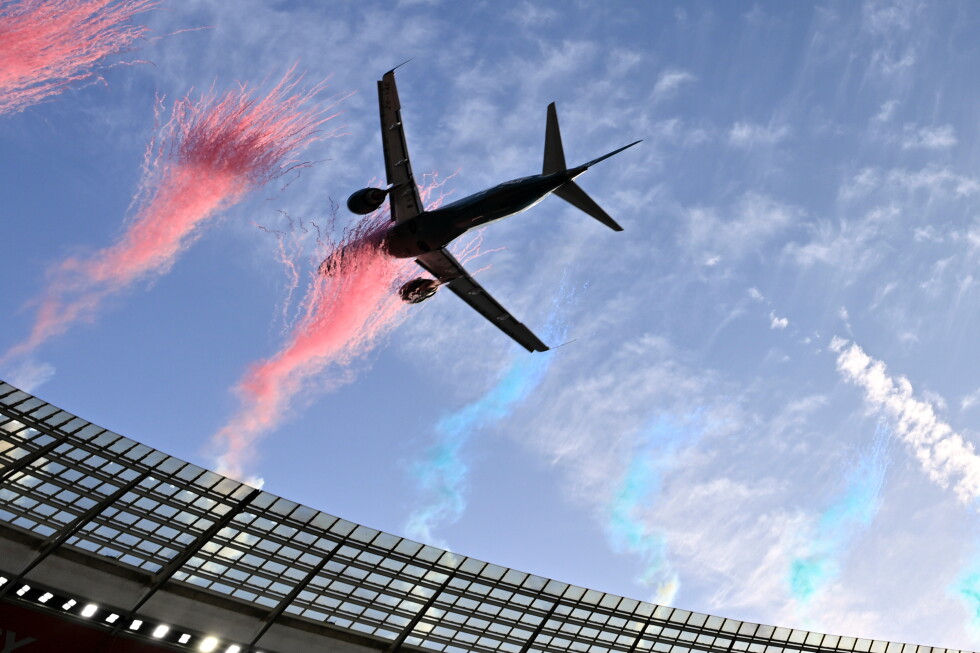
CAPE TOWN, South Africa – A high-drama pre-game aerial stunt featuring two commercial passenger jets screaming just meters above the roof of Cape Town’s DHL Stadium has electrified a sell-out crowd of 56,000 rugby fans, but ignited fierce global discussion over whether the event crossed unacceptable safety lines. The low-altitude formation flyby, carried out by South African regional carrier Airlink ahead of a blockbuster rugby clash between the world’s top two ranked teams – South Africa and New Zealand – on Saturday, went viral almost immediately after footage from broadcast cameras and fan witnesses spread across social media.
Flight tracking data from the widely used aviation monitoring service Flightradar24 estimates the lead Embraer jet passed as close as 12 to 14 meters (41 to 46 feet) above the stadium’s roof, with thousands of spectators and both competing teams positioned directly below. Trailing just behind its lead, the second jet flew straight through a cloud of pink ceremonial dust that had been released from the stadium roof as part of the pre-game entertainment program. As the primary sponsor of the South African national rugby team, Airlink has moved quickly to defend the event, insisting every step of the flyby was planned and executed in full compliance with South African civil aviation safety rules.
According to a statement released by the airline Sunday, the stunt underwent weeks of detailed planning and multiple full rehearsals before the match. The jets, which carried no commercial passengers, were crewed by three senior captains each: one serving as flight commander, one as co-pilot, and a third dedicated exclusively to monitoring on-board safety conditions. When passing over the stadium, the aircraft maintained a steady speed of approximately 150 knots (278 kph/172 mph), a speed the airline says was well within regulated limits. The airline also noted that both the South African Civil Aviation Authority and national Air Traffic Navigation Services reviewed the plan, issued formal approval, and provided ongoing guidance throughout the preparation and execution of the flight. Post-flight analysis of flight data from both jets, Airlink added, confirms all altitude and speed parameters remained within official civil aviation safety limits.
Low-altitude stadium flybys are a long-standing tradition for major South African rugby matches, dating back to the iconic 1995 Rugby World Cup final – also between South Africa and New Zealand, the sport’s most storied fierce rivals – when a Boeing 747 completed a low pass over Johannesburg’s Ellis Park Stadium. But this weekend’s event was far lower and more dramatic than any previous flyby, drawing international attention and immediate pushback from aviation safety experts, who argue the stunt left an unacceptably small margin for error.
Chris Martinus, president of the Aircraft Owners and Pilots Association South Africa, told the Associated Press that the lead jet’s altitude adjustments as it passed over the stadium – dipping and climbing to follow the roof contour – created unnecessary risk. “Basically, that lead aircraft … was kind of like dodging over the roof and climbing over the one side and dipping below and then climbing over the other side. That was a little bit uncomfortable,” Martinus said. He emphasized that at such an extremely low altitude, pilots have almost no room to respond to an unexpected emergency: if any unplanned adverse event occurs, there are simply no actionable options to avoid disaster.
Keith Tonkin, an Australian aviation consultant and former military and commercial pilot, echoed those concerns, noting that Embraer regional jets like the ones used for the stunt are designed for medium-altitude commercial passenger routes, not low-level aerobatic-style operations. Tonkin also warned that the event sets a dangerous precedent that other organizers may try to replicate in the future. “The bigger picture is that a benchmark has been established and others may expect to do something similar, and that’s not going to end well,” Tonkin said. He pointed to common in-flight hazards that become catastrophic at low altitude: even a minor bird strike or unexpected turbulence would leave pilots with too little space to maneuver to avoid crashing into the crowded stadium below.
As of Monday, South African civil aviation authorities have not issued any additional public comment beyond the Airlink statement confirming their prior approval of the event. The debate over the stunt continues to unfold across aviation and sports circles online, with spectators praising the unforgettable pre-game experience even as safety experts call for stricter rules for future aerial stunts at public sporting events.