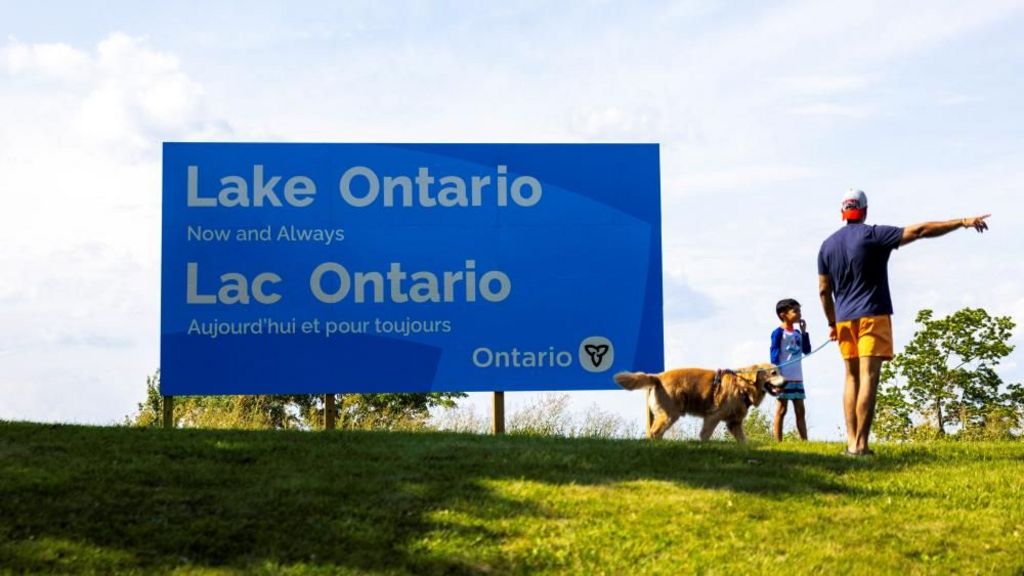
A fresh diplomatic and political standoff has erupted between Canada and the United States after U.S. President Donald Trump issued an executive order unilaterally renaming the shared Great Lake, Lake Ontario, to “Lake America” — triggering a fiery response from top Canadian officials led by Ontario Premier Doug Ford.
Ford, the head of government for the Canadian province that shares its name with the iconic waterway, hit back at Trump’s provocative move over the weekend by unveiling a massive, permanent sign along the Canadian shoreline of the lake emblazoned with the defiant message: “Lake Ontario. Now and Always.” In remarks delivered directly in front of the newly installed sign, Ford made clear that Canada would not back down on the long-standing name. “Long before President Trump, this lake was called Lake Ontario. Long after President Trump is gone, it will still be called Lake Ontario,” Ford said, adding that Trump’s action was driven by retaliation for Canada’s refusal to back down in trade negotiations.
The dispute comes on the heels of collapsed bilateral trade talks that have already sparked a new trade war: after the talks fell apart, the U.S. imposed a steep 50% tariff on $20 billion worth of Canadian goods, and Canada has pledged to implement “dollar for dollar” reciprocal counter-tariffs starting next month.
When signing the executive order Thursday, Trump claimed the name change would take effect immediately. While the U.S. president holds broad authority over how domestic geographic features are recognized within U.S. borders, no international regulation requires other sovereign nations to adopt U.S.-imposed names for shared waterways. Canadian officials across all levels of government have uniformly rejected Trump’s order as invalid and meaningless.
To amplify his announcement, Trump shared multiple AI-generated videos on his social media channels over the weekend. One edited clip shows the president kicking over an existing Lake Ontario sign and replacing it with one that reads “Welcome to Lake America.” A second even more outlandish video depicts a flock of Canada geese edited to have Trump’s signature hairstyle, holding rifles and patrolling the shoreline of what the video labels the newly renamed lake.
Ford’s public rebuke echoes a statement released earlier by Canadian Prime Minister Mark Carney, who also pushed back on the renaming. “Things must be called by their name, and this lake is called Lake Ontario – today and forever,” Carney insisted.
For context, Lake Ontario is the smallest of the five North American Great Lakes, with a shoreline spanning both the Canadian province of Ontario and the U.S. state of New York. Four of the five Great Lakes draw their names from Indigenous North American languages, including Ontario, Huron, Michigan and Erie; the fifth, Lake Superior, takes its name from an anglicized French term.
Under the terms of Trump’s latest executive order, the U.S. Department of the Interior has 30 days to update the name in the Geographic Names Information Service, the U.S. federal government’s official database of domestic geographic names. This is not the first time Trump has unilaterally renamed a shared international body of water: shortly after returning to the White House in 2025, he issued a similar order renaming the Gulf of Mexico to the “Gulf of America.”
That earlier move also sparked widespread international pushback. The Mexican government rejected the change entirely, arguing that no single nation can unilaterally rename a shared international waterway. The dispute also spilled into the private sector, leading to a legal battle between Mexico and tech giant Google, which opted to adjust its mapping platform to reflect the change for U.S. users. Currently, Google Maps displays “Gulf of America” for users located within the U.S., “Gulf of Mexico” for users in Mexico, and a combined label “Gulf of Mexico (Gulf of America)” for users in all other countries.
The latest renaming clash has further inflamed already tense bilateral relations between the U.S. and Canada, compounding the growing trade rift that preceded the naming dispute.