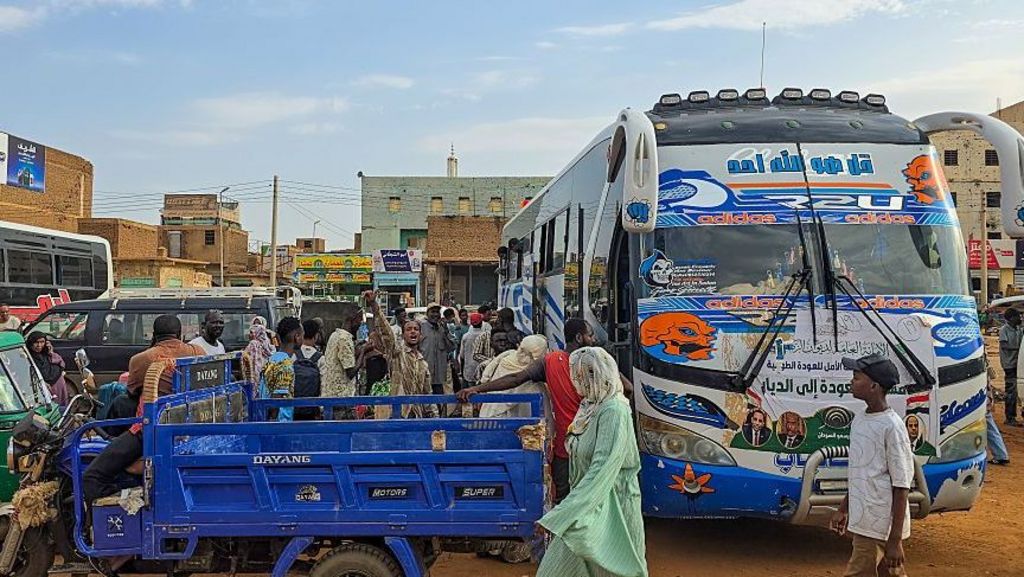
Two and a half years after Sudan’s devastating civil war erupted between the national army and the paramilitary Rapid Support Forces (RSF), a tentative step toward normalcy has come to the capital Khartoum – even as the conflict risks escalating into a full regional crisis.
Sudan’s military-led transitional government has formally scrapped the strict curfew and state of emergency that was imposed on Khartoum shortly after fighting broke out in April 2023, state media confirmed. The policy shift comes 18 months after Sudan’s regular armed forces retook full control of the capital from RSF fighters, ending large-scale urban combat in the city that displaced millions of residents.
Today, around 40 percent of the 5 million people who fled Khartoum at the height of the fighting have begun returning to their homes, data from the International Organization for Migration shows. Government officials say lifting the emergency restrictions is intended to kickstart the process of rebuilding daily life in the capital. Authorities have already resumed limited commercial operations at Khartoum’s main international airport and have launched outreach campaigns to encourage displaced businesses and foreign diplomatic missions to reestablish their presence in the city.
But for returning residents, the path to recovery remains fraught with severe challenges. Widespread destruction and looting have left most residential and commercial structures damaged, and chronic power outages have become a daily reality across the city. Khartoum state government spokesperson Altayeb Saadeldin told Reuters that the electricity crisis stems from multiple factors: large-scale looting of critical infrastructure including copper wiring, fuel and power generation components, plus repeated drone attacks on power facilities that the government blames on the RSF. An anonymous RSF source has dismissed the accusations as fabricated army propaganda, rejecting all responsibility for the damage to the capital’s power grid.
Even with the state of emergency lifted, security authorities remain on high alert for residual RSF activity in the capital. Permanent security patrols will continue operating across all of Khartoum state, and residents traveling after dark are still required to carry official photo identification. BBC Monitoring reports that the Sudanese army is also conducting ongoing security sweeps throughout the greater Khartoum region, targeting suspected RSF sleeper cells, undocumented migrants, and criminal networks operating in the war-torn area.
While Khartoum stabilizes, heavy fighting continues in southern and western regions of Sudan, and mounting evidence confirms the conflict is spilling across Sudan’s international borders, raising alarm among global policymakers. The most recent escalation came on August 20, when the government of Chad accused Sudan’s military of carrying out an airstrike on a Chadian military convoy located roughly 100 kilometers inside Chadian territory in the country’s Ennedi-Est province. Chad has since placed all of its border forces on maximum alert in response to the incident.
Sudan’s government has flatly rejected the accusation, saying it is perplexed that the blame was placed on its army before any independent investigation could be completed. In an official statement, Sudan’s foreign ministry stressed that the Sudanese Armed Forces (SAF) is focused solely on defending the country’s sovereignty, security and territorial integrity against internal threats, and remains fully committed to respecting the sovereignty of all neighboring states.
Tensions between Sudan and Chad have been simmering for months, as Sudan accuses Chadian authorities of allowing military supplies from the United Arab Emirates to be routed to the RSF through Chadian airports and border crossings. Both Chad and the UAE have repeatedly denied these allegations, despite corroborating reports from United Nations experts and multiple international investigative media outlets.
The cross-border strike has prompted urgent concern from the United States, which has warned that the expanding conflict threatens to destabilize the entire Sahel region. Massad Boulos, the U.S. Senior Adviser for Arab and African Affairs, released a statement condemning the SAF airstrike on Chadian territory and repeating Washington’s longstanding position that there is no military solution to Sudan’s civil war.
“There is absolutely no justification for expanding the violence beyond Sudan’s borders,” Boulos wrote in a public post on X, adding that all external military and financial support to both warring parties must end immediately. Boulos has also pushed for an immediate humanitarian truce, and has publicly expressed frustration with the Sudanese military’s refusal to enter peace talks unless the RSF first disarms and withdraws from all occupied territory.
Earlier this month, the U.S. envoy to the United Nations submitted a draft resolution to the UN Security Council that would expand an existing 2005 weapons embargo covering the Darfur region – the RSF’s primary stronghold – to the entire territory of Sudan. The draft would also add a full ban on the transfer of attack drones, a weapon that both the SAF and RSF have increasingly relied on throughout the conflict.
Sudan’s government and military leadership have rejected the draft resolution, with local media reporting that officials argue the measure unfairly treats the internationally recognized national military as equivalent to an illegal paramilitary group, and would unnecessarily restrict the army’s ability to defend Sudanese civilians from insurgent attacks.