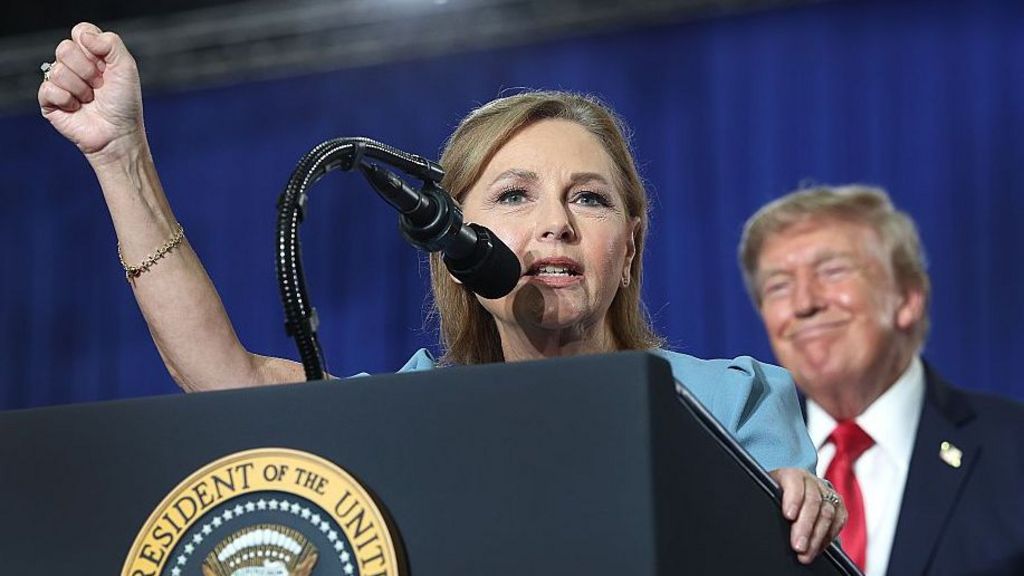
In a high-stakes primary election that has underscored former President Donald Trump’s enduring hold over the U.S. Republican Party, South Carolina voters have tapped Darline Graham — the younger sister of late longtime Senator Lindsey Graham — as the party’s nominee for the November U.S. Senate general election. Graham, who has never before campaigned for public office, was appointed as an interim senator in July to finish out her brother’s term following his unexpected sudden death that month, and her successful bid for the permanent nomination came with robust, high-profile support from Trump, who traveled to the state to rally voters on her behalf.
With vote counting nearly completed, CBS News — the U.S. partner of the BBC — projects Graham secured 52.5% of the Republican primary vote, beating out a challenge from hardline right-wing incumbent Congressman Ralph Norman. A fellow Trump ally who has supported the majority of the former president’s policy agenda, Norman attempted to frame Graham as a tool of establishment Washington insiders during the campaign. The head-to-head runoff was triggered after the two candidates finished as the top two vote-getters in an earlier crowded primary contest held earlier this month. Norman’s 2024 decision to initially back Nikki Haley, Trump’s rival for the Republican presidential nomination, is widely seen as having undermined his standing with party loyalists, opening a door for Trump’s endorsement to carry Graham to victory.
Graham’s victory has already been interpreted by political observers as clear proof of Trump’s unbroken influence over the national Republican Party, even as the 2026 midterm elections enter their final stretch. Graham acknowledged her lack of traditional political experience during the primary campaign, a gap that became a central point of discussion after she stumbled while answering a foreign policy question during a televised debate. When pressed to outline the U.S. policy position on Taiwan, Graham admitted openly: “I’m not that informed on national security. National security is not my thing, not my area of expertise, but I do support the military.” Following her win, Graham took to the social platform X to share her reaction, thanking her supporters and Trump, and saying she was “deeply honoured and humbled” by the outcome of the vote.
Political analysts widely predict Graham will win the November general election, noting that South Carolina has not elected a Democratic candidate to the U.S. Senate in more than 70 years, making the solidly red state unlikely to flip to Democrats this cycle. Beyond South Carolina, Tuesday’s primaries marked a key testing ground for Trump’s political clout in other Republican contests across the country. In Oklahoma, another deep red state, Trump-endorsed former state lawmaker Mike Mazzei faced off against incumbent state Attorney General Gentner Drummond for the Republican gubernatorial nomination; the winner of that contest is all but guaranteed to win the general election in November. For the national political landscape, the 2026 midterm elections as a whole will determine which party holds a majority in both chambers of the U.S. Congress, a balance of power that will shape the entire second half of Trump’s current presidential term.
South Carolina was not the only state holding special elections on Tuesday to fill seats left vacant by sitting lawmakers’ deaths. In the Atlanta, Georgia area, voters cast ballots to replace Democratic Congressman David Scott, who died in office back in April. Scott’s daughter, Marcye Scott, joined the crowded field of candidates seeking to finish out the final months of his term, which ends in January. However, U.S. media projections show that she was defeated by opponent Everton Blair, who will serve out the remaining months of the term, with a new general election for a full two-year term set for November.