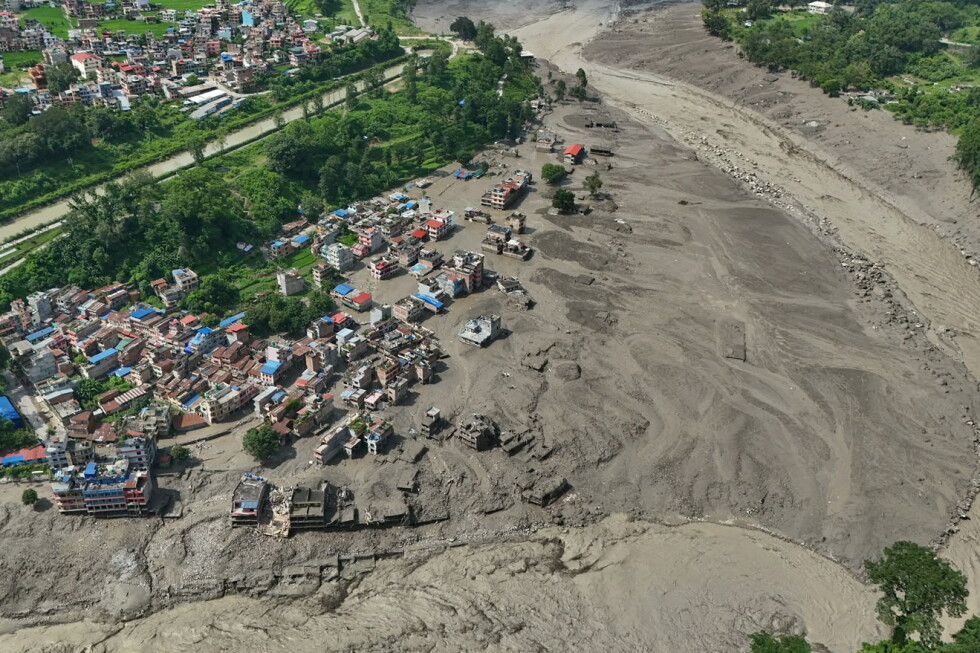
A catastrophic natural disaster has struck northern Nepal, where a combined ice and rock avalanche unleashed devastating flash floods on Wednesday, leaving at least eight people dead, hundreds unaccounted for, and critical local infrastructure in ruins. Among the 384 people reported missing are 291 international tourists hailing from nations including India, the United States, the United Kingdom, and Malaysia, according to official government statements.
The destructive floodwaters surged along the Bhotekoshi River starting around 9 a.m. local time, wiping out entire riverside villages, key travel routes, and large-scale hydropower projects along its path. In response to the crisis, Nepali authorities issued urgent evacuation and safety warnings to communities across multiple districts, urging residents to immediately relocate to higher ground away from the banks of the Bhotekoshi, Trishuli, and Narayani rivers, all at risk of dangerous surging waters.
To bolster ongoing search and recovery operations, the Nepali government has formally requested international assistance from neighboring India and China, confirmed Sasmit Pokharel, a spokesperson for the national administration.
The hardest-hit region, Rasuwa district, faced an almost identical disaster just 14 months prior, in August 2023. On that occasion, outburst flooding from a glacial lake in the adjacent Tibet Autonomous Region of China, driven by record high temperatures in the high Himalayas, killed nine people and destroyed critical cross-border infrastructure, including a key bridge connecting Nepal and China.
Climate and disaster researchers based at the International Centre for Integrated Mountain Development (ICIMOD), a Kathmandu-based leading regional research institution, have pinpointed the cause of Wednesday’s disaster: a sudden avalanche breaking loose from a Nepal-based glacier. Experts explain that the avalanche deposited a massive block of ice and rock into the Lhende Khola River, a major tributary of the Bhotekoshi, temporarily damming the waterway before the accumulated pressure triggered a catastrophic sudden surge downstream that turned into the destructive flash flood. This marks the second major flood event on the Lhende Khola in just over a year, a striking increase in frequency for the region.
Scientists warn that this disaster is far from an isolated event, and is directly tied to accelerating human-caused climate change heating the Hindu Kush Himalaya region far faster than the global average. This rapid warming has made the entire mountain range exponentially more vulnerable to extreme events including avalanches, outburst floods, landslides, and glacial melt events. Earlier research published by ICIMOD this year confirmed that glacial ice loss across the entire Hindu Kush Himalaya region has doubled since 2000, with rising global temperatures identified as the primary driver of the accelerating melt.
“In a warming Himalaya, functional early warning systems are the first line of adaptation for at-risk communities,” said Saswata Sanyal, a disaster risk reduction specialist at ICIMOD, emphasizing the urgent need for improved preparedness as extreme weather events grow more frequent.
This reporting is part of the Associated Press’ global climate and environmental coverage, which receives philanthropic funding from multiple private foundations, with the AP retaining full editorial control over all independent content.