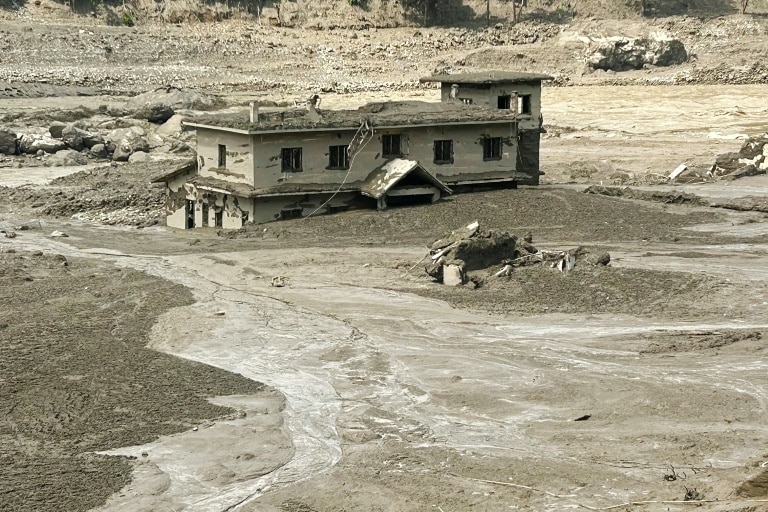
A catastrophic flash flood and subsequent mudslide event along the shared Nepal-China border has left at least eight people dead in Nepal and caused “major casualties” on the Chinese side of the boundary, authorities confirmed Wednesday. The disaster, which unfolded in the Himalayan border region, has destroyed infrastructure, swept away homes and vehicles, and disrupted critical services across both sides of the frontier.
Eyewitness accounts and visual evidence captured the devastating scale of the flood. Images released by Nepal Police show muddy floodwaters surging through river valleys, with only the top floors of submerged homes visible above the silt. Social media videos shared by law enforcement and local residents document torrents of brown water crashing through mountain valleys in Nuwakot, the Nepali district that forms the border with China’s Tibet Autonomous Region.
“I witnessed the flood sweep away eight or nine trucks, along with houses and people,” 34-year-old local teacher Suman Chalise told AFP from Nuwakot. “It was absolutely heart-wrenching. I had not witnessed such devastation before.”
As of Wednesday evening, Nepali police had recovered eight bodies, with search and rescue operations still ongoing across the affected zone. “So far, eight bodies have been found. Rescue operations are underway,” Nepal police spokesman Abi Narayan Kafle told AFP. Early in the response, authorities had already issued evacuation orders for communities located along the region’s riverbanks, as officials initially worked to assess the full extent of the damage.
The Nepal Army has deployed helicopters and specialized disaster response teams to the hard-hit area to support search and recovery efforts. Critical energy infrastructure has also been heavily impacted: the Nepal Electricity Authority announced that approximately 430 megawatts of power generation capacity from hydropower and solar facilities was damaged by the flood. Floodwaters damaged generation stations, transmission lines and distribution networks, cutting electricity service to large parts of the affected region.
Preliminary geoscientific assessments point to a natural geological trigger for the disaster originating on Nepali territory. Sarthak Shrestha, a remote sensing and geo-information analyst at the Kathmandu-based International Centre for Integrated Mountain Development (ICIMOD), said initial surveys found no unusual activity on the Chinese side of the border. “We believe a rock-ice avalanche occurred in Nepal, blocking the Lhende river and causing the cascading flood event,” Shrestha explained.
On the Chinese side of the border, the disaster triggered a major mudslide at Gyirong Port, a key trade hub connecting Tibet and Nepal. Chinese state broadcaster CCTV reported Wednesday that the mudslide originating on the Nepali side caused major casualties and multiple missing people at the port. AFP has not yet been able to independently verify the footage released by CCTV, which shows floodwaters carrying debris and tree branches across a submerged road.
Chinese President Xi Jinping has ordered full-scale rescue operations in the affected area of Tibet, according to Chinese state media. “The most urgent task is doing everything possible to search for and rescue the missing people… quickly treat injured people and minimise casualties to the greatest extent possible,” Xi stated, per CCTV. No official figures for deaths or injuries on the Chinese side have been released as of Wednesday. Local traffic authorities in Tibet’s Shigatse City have warned that roads in the area remain at high risk of additional mudslides and are unsafe for travel. This is not the first deadly disaster to strike the region: last July, 17 people went missing following a mudslide near Gyirong Port, according to official Chinese reports.
The disaster comes amid annual monsoon season that spans from June to September across South Asia, a period that regularly brings deadly floods and landslides to the Himalayan region. Climate scientists have warned that human-caused climate change is increasing both the frequency and intensity of these extreme weather events across the Hindu Kush Himalaya region.
Authorities are already warning of a second imminent flood threat. A blocked river channel remains upstream along the border river, and Qianggong Zhang, head of climate and environmental risks at ICIMOD, told AFP that a secondary flood event could occur in the coming days as response efforts continue.