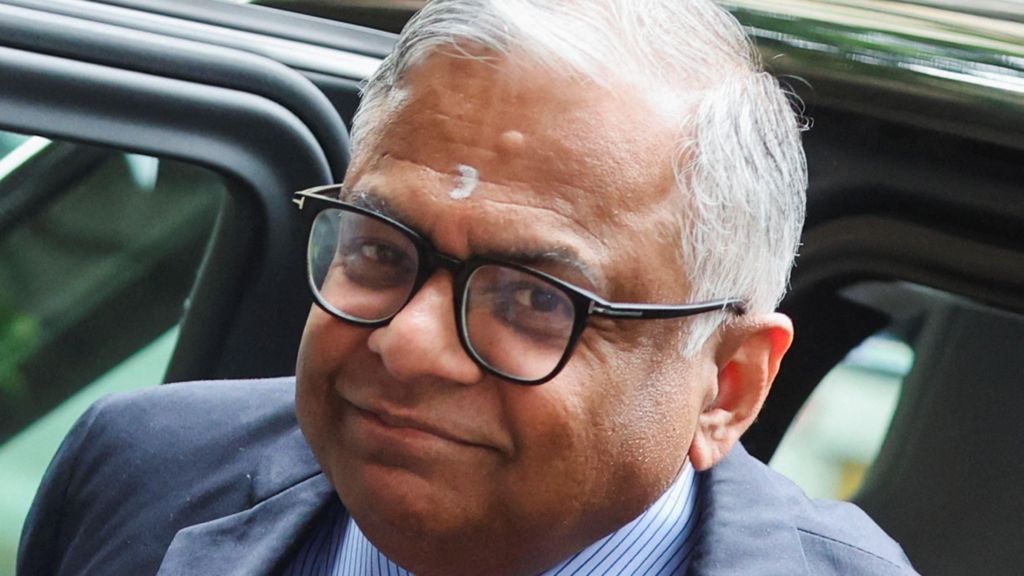
In a surprising development that has sent ripples across India’s corporate landscape, Tata Sons chairman N. Chandrasekaran stepped down on August 12, deepening long-running tensions between the holding company and its controlling shareholder, Tata Trusts. The departure leaves a vacancy at the top of India’s most iconic conglomerate, a $300 billion sprawling empire that spans luxury automaker Jaguar Land Rover, flag carrier Air India, and Apple’s domestic iPhone manufacturing operations, and sets off what industry analysts describe as one of the most challenging leadership searches in recent Indian business history.
Chandrasekaran’s exit came after a months-long deadlock over his reappointment, as disagreements between the Tata Sons leadership and the Tata Trusts board widened beyond repair. Sources close to the matter confirm the core points of contention were Chandrasekaran’s push for a public listing of the unlisted Tata Sons holding company, plus his aggressive capital allocation strategy for a slate of new high-growth, cash-burning businesses including semiconductors, electric aviation, and domestic e-commerce.
Under Chandrasekaran’s tenure, the Tata Group launched its largest ever capital expenditure cycle, pouring tens of billions of dollars into transformative projects: building India’s first commercial semiconductor fabrication plant, scaling domestic electric vehicle battery production, and overseeing the turnaround of Air India, which the group acquired from the Indian government in 2022. This breakneck expansion has left the next chairman facing a steep set of challenges from day one, governance experts warn.
“It is an incredibly difficult role not just for the individual who will get it but also for the selection committee to find someone,” explained Hetal Dalal, head of Institutional Investor Advisor Services (IiAS), a leading Indian governance advisory firm, in an interview with the BBC. “It requires a multitude of skillsets and experience: managing the working relationship with Tata Trusts, steering the Tata Sons board, understanding the unique dynamics of our new emerging businesses, and maintaining strong, collaborative ties with Indian regulators and the central government.” Dalal added that few global executives lead conglomerates of Tata’s size and diversification, and many sitting leaders would be reluctant to leave their current roles to take on the high-stakes position.
The complexity of the role has grown sharply in recent years, notes Nirmalya Kumar, former chief strategy officer at Tata Sons. “The collective losses of the new businesses are more than the cashflow generated by older companies like TCS, the group’s software arm whose business model has itself been challenged by the rise of artificial intelligence,” Kumar explained. For decades, Tata Consultancy Services (TCS) served as the group’s undisputed cash cow, contributing roughly 85% of total operating cash flow to fund new investments. Today, that historic pillar of support has weakened significantly, putting greater pressure on new leadership to right the ship of unprofitable new ventures.
While Dalal points out that the group has a deep bench of seasoned internal executives who may put their names forward for the role, she warns that finding an immediate “plug and play fit” is nearly impossible. “Any person who comes in will have a set of skills and experience, but must also be groomed for the unique demands of this role,” she said. Kumar, however, argues that existing internal leaders are not equipped to address the group’s current strategic challenges. “The people internally are good executors of existing business models. Companies like Tata Steel and Tata Motors are almost running on auto-pilot with a CEO in charge. The new chairman will have to understand new business models of the four unlisted businesses that are losing money,” he noted.
For institutional and retail investors holding shares in Tata Group’s listed entities, Chandrasekaran’s resignation is expected to bring a prolonged period of market uncertainty. Experts agree that new leadership will almost certainly shift the group’s strategic direction, particularly when it comes to the aggressive expansion agenda pursued by Chandrasekaran. “Some of the bleeding businesses will need a strategic plan to be made profitable. [The new person] will need to decide whether to scale back or exit some investments,” Dalal said. Kumar adds that the next chairman will also need to deliver a clear roadmap to markets, outlining how much additional capital will be required for ongoing projects and when investors can expect those high-risk bets to reach break-even.
But the single most critical priority for the new chairman, analysts agree, is repairing the fractured relationship between Tata Trusts – the charity foundation that holds a controlling stake in Tata Sons – and the Tata Sons operating board. The Tata Group enjoyed its most successful era under JRD Tata and Ratan Tata, when the same leaders helmed both the Trusts and the operating holding company, eliminating strategic friction. The first major breakdown came under former chairman Cyrus Mistry, when the roles were separated, and Chandrasekaran’s exit marks the second time a Tata Sons chairman has stepped down over a rocky relationship with the Trusts.
Mukund Rajan, former brand custodian for Tata Sons, told India Today that misalignment between the controlling shareholder and operating leadership is a fundamental, structural issue that must be addressed. “You cannot have companies being run where the majority shareholder is either feeling ignored or not aligned with the way the company will be run going forward,” Rajan said. “Repairing this relationship will have to be a key priority for whoever is next in the driving seat.”
Thus far, the ongoing leadership turmoil has already damaged the Tata Group’s decades-old reputation for stable, consensus-driven governance, experts say. Clear communication with stakeholders has long been a pain point for the group, Dalal explains, and the current silence creates unnecessary risk even though Tata Sons itself is unlisted. Movements at the holding company have a direct, tangible impact on millions of shareholders across the group’s 28 listed entities, she notes.
Minari Shah, a corporate communications advisor who previously worked with Tata Motors, told the BBC that the group’s immediate priority should be reducing uncertainty, not rushing to deliver full answers. “That means demonstrating that governance mechanisms are working, reassuring stakeholders that business continuity is unaffected and providing clarity around the process for leadership transition. It is okay not to have all the answers immediately, as long as stakeholders have confidence that the disagreeing parties are in dialogue,” Shah said.
As of nearly two weeks after Chandrasekaran’s resignation, neither Tata Sons nor Tata Trusts have released a detailed public statement outlining a succession roadmap or a path forward to resolve strategic differences. Tata Sons’ recent annual general meeting was even adjourned due to a lack of quorum, leaving key governance and succession decisions in limbo at a moment when stakeholders across India’s most valuable corporate group are craving clarity more than ever.