The long-running territorial standoff between Russia and Japan reignited this week, after Moscow delivered a formal diplomatic protest to Tokyo over harsh Japanese condemnation of President Vladimir Putin’s historic visit to the disputed Pacific Kuril Islands chain.
The flashpoint of the conflict centers on four southern Kuril Islands, which Moscow controls and Japan claims as its Northern Territories. The Soviet Union seized the archipelago from Japan in the closing days of World War II, and the unresolved dispute has prevented the two nations from signing a formal peace treaty to end World War II hostilities for nearly 80 years.
Last week, Putin made his first ever visit to Iturup – one of the four contested southern islands, which Japan refers to as Etorofu. The trip immediately triggered sharp pushback from Japan’s top leadership. Prime Minister Sanae Takaichi called the visit “absolutely unacceptable” and said it directly contradicted Japan’s long-held territorial claims. Takaichi added that the trip would further fray already strained bilateral relations, which have been soured by Russia’s full-scale invasion of Ukraine, and warned Moscow must face the consequences of its actions.
Japanese Foreign Minister Toshimitsu Motegi echoed the prime minister’s stance, issuing a “strong protest” and asserting that the entire Northern Territories, including Etorofu, are Japan’s inherent territory under both historical precedent and international law.
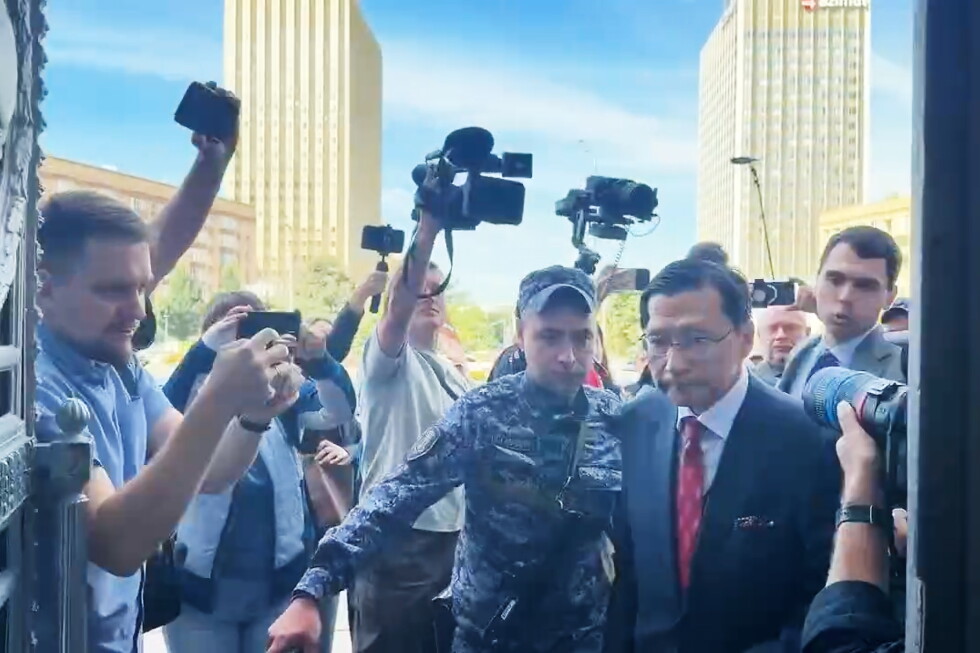
In response to the Japanese criticism, Russia’s Foreign Ministry summoned Japanese Ambassador Akira Muto on Tuesday, where Deputy Foreign Minister Mikhail Galuzin delivered Moscow’s formal counter-protest against what it called the “anti-Russia statements” from Takaichi and Motegi.
According to an official statement from the Russian Foreign Ministry, Galuzin made clear to Muto that Russia’s sovereignty and jurisdiction over the southern Kuril Islands is “absolutely unshakable.” The ministry emphasized that the territories were granted to the Soviet Union as a legal outcome of World War II, a status enshrined in Allied wartime agreements and the Charter of the United Nations. “Any attempts by the Japanese side to directly or indirectly call this obvious reality into question are absolutely unacceptable and unlawful,” the statement read.
Galuzin also noted that Tokyo has aligned itself with Western-led sanctions against Russia over the Ukraine conflict, and confirmed that “Moscow reserves the right to take appropriate countermeasures” in response to Japan’s recent actions.
For decades, sustained diplomatic efforts to reach a mutually acceptable settlement to the territorial dispute have failed to produce tangible progress. Over the years, Moscow has significantly strengthened its military deployment across the Kuril Islands, a move widely seen as a reinforcement of its uncompromising claim to the archipelago.
Speaking during his visit last week, aboard a Russian warship participating in Pacific military drills, Putin reflected on the shifting state of bilateral ties. He noted that Russia had previously built constructive working relationships with multiple former Japanese leaders, including the late former Prime Minister Shinzo Abe, who invested significant political capital in advancing closer ties and narrowing differences between the two nations. However, Putin said that dynamic shifted after Japan imposed sweeping sanctions on Russia following the February 2022 invasion of Ukraine, when Tokyo officially designated Russia as “a source of primary threats” to Japanese national security.
Despite the recent escalation, Putin reaffirmed that Moscow remains open to diplomatic engagement. “Russia remains ready to cooperate with all its neighbors, including Japan and other states in the region,” he said.