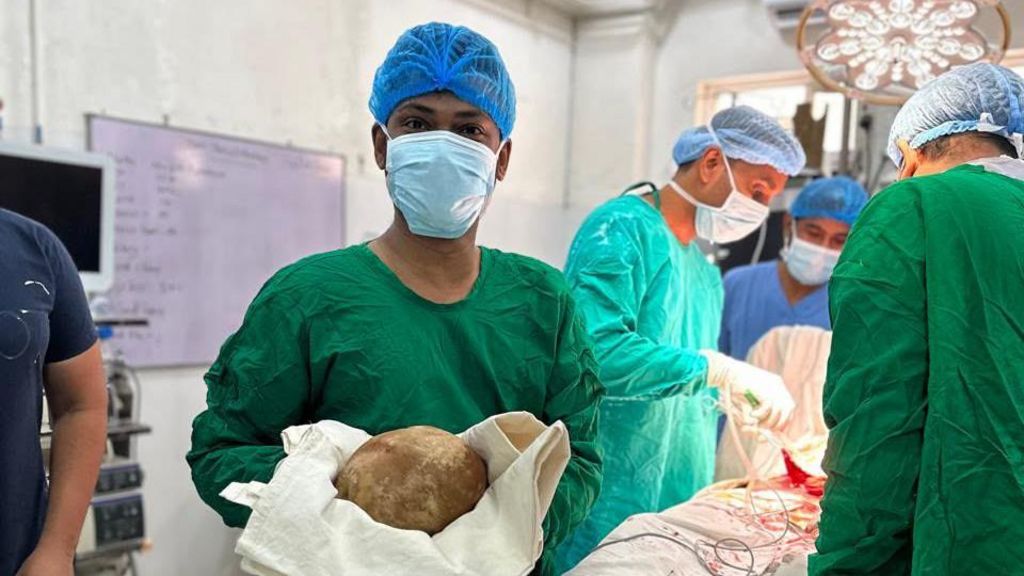
A medical team at Sri Lanka’s Trincomalee General Hospital has made global medical history after successfully extracting an extraordinarily large bladder stone weighing 3.1 kilograms (6.8 pounds) — a mass roughly equal to the weight of a full-term newborn baby and matching the dimensions of an ostrich egg.
The unprecedented procedure was performed last week on a 55-year-old male patient who had initially been admitted to the eastern Sri Lankan hospital for care following a stroke. While managing his post-stroke treatment, clinicians noticed the patient was experiencing persistent difficulty urinating, which prompted further diagnostic testing. That evaluation uncovered the massive solid mineral mass growing in his urinary bladder.
Speaking to BBC Sinhala following the successful surgery, lead surgeon Dr Prahalahan Balakrishnan confirmed that based on all available global medical documentation, this is the largest surgically removed bladder stone ever recorded. Measuring approximately 17 centimeters wide, the mass is only slightly shorter than the previous record-holding bladder stone removed in Brazil in 2003, which was recognized by Guinness World Records at 17.9 centimeters long but weighed just 1.9 kilograms — more than a kilogram less than the specimen extracted in Sri Lanka.
Dr Balakrishnan added that the newly removed stone had likely been developing gradually in the patient’s bladder for anywhere between five and 10 years before its detection. Despite the stone’s extraordinary size, the surgeon confirmed the patient is now in very good health following the procedure. He remains hospitalized to continue receiving ongoing care for the stroke that led to his initial admission.
Bladder stones form when concentrated minerals in urine crystallize and clump together into solid masses. They most often develop when the bladder does not fully empty during urination, leaving behind stagnant, concentrated urine that promotes crystal formation. Small bladder stones, often no larger than grains of sand, can pass out of the body without medical intervention, but any stone larger than 1 centimeter can block urinary flow and require surgical removal. Any mass larger than 4 centimeters is already classified as a giant bladder stone, making the 17-centimeter Sri Lankan specimen far outside the range of typical cases.