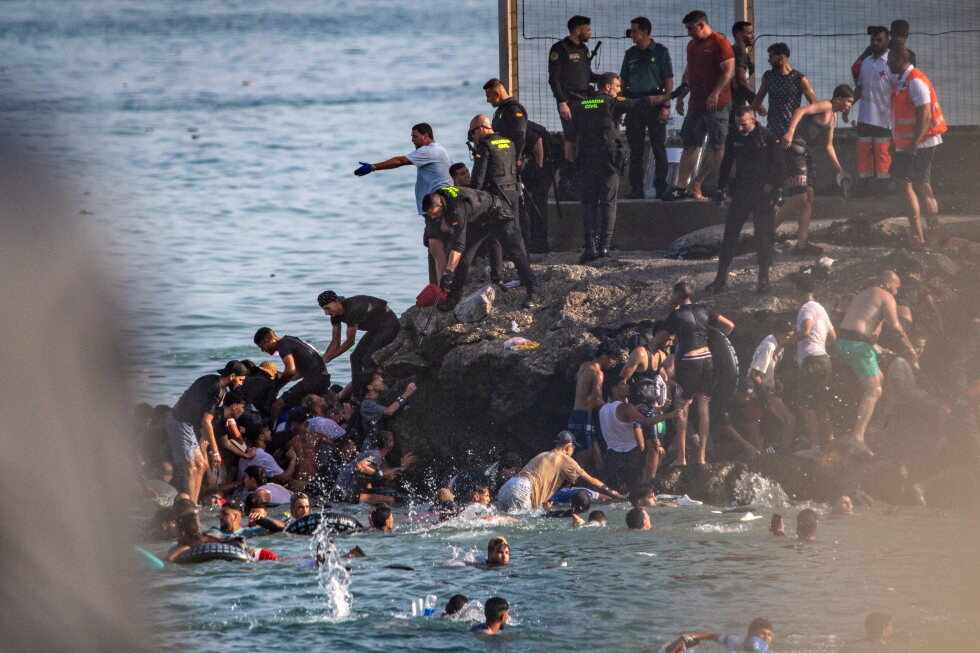
On the rugged North African coastline, where Morocco meets the Spanish exclave of Ceuta, a deadly wave of irregular migration unfolded last month, leaving dozens dead, countless families shattered, and exposing the deep-rooted drivers pushing people to risk everything for a chance at a better life in Europe. What began as viral misinformation spread across social media platforms snowballed into the deadliest migration crisis between the two nations in modern memory, with more than 70,000 aspiring migrants – from Morocco and beyond – flooding across the border breakwater by swimming or climbing over barriers.
Official data puts the confirmed death toll at at least 90, but human rights organizations argue the actual number of fatalities is far higher, and dozens of families still wait to recover the remains of their loved ones, trapped in bureaucratic limbo between Moroccan and Spanish authorities. Nearly all surviving migrants have been returned to Morocco, and both governments have since ramped up border security measures, placing blame on unregulated social media rumor-mongering and sophisticated human smuggling networks. But for the migrants who joined the surge, the choice was rooted in systemic economic despair: chronically high unemployment and stagnant low wages that leave even skilled workers unable to access basic needs or build stable futures.
The human cost of this crisis is etched into the stories of three men who did not return. Thirty-one-year-old Ayoub Akbili, a resident of Tangier just an hour from the border town of Fnideq, had never considered irregular migration before. A college graduate with a physics degree, he could not secure work in his field and was forced to take a job at a local auto parts factory, earning roughly $421 a month – slightly above Morocco’s national median salary. While Morocco’s macroeconomic outlook is relatively robust, with projected 4.5% growth this year driven by ambitions to become a regional automotive manufacturing hub, policymakers have failed to translate that growth into inclusive, well-paying jobs for young, educated workers.
It was while working his 2 p.m. to 10 p.m. shift that Akbili saw viral Facebook posts claiming the Ceuta border was open to new crossings. Desperate to earn enough to pay for his mother’s urgently needed hernia surgery, he made the split-second decision to go, persuading his roommate and relative Abdelhakim Saadaoui to join him. The pair paid $129 – equivalent to two months’ rent for a local apartment – for a driver to take them to the border perimeter. When they arrived, Saadaoui recalled, the scene was total chaos: crowds of people stretching as far as the eye could see, moving toward the frontier like a swarm of ants. Moroccan police deployed stun grenades and tear gas to disperse the crowd, and Saadaoui chose to turn back. Akbili pressed on.
The two stayed in contact by phone until Akbili suddenly stopped answering calls. A Moroccan Interior Ministry document obtained by the Associated Press confirms Akbili died just before midnight on July 31, his death classified as “unnatural” caused by severe head trauma after a fall from a cliff. He was buried quickly in his hometown of Khenifra, but his cousin Zakaria Akbili questions the official account, noting his cousin’s phone and wallet remained intact on his body – a detail he says contradicts the claim of a fatal cliff fall, and he is calling for a full independent investigation.
For 28-year-old Hamza Haibouri, a second-division professional soccer player with Morocco’s Kenitra Athletic Club, the draw of Europe was the chance to turn his athletic talent into a stable, successful career. Haibouri, who had visited France as a child and dreamed of returning to play at a higher level, was vacationing in the coastal town of Martil, 40 kilometers from Ceuta, when he saw the crowds heading for the border and decided to join. A deeply religious man who had played soccer professionally his whole adult life, he had not been able to secure a playing contract all year, and relied on the roughly $540 a month he had earned in previous seasons to get by. His club’s official fan club later announced his death during the crossing attempt.
The youngest victim, 19-year-old Abdelouahed Iken, was still finishing high school in the southern Moroccan city of Agadir when he saw glossy social media posts from a friend who had migrated to Italy, showing off a comfortable, prosperous life abroad. When rumors of an open border spread, Iken told his mother he was traveling to his home village, but instead journeyed more than 850 kilometers north to Ceuta with a group of friends. Unable to swim, he bought a cheap life jacket for the water crossing, but surviving friends told his family they watched him struggle in the currents before drowning. His family first learned of his death through a Facebook post, and are still fighting to bring his body home.
For many Moroccans, Europe remains a symbol of opportunity, stability, and upward mobility that feels out of reach at home. Migrants who successfully establish lives overseas often return with visible markers of success – designer clothing, new cars, European currency – making them objects of both admiration and envy for those who stay. The economic impact of migration is already significant: Moroccan government data shows remittances from overseas Moroccans hit $6.6 billion in the first half of this year alone, accounting for more than 3% of the country’s entire gross domestic product.
Yet for the families of those who died, the tragedy is compounded by bureaucratic gridlock and prohibitive costs to recover their loved ones’ remains. Family members report being asked to pay up to 2,500 euros in repatriation fees to bring bodies back from Ceuta, a sum far out of reach for most working-class Moroccan families. While the AP could not independently confirm the exact fee amount, repatriation requires multiple official documents: authorization from the Moroccan consulate, a transit permit from Spanish mortuary authorities, a sealed coffin, and a medical certificate confirming the death was not caused by a contagious disease.
A spokesperson for Ceuta’s regional government told the AP Friday that all required paperwork for repatriation has been completed, but Moroccan national authorities have not accepted the documents to allow transfer. The Moroccan government did not respond to multiple AP requests for comment on the delay, cost allocation, or potential government assistance for grieving families. Forensic officials in Ceuta have completed autopsies for all 82 migrants whose bodies were recovered on Spanish soil, but family members still face long waits and bureaucratic hurdles. Haibouri’s sister completed DNA testing to confirm his identity, and was only given his identification and driver’s license – authorities refused her request to see her brother’s body, and she has been told the repatriation process will take 20 days or more. “You can’t imagine the families’ suffering,” said Bilal Ratib, Haibouri’s childhood friend.
Morocco’s Trade Union Network for Migration has issued an urgent call for both governments to cover all repatriation costs and cut through red tape to return bodies to their families. Back in Tangier, Akbili’s roommate Saadaoui still struggles with the loss. He moved out of the apartment they shared, unable to bear living without his friend. “He was telling me at the border, ‘I will never come back,’” Saadaoui recalled. “And indeed, he will never come back.”