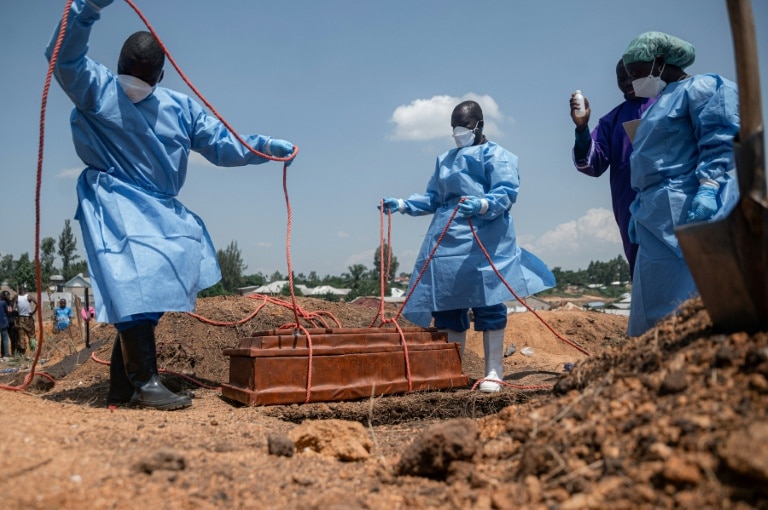
A rapidly accelerating Ebola epidemic sweeping through the Democratic Republic of the Congo (DRC) has officially become the deadliest outbreak the country has ever experienced, new official government data released Monday confirms. With 2,325 fatalities recorded among 4,945 confirmed cases, the current 17th documented Ebola outbreak in the DRC has now surpassed the 2018–2020 epidemic, which killed 2,299 people according to World Health Organization (WHO) statistics.
The United Nations has warned that this outbreak is “the fastest growing on record,” with one person dying from the virus every half an hour across affected regions. Unlike previous outbreaks, the current surge is driven by the Bundibugyo strain of Ebola, for which no specifically approved vaccine or targeted treatment currently exists. Like all Ebola variants, it spreads through direct contact with infected bodily fluids and causes life-threatening hemorrhagic fever.
First publicly declared on May 15, health experts confirm the virus had already been circulating undetected in communities for several weeks before the official announcement. The outbreak has taken root in the country’s remote northern and eastern regions, where central government authority is limited, public health infrastructure is chronically underfunded and sparse, and armed rebel groups have operated freely for decades. It first emerged in the conflict-ravaged northeastern province of Ituri, and has since spread to five additional provinces across the DRC, a large central African nation with a population of more than 100 million people.
Global public health officials note response efforts are grappling with a critical barrier: deep-rooted community mistrust of official health interventions. In Bunia, the provincial capital of Ituri where the majority of cases have been confirmed, protective measures are barely enforced. An Agence France-Presse correspondent on the ground observed that while local officials ordered traders to install hand-washing stations at market entrances, crowds of shoppers continue to gather with little adherence to safety protocols.
“Community engagement in the response is still far too weak,” explained Mohamed Janabi, WHO’s Regional Director for Africa. He added that over 70% of Ebola deaths occur in community settings rather than in designated treatment centers, as many families opt to care for sick relatives at home instead of seeking formal care. Jean-Paul Malo Lotsima, a civil society representative in Ituri’s Djugu territory, explained that many local residents misattribute early Ebola symptoms to poisoning or other common illnesses, delaying medical intervention. “It’s often at the last minute, when the family realizes that the situation is getting worse, that patients are taken to hospital. And sometimes, they die on the way,” he said.
Flavier Ngurima, a resident of Nizi, one of the outbreak’s hardest-hit hotspots, shared that his own brother died before he could reach a treatment center. “We had called on a nurse from the family to treat him at home because the patient and the family members were afraid to go to the ETC (treatment centre),” he said. “They said that over there, a lot of people die.”
Beyond community mistrust, access to affected areas is severely complicated by ongoing armed conflict in many impacted regions. North Kivu and South Kivu provinces, which have recorded cases, are split by active front lines between the Congolese national army and the Rwandan-backed anti-government M23 rebel group, which controls large swathes of territory.
The international public health response has also faced widespread criticism for being slow, under-resourced and uncoordinated. In recent weeks, local health workers including nurses and safe burial teams have held strikes and protests across multiple Ituri hospitals to demand long-overdue bonus payments that have not been disbursed. On Friday, the International Council of Nurses issued a formal statement urging DRC government authorities to deliver fair compensation and adequate protective equipment to frontline workers fighting the outbreak.
Currently, several experimental vaccines are undergoing clinical trials to test their effectiveness against the Bundibugyo strain. Last week, the WHO announced it was targeting a reversal of outbreak spread within three months. To date, the deadliest Ebola epidemic in global history remains the 2013–2016 West African outbreak, which killed more than 11,300 people, primarily in Liberia, Sierra Leone and Guinea.