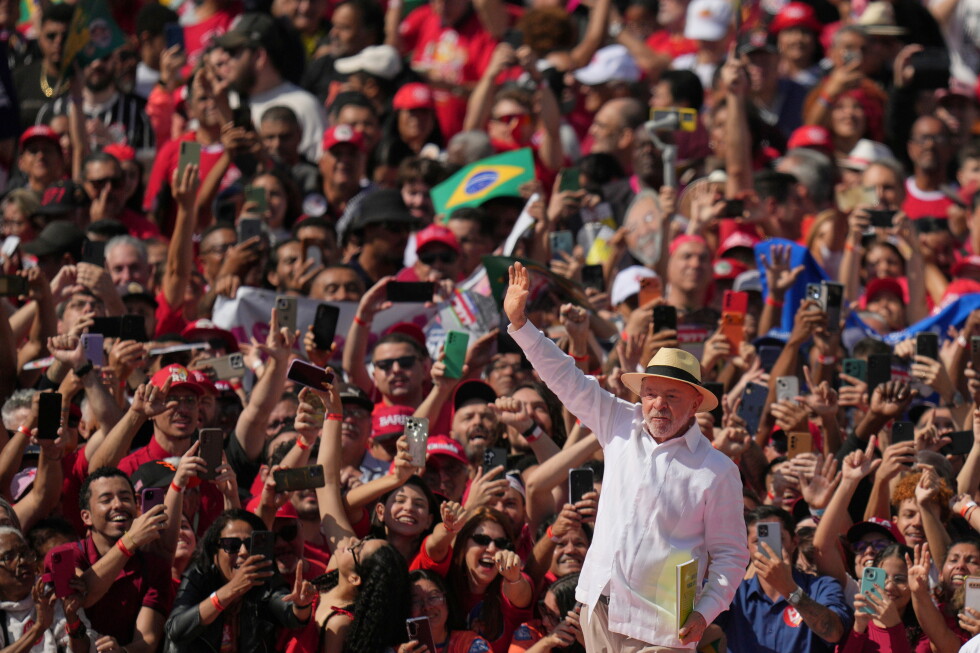
On Sunday, Brazil’s two leading contenders for the October presidential election officially launched their campaign cycles, marking the first day of permitted electoral activity under the country’s electoral rules, in a contest already shaping up to be one of the most competitive in recent Brazilian history.
Incumbent President Luiz Inácio Lula da Silva kicked off his bid for a fourth nonconsecutive term at Vila Euclides Stadium, located just outside São Paulo in São Bernardo do Campo. The venue holds deep personal and political meaning for Lula: it was here 47 years ago, during Brazil’s 1964 to 1985 military dictatorship, that he first rose to national prominence as a metalworkers’ union leader. More than 10,000 cheering supporters packed the stadium to hear his opening campaign address.
Across the country in Rio de Janeiro, Sen. Flávio Bolsonaro, the 45-year-old son of former far-right President Jair Bolsonaro, held his own campaign kickoff on iconic Copacabana Beach, drawing thousands of conservative voters. Notably absent was the elder Bolsonaro, who remains under house arrest following his conviction on charges related to an attempted coup against Lula’s 2022 inauguration, and is barred from running for public office in this cycle.
A core theme of Lula’s opening address was pushing back against perceived external meddling in Brazil’s democratic process. His political allies have repeatedly accused the U.S. government of taking deliberate actions to bolster Flávio Bolsonaro’s campaign, including imposing new tariffs on Brazilian exports and revoking the visa of Brazil’s ambassador to Washington. Lula reiterated that outside powers would not be allowed to dictate Brazil’s electoral outcome or exploit the country’s natural resources. Speaking of Brazil’s vast untapped reserves of critical rare earth minerals, Lula emphasized, “No one [abroad] will tap our minerals. We are going to tap them for the benefit of the Brazilian people.”
With women making up nearly 53% of Brazil’s 158 million registered eligible voters, both candidates centered their opening messaging on courting this decisive voting bloc. Standing alongside his wife, First Lady Rosângela da Silva — who served as one of the event’s keynote speakers — Lula called for structural cultural change to advance gender equality. “Men need to learn from childhood that they are no better than women. We need to be equal,” he said, announcing that he would release his full campaign platform within 10 days, including detailed proposals to expand educational access for women and strengthen laws to prevent and punish gender-based violence.
Flávio Bolsonaro echoed that rhetoric, positioning his own campaign as committed to combating violence against women, appearing alongside his mother and wife at the Copacabana Beach rally. The younger Bolsonaro, tapped as the Liberal Party’s presidential candidate by his father, has faced early challenges to his campaign, with multiple moderate Brazilian political parties refusing to align with his ticket. Looking to distance himself from his father’s polarizing legacy and establish an independent political identity, Flávio Bolsonaro leaned into populist conservative messaging in his opening address. He vowed to crack down on violent crime and purge what he frames as left-wing ideological influence from Brazilian public schools, arguing that “every student has the right to dream of being Elon Musk someday.”
Ahead of his public appearance, Flávio Bolsonaro claimed during a live social media broadcast that he has received more than 1,800 death threats, though he offered no evidence to support the assertion. He appeared in public wearing a bulletproof vest, referencing the 2018 stabbing attack on his father during that year’s presidential campaign, which left the elder Bolsonaro with severe internal injuries. Addressing the widespread comparisons between himself and his father, Flávio Bolsonaro acknowledged their physical resemblance but pushed back on being seen as a mere stand-in for the former president. “I know I look like him. But it is hard to compare Pelé’s son with Pelé,” he said, referencing the legendary three-time World Cup-winning Brazilian footballer who died in 2022.