After more than two years of relative calm across Yemen, large-scale violence has re-erupted, as the Houthi movement has launched a wave of fresh missile and drone strikes against government-held territories that have left civilians dead, injured, and displaced, while forcing a key strategic port to halt all commercial operations. According to Yemeni government officials and multiple regional media reports, the latest escalation of hostilities has shattered the informal truce that had largely held across most of the country since April 2022, with fighting spreading across four key provinces in recent weeks.
Authorities in Marib Governorate confirmed that over the weekend, Houthi forces launched six ballistic missiles and four unmanned aerial drones targeting residential neighborhoods in the densely populated provincial capital of Marib. The governorate’s media office stated that the strikes wounded at least four civilians and caused extensive damage to private homes, civilian vehicles, and other civilian infrastructure. One of the projectiles directly hit a local bakery in the al-Sharika district, located just north of Marib city, leaving one baker with serious injuries. Photographs released by the governorate after the attack show a large impact crater in a residential neighborhood and the burned wreckage of a civilian vehicle damaged in the strike.
Officials have emphasized that the ongoing offensive puts not just local residents at risk, but also the thousands of displaced Yemenis who have sought shelter in camps across Marib Governorate, which has long been a safe haven for people fleeing violence in other parts of the country. The Marib media office has issued an urgent appeal to the global community, calling for immediate condemnation of what it describes as deliberate crimes against civilian populations, displacement camps, and civilian infrastructure, and urging the international community to formally document these attacks as violations of international humanitarian law. The strikes on Marib match earlier reports of multiple missile and drone attacks targeting civilian sites across the province, which were confirmed by both Yemen’s state-run Saba TV and government-aligned Aljoumhouria TV, which reported widespread explosions across the city over the weekend.
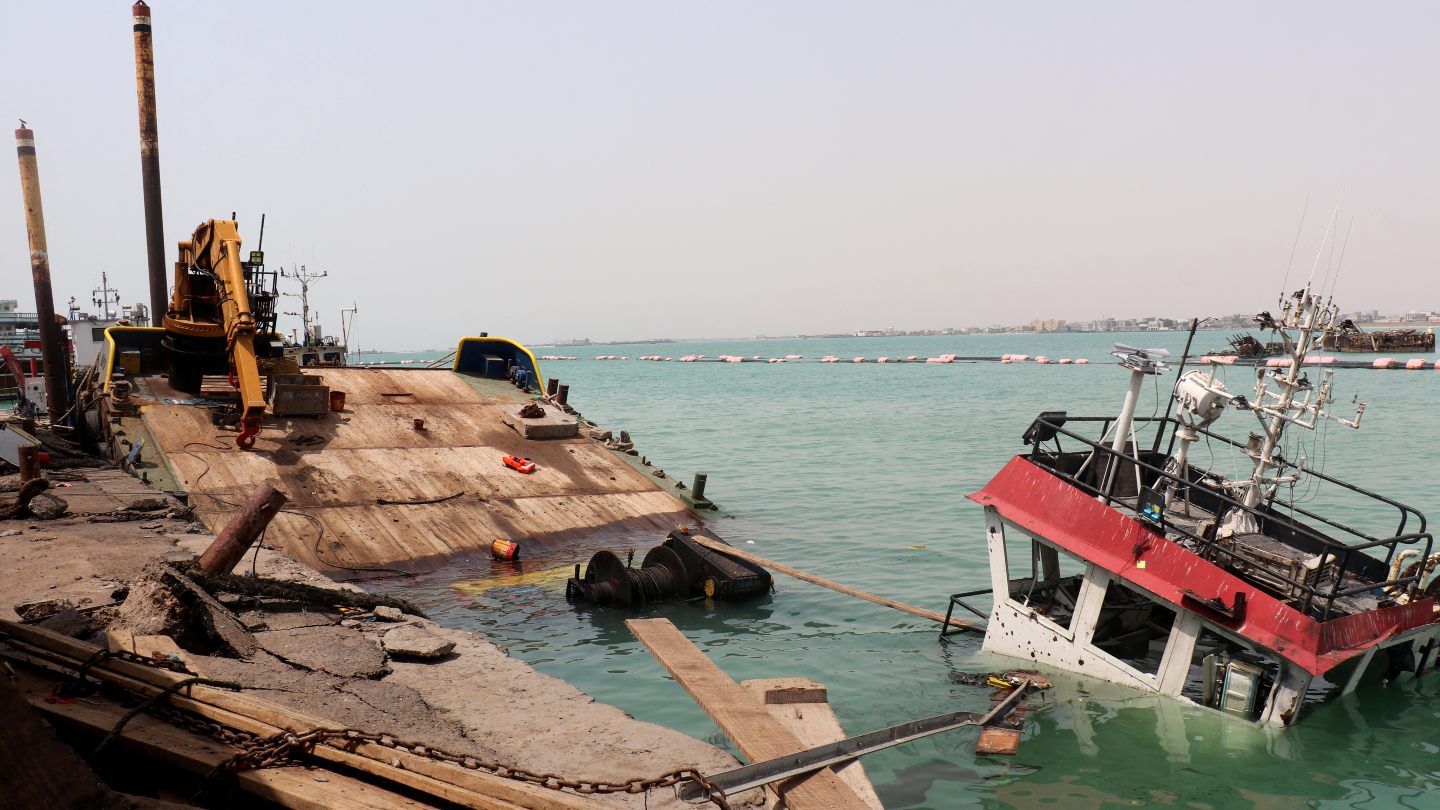
Further south, repeated Houthi attacks on the Red Sea port city of Mocha have forced a full suspension of all commercial and maritime operations at the strategic facility, according to port director Abdulmalik al-Sharabi. Sharabi told Yemen’s state-run Saba news agency that the strikes have killed seven people: four security personnel assigned to protect the port and three civilian port employees. Total economic damage from the attacks is estimated at $16 million, he added.
Located in southwestern Taiz province just off the Bab al-Mandab Strait, a key global shipping chokepoint connecting the Red Sea and the Gulf of Aden, Mocha port has faced more than 25 missile strikes since August 9. This marks the first time the facility has been targeted since the 2022 truce went into effect. The attacks damaged six wooden commercial fishing vessels and a large dredger that was being used for a port expansion project designed to increase the facility’s capacity to receive critical humanitarian and commercial shipments. With all operations halted, approximately 1,300 port workers have been left without any source of income, Sharabi said. Just days earlier, the government-aligned National Resistance Forces reported that Houthi forces had launched 40 ballistic missiles, 46 drones, and several explosive-laden boats targeting Mocha, its port, and surrounding civilian sites in the preceding week.
Houthi officials have pushed back on government claims, stating that their strikes only targeted legitimate military objectives: military gatherings, weapons storage depots, and military vessels operating in the area around Mocha.
The resurgence of violence has not been limited to Marib and Mocha. Clashes have also intensified in southwestern Taiz province, where Yemeni military officials reported that three Houthi fighters were killed and multiple others, including senior field commanders, were wounded in a Yemeni army drone strike on Saturday. A military source told Saba TV that the drone attack targeted Houthi personnel and vehicles on the Maqbanah front, located west of Taiz city.
In the weeks since the relative calm that followed the 2022 truce collapsed, fighting has intensified across Marib, al-Jawf, al-Dhalea, and Taiz, undoing most of the progress toward stability that the truce had enabled.
Yemen’s nearly decade-long conflict began in September 2014, when Houthi forces seized the capital Sanaa and large swathes of northern and western Yemen, forcing the internationally recognized Yemeni government into exile. The ensuing conflict has dragged Yemen into what the United Nations has repeatedly described as one of the world’s worst humanitarian and economic crises, with more than 21 million Yemenis in need of humanitarian assistance and millions facing acute food insecurity.
Rashad al-Alimi, chairman of Yemen’s internationally backed Presidential Leadership Council, warned that the recent attacks on Mocha port pose a direct threat to regional shipping traffic and to the flow of critical food and fuel supplies into Yemen, a country that relies on imports for more than 90 percent of its food. The disruption of port operations, he said, threatens to push Yemen’s already catastrophic food crisis even further.