For the first time in nearly two centuries, an Indigenous individual leads Mexico’s highest judicial body, and the newly sworn-in chief justice is opening up about the constant prejudice he faces because of his heritage.
Hugo Aguilar, 53, a member of the Mixtec community hailing from the small Indigenous town of San Agustin Tlacotepec in Oaxaca, made history last year when he won the first popular election for Mexico’s Supreme Court presidency. He is only the second Indigenous leader to ever hold this position, following the iconic Benito Juarez — Mexico’s first Indigenous president, who led the top court between 1857 and 1858, whom Aguilar calls his lifelong inspiration.
Aguilar credits his groundbreaking appointment entirely to a judicial voting reform pushed forward by Mexico’s leftist national government. Under the new policy, top court leaders are selected via public popular vote instead of exclusive internal appointment. “Without the reform, I wouldn’t be here,” Aguilar shared in his first interview with an international media outlet since taking office, speaking to Agence France-Presse. He recalled that prior to the reform, even entering the Supreme Court building felt like an unattainable milestone for someone of his background.
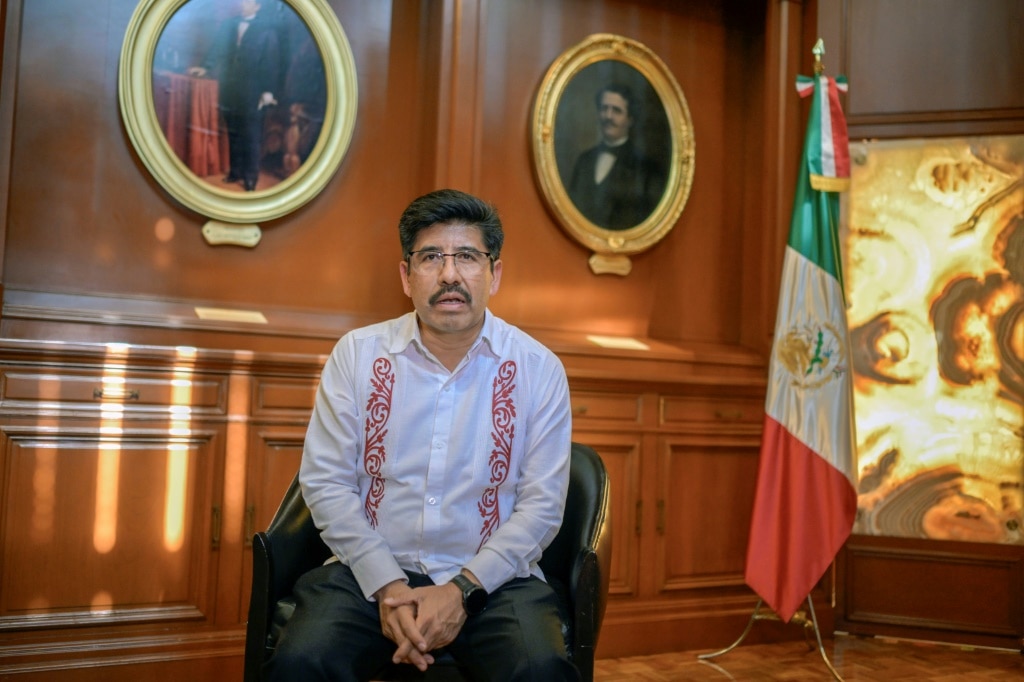
Dressed in a traditionally embroidered white shirt, Aguilar has spent his entire legal career advocating for Indigenous rights and marginalized communities. He has pushed back forcefully against two of the most common criticisms leveled against him and the new reform.
Opponents of the reform, including Mexican opposition parties and many legal experts, have argued that the policy politicizes the judiciary, claiming the ruling coalition pushed favored candidates including Aguilar to secure the top position. Critics have also labeled Aguilar a puppet of the previous administration led by Andres Manuel Lopez Obrador and current President Claudia Sheinbaum. Aguilar rejects these claims outright: “If I were a government pawn, I would have been appointed to the Supreme Court five or six years ago,” he said.
He also hit back at widespread discrimination he encounters on a daily basis, noting that almost all attacks on him center on his Indigenous identity rather than his professional work or judicial rulings. “The criticism directed at me is because I am Indian,” he explained. Detractors, he said, assume that because of his background, “he has no prospects, no ability, no knowledge, no aptitude.”
Addressing concerns about judicial politicization, Aguilar made clear that the court will remain strictly independent of political interests. “Everyone thought the court was going to step into the realm of judicial activism, issuing rulings with no legal basis… That is completely out of the question,” he insisted.
Aguilar acknowledged that the reform is a long-term project to fix deep-rooted problems in Mexico’s justice system, including widespread corruption that has plagued the institution for decades. He urged the public to give the new system time to deliver results, noting that “there’s a set of deeply ingrained habits that are hard to break.”
In his first months in office, Aguilar highlighted early progress the court has made, including cutting the persistent backlog of unresolved cases and expanding access to justice for low-income and marginalized communities.
Outside of his work at the court, Aguilar recalled his childhood growing up in his rural Mixtec village, where he spent much of his time caring for the land and connecting with nature. He said he plans to return to that quiet, community-focused lifestyle once his term ends, and he has no plans to abandon his roots. “My mother told me that the day I change will be the day I don’t return to the village,” he said. Emphasizing that power and social status should not create distance between leaders and the communities they serve, he added, “It shouldn’t make us unreachable.”