On September 16, a high-profile meeting between Israeli Foreign Minister Gideon Saar and Moroccan Foreign Minister Nasser Bourita in New York yielded a landmark agreement to deepen bilateral relations between the two North African and Middle Eastern nations. The core of the new deal elevates both countries’ existing diplomatic missions to full embassy status and paves the way for the appointment of resident ambassadors, marking a major step forward in the normalization process that began with the 2020 Abraham Accords brokered during former U.S. President Donald Trump’s first term. Two supplementary pacts — one focused on investment protection and another addressing double taxation — are also scheduled to be finalized before the end of 2024.
In a joint statement released after the announcement, the United States, Israel, and Morocco reaffirmed their commitment to the principles of the Abraham Accords, arguing that full, peaceful diplomatic and friendly ties between Rabat and Tel Aviv serve the shared interests of all parties, with the potential to drive regional stability and unlock new economic and social opportunities across the Middle East and North Africa.
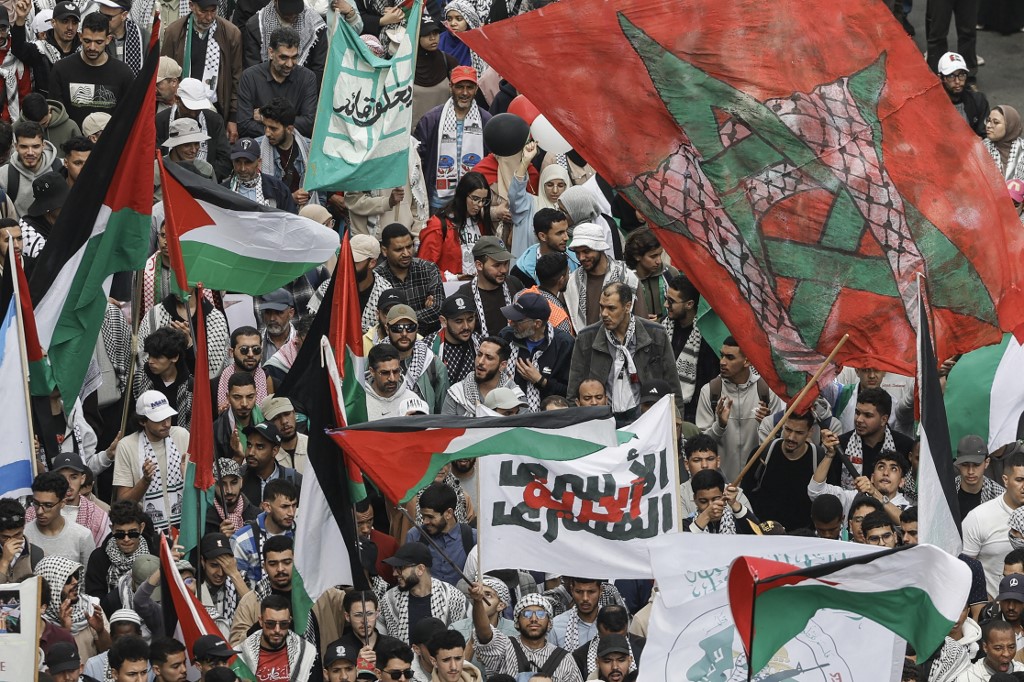
But this latest advancement in normalization has unfolded against widespread public opposition in Morocco, where broad popular support for the Palestinian cause and consistent condemnation of formal ties with Israel have remained deeply entrenched since the original accords were signed four years ago. The announcement also comes just one week ahead of Morocco’s September 23 general elections, leaving the sitting government in a caretaker role with limited authority to act on major policy changes — a detail that has sparked internal political discussion over who holds ultimate decision-making power over foreign affairs in the kingdom.
When the Abraham Accords were first signed in 2020, the Islamist-leaning Justice and Development Party (PJD) held the premiership under Saadeddine El-Othmani. PJD officials have long clarified that the 2020 accords did not contradict the party’s official pro-Palestine stance, pointing to Morocco’s unique political structure, where ultimate authority over international relations rests with the monarchy, not the sitting head of government. “Yes, PJD was in power when the Abraham Accords were signed, but the decision was made by the king; the head of government in Morocco does not have the power over international affairs,” a senior active PJD member, speaking on condition of anonymity to Middle East Eye, explained. The caretaker status of the current government during the recent announcement, he added, only reinforces that the monarchy retains full control over this major foreign policy shift.
To date, PJD remains the only officially registered political party in Morocco that has openly condemned the latest agreement to deepen ties with Israel. Following an urgent virtual meeting held the same day as the New York announcement, the party released an official statement reaffirming its “firm and unwavering stance against any form of normalisation or agreements with Israel.” The banned Islamist movement Al Adl Wal Ihsane has also publicly denounced the diplomatic upgrade, with Dr. Boubker El Ounkhari, a senior member of the movement’s political circle, calling the move “a blatant affront to Moroccans’ sentiments and a provocation against the popular will.”
El Ounkhari emphasized that at a moment when international pressure should be mounting on Israel to hold it accountable for its ongoing occupation and military campaign in Gaza, Rabat has instead chosen to formalize and deepen its bilateral relationship with Tel Aviv. Morocco’s current governing coalition, made up of the leading National Rally of Independents (RNI), the Authenticity and Modernity Party (PAM), and the Istiqlal Party, has remained largely silent on the agreement, with senior party members citing the sensitive pre-election context as a reason to avoid public comment.
A senior RNI member, also speaking anonymously, told Middle East Eye that internal party reaction to the deal was marked by “a kind of rationality and calmness.” He framed this muted response as predictable, noting that Moroccan-Israeli relations have been an established, non-negotiable part of the kingdom’s foreign policy since the 2020 accords were signed. A senior PAM member echoed the sentiment of caution, explaining that no party figure would risk commenting on a divisive issue that could be weaponized by political opponents in the final days of campaigning.
Moroccan officials have sought to justify the diplomatic upgrade by framing closer ties as a tool to advance humanitarian and diplomatic support for Palestinians. Foreign Minister Nasser Bourita told reporters that despite deeper cooperation, “Rabat does not agree with Israel 100 percent” — a narrative that mirrors the justification Rabat used when it deployed military personnel to the U.S.-backed International Stabilisation Force in Gaza as part of the 2020 Trump peace plan. The RNI member echoed this government framing, arguing that “Morocco can use its relations with Israel as a channel of diplomatic dialogue and pressure for stopping escalation and advancing a two-state solution,” though he acknowledged that “Moroccan-Israeli cooperation does not automatically translate into benefits for the Palestinians.”
Critics of normalization have rejected this justification outright. Ahmed Ouihmane, president of the Moroccan Observatory Against Normalisation and a member of the national secretariat of the Moroccan Working Group for Palestine, dismissed the claim that normalization serves Palestinian interests as “nothing but nonsense and an insult to the intelligence of the Moroccan people.” He challenged the government’s narrative, asking: “If normalisation is a means to serve the Palestinian cause, what results have actually been achieved for the Palestinians through it?”
Ouihmane pointed to the staggering human cost of Israel’s military campaign in Gaza, where the United Nations has recorded that at least 21,000 Palestinian children have been killed in Israeli attacks since October 2023. He argued that tangible support for Palestinians would require cutting all cooperation that enables Israel’s military operation, including ending Morocco’s role as a key transit hub for arms shipments bound for Israel — a role that has included facilitating transport of components for F-35 fighter jets used in attacks across Gaza. “Real aid for Palestinians would begin by denying the Israeli war machine any form of cooperation, support or facilitation – such as allowing Moroccan ports to receive ships laden with lethal weaponry destined for the Zionist killing machine,” he said.
The announcement of the diplomatic upgrade comes at a particularly fraught time for the Moroccan government, which is already navigating multiple concurrent crises ahead of the general election. These include ongoing fallout from the Ceuta migrant crisis, allegations of Moroccan involvement that the kingdom has denied, a major high-profile leak that exposed the personal data of more than 70,000 Moroccan intelligence personnel, and a controversial Spanish bill that would grant citizenship to Sahrawis born in Western Sahara during the Spanish colonial era — a move that Rabat strongly opposes.
Many political observers and insiders frame the ongoing advancement of normalization as rooted in long-standing geopolitical and strategic priorities, most notably Morocco’s claim to sovereignty over Western Sahara. In December 2020, the United States formally recognized Morocco’s sovereignty over the disputed territory in a side agreement that was tied directly to Rabat’s signing of the Abraham Accords. The Western Sahara dispute has dominated Morocco’s foreign policy for decades, with the kingdom locked in a long-running regional rivalry with Algeria, which supports the pro-independence Polisario Front’s claims to the territory.
The PJD member acknowledged that Western Sahara is a core driving force behind the kingdom’s policy, explaining: “The state has its own geopolitical calculations that drive it to make such difficult decisions, that sometimes run counter to the will of the people.” Even so, he added, the rights of Palestinians remain a core principle for pro-Palestinian activists across the kingdom, and no strategic calculation can justify formal ties with Israel.
El Ounkhari echoed widespread public frustration, noting that Moroccans have consistently rejected normalization across every recent poll and public protest, yet official policy continues to move steadily toward deeper ties with Israel. “The official process continues in the opposite direction, moving from one stage to another in deepening relations with the Zionist entity,” he said.
Since the start of Israel’s military campaign in Gaza in October 2023, peaceful pro-Palestinian protests have been held every week outside Morocco’s parliament in Rabat, drawing thousands of participants from a broad coalition of trade unions, political groups, and civil society organizations. The Moroccan Working Group for Palestine, which Ouihmane serves on, is one of the leading umbrella organizations coordinating this grassroots movement.
Just four days after the diplomatic deal was announced, Ouihmane was physically assaulted by alleged members of a pro-normalization group called “We Are All Israelis” on a major street in central Rabat, requiring hospitalization. Local activists note that the attack marks an escalation of tensions: prior to the assault, the loose network of pro-Israel Moroccans, which formed after October 2023, had limited its activities to online harassment of anti-normalization activists.
Despite the attack, Ouihmane told Middle East Eye that the grassroots movement would continue its fight across all levels to reverse the normalization process. “We will continue our struggle at all levels […] our goal is to overturn the normalisation process,” he said. The movement’s demands are clear: end all normalization efforts, close the Israeli liaison office in Rabat, and cut all forms of cooperation with what Ouihmane calls a “rogue entity.”
Protesters have repeatedly made their position clear in mass rallies across every region of Morocco, Ouihmane added, and the message remains unchanged: “Palestine is a Moroccan national cause, […] while normalisation is a betrayal.”
El Ounkhari emphasized that official state policy does not make normalization inevitable or acceptable to the Moroccan public. “Embassies may be opened, and ambassadors exchanged, but that does not mean normalisation has become acceptable to the Moroccan people. Palestine will remain present in the conscience of Moroccans,” he said.