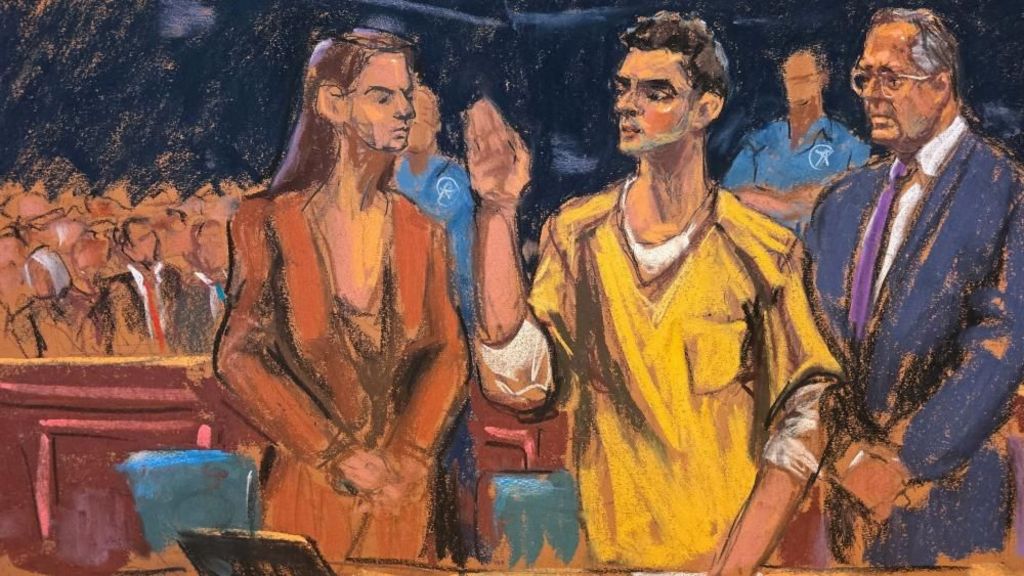
Eighteen months after the high-profile assassination of UnitedHealthcare chief executive Brian Thompson that sent shockwaves across the United States, accused killer Luigi Mangione entered a New York federal courtroom Friday to formally admit his role in the killing, ending months of speculation and legal maneuvering. The 28-year-old defendant, clad in a standard-issue beige prison uniform over a plain white T-shirt, entered the room with shackles securing his ankles, his hands held behind his back without handcuffs per U.S. Marshals protocol.
The small courtroom was filled to capacity, with a cross-section of attendees including national reporters, self-identified supporters of Mangione, independent court observers, and a small group of court staff who won a public lottery to claim one of the limited public seats. In the front row, directly behind the prosecution team, sat members of Thompson’s family, who struggled to contain visible emotion as proceedings got underway. The hearing, originally scheduled to kick off at 11 a.m., started shortly after its planned start time, and opened with a dramatic announcement that set the tone for the day.
Lead defense attorney Karen Friedman Agnifilo was the first to speak, informing Judge Margaret Garnett directly that her client was ready to enter a guilty plea. What followed was a period of quiet procedural checking, as Garnett walked Mangione through a series of standard questions to confirm he fully understood the ramifications of his decision, including queries about his personal background and any prescription medications he takes. Mangione responded to each question briefly but with clear resolve, confirming he understood the possibility of a life sentence for his crimes. Only when he began to read his prepared statement to the court did the defendant show visible nerves; his speech came quickly and was at times difficult to hear. After a gentle prompt from Garnett to move closer to the microphone, he regained his composure and continued to the end of his statement, where he explicitly admitted to killing Thompson.
Weeks leading up to the hearing, U.S. media outlets had reported that Mangione was expected to enter into a formal plea deal with prosecutors, but that did not come to pass. Instead, Mangione simply changed his original not guilty plea to a plea of guilty, laying out his own account of the planning and execution of the attack in open court for the first time.
Mangione told the court he had spent years living with chronic severe pain from a broken back, and had repeatedly clashed with the U.S. health insurance system over access to care. After learning that UnitedHealthcare planned to hold its annual conference in Manhattan in December 2024, he began to plan the attack. He conducted open-source online research on the event, and posed as an independent investor in an email to the company to obtain additional details about Thompson’s public schedule — a query that received a far quicker response than any of his past inquiries to insurers about his own medical care, he told the court. He added that he manufactured the firearm used in the attack using a 3D printer. On the morning of December 4, 2024, he carried out the shooting on a Manhattan street. “I shot Mr Thompson in Manhattan and he died,” he told the court plainly.
This hearing marked the first time Mangione has publicly recounted the details of the crime, which sparked a national media firestorm and drew international attention immediately after it occurred. After the statement was complete, Garnett asked Mangione to formally state his plea for the record. “Guilty,” he said clearly, leaning into the microphone. The judge formally accepted the plea.
Shortly after the ruling, Thompson’s family released a statement calling the day an important milestone in their quest for justice, as they remained visibly shaken in court during the admission. Mangione’s sentencing is scheduled for December 18 of this year. Each of the two stalking charges he faces carries a maximum possible sentence of life in prison, while prosecutors have formally recommended a 24 to 30 year prison term; final sentencing authority rests with Judge Garnett. A separate trial on state-level charges connected to Thompson’s killing is still on track to begin in September.