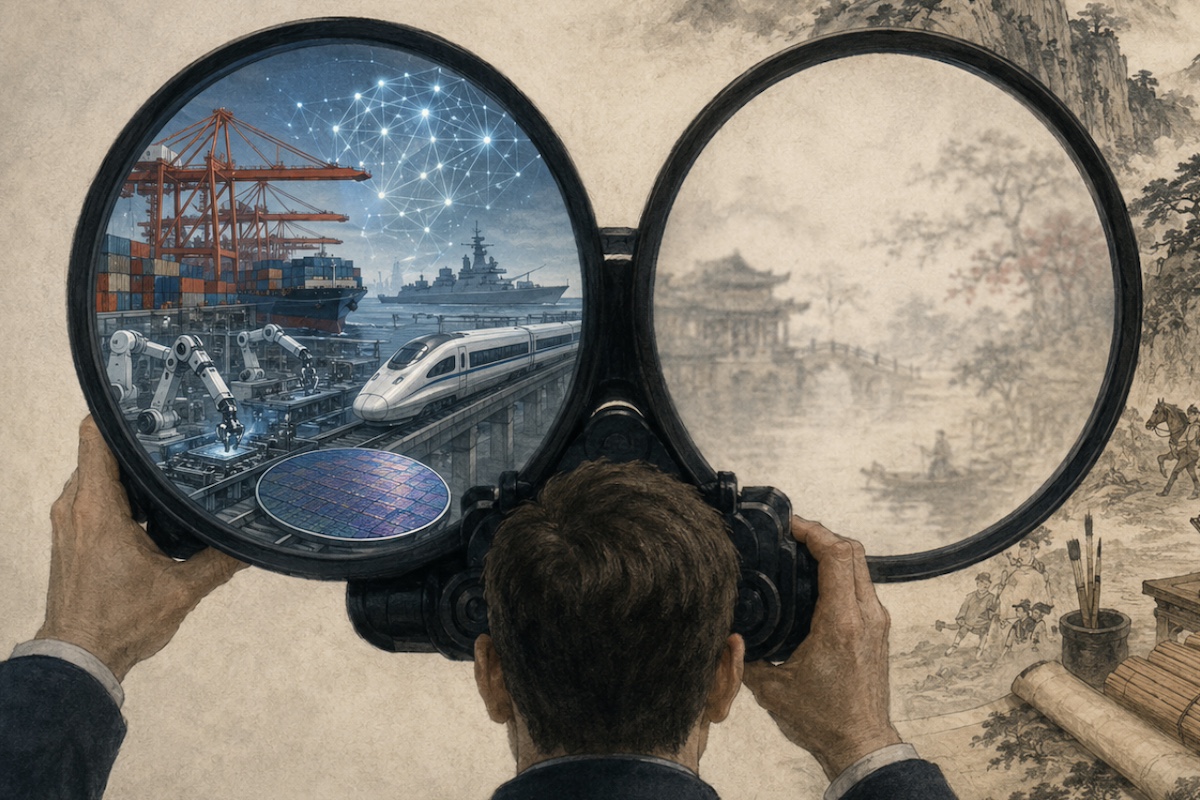
Against the backdrop of rising geopolitical tension between China and the United States, a pivotal 2026 Beijing summit exchange between the two nations’ leaders crystallized the core strategic question of the era: whether a rising power and an established hegemon can avoid the violent conflict that defines the Thucydides Trap. In that conversation, Chinese President Xi Jinping also issued a clear warning: mismanagement of the Taiwan issue could plunge both countries into open confrontation. This high-stakes exchange underscores a growing, dangerous imbalance in how the world engages with China today.
Over the past decades, China’s rise has reshaped the global order, visible in its expanding manufacturing base, growing patent output, cutting-edge artificial intelligence development, growing maritime capabilities, sprawling global infrastructure initiatives, and massive cross-border trade volumes. Governments across the Global North study China’s industrial strategy, advanced automated manufacturing systems, and technological leadership to unpack the mechanisms behind its success, while developing nations across the Global South actively adapt useful Chinese models for their own development. Yet one critical area has failed to keep pace with China’s growing global influence: deep, widespread study of China’s language, history, philosophy, and core cultural traditions.
Today, the world has learned a great deal about how China produces goods, finances projects, and competes in global markets. But it has not invested comparable effort in understanding the historical and cultural frameworks through which Chinese society debates core concepts: national order, historical humiliation, social obligation, political authority, and the project of national renewal. This gap is already visible in higher education: data from the U.S. Modern Language Association’s 2021 enrollment survey shows that undergraduate enrollments in Chinese language programs at American colleges and universities fell 14.3% between 2016 and 2021, while graduate program enrollments dropped from 1,266 to just 892. Sustained academic exchange has also contracted sharply, as rising geopolitical friction, broad security concerns, lingering travel restrictions, and increasing political barriers have made long-term cross-border engagement far more difficult. At the exact moment when deep China expertise is most critical to global stability, the pipelines that produce that expertise are rapidly narrowing.
What does meaningful cultural literacy about China actually entail? It does not require unconditional acceptance of the Chinese government’s policy positions. Instead, it demands recognition that all Chinese policies and public statements are interpreted through distinct historical memories and unique moral vocabularies that differ sharply from dominant frameworks in the West. Traditional American political discourse centers on individual rights and constrained government power, while Chinese political discussion more often prioritizes social cohesion, collective welfare, and reciprocal social obligations. Neither society presents a monolithic uniform perspective, but these core differences help explain recurring disagreements over issues ranging from human rights to governance models to social stability. In diplomatic and business settings, Chinese interlocutors also often prioritize personal relationships, indirect communication, and the preservation of mutual “face” far more than American counterparts, who are typically socialized to engage in open, explicit disagreement.
Historical memory plays an equally critical role in shaping differing perspectives. Western and Japanese imperial expansion inflicted profound suffering on China during the 19th and early 20th centuries, a narrative that is central to Chinese education and official public memory. Yet many Western members of the public remain largely unfamiliar with the Opium Wars, the unequal treaties forced on China, or the scale of Japanese invasion during the 20th century. Where one side sees a discrete contemporary policy choice, the other may interpret the action through the long lens of historical national vulnerability and repeated foreign intrusion.
At the same time, Chinese cultural memory also stretches back centuries to a period when China was one of the world’s most advanced and sophisticated civilizations. It developed a resilient, effective bureaucratic tradition, and during the Song dynasty, achieved groundbreaking advances in commerce, mass education, printing technology, applied science, philosophy, and the arts. This history does not inherently justify modern territorial claims or specific government policies, but it helps explain why many Chinese people frame national rejuvenation not as the emergence of an entirely new expansionist power, but as a recovery from a century of external interference and internal disruption that interrupted China’s long historical trajectory.
Former U.S. Secretary of State Henry Kissinger once drew a clear contrast between American and Chinese conceptions of national exceptionalism: each nation carries a foundational story about its unique place in world history. When diplomacy is conducted without understanding these foundational narratives, it is far too easy to misread symbolism as substantive threat, defensive action as aggressive ambition, or compromise as national humiliation.
A core principle of meaningful understanding is that China cannot be reduced to the actions or identity of its current state. Just as American civilization cannot be reduced to the platform of any single political party, Chinese society and civilization cannot be reduced only to the rule of the Communist Party of China, nor can Chinese civilization be reduced to the single tradition of Confucianism. China’s modern identity has been shaped by overlapping, competing traditions: Confucianism, Daoism, Buddhism, and Legalism, alongside popular folk religion, Marxism, nationalism, global capitalism, and the forces of global modernity.
The evolving discourse around New Confucianism offers a revealing example of this internal contestation. The movement emerged in the early 20th century as Chinese thinkers responded to the rise of Western power and modern institutional models. Philosophers including Mou Zongsan, Tang Junyi, and Xu Fuguan defended the Confucian tradition against critics who blamed it for China’s 19th century weakness, while also grappling with how Confucian thought could adapt to modern demands for science, democracy, and individual freedom. After 1949, this line of scholarship continued primarily in Hong Kong and Taiwan, while Confucianism was officially disavowed and, during the Cultural Revolution, violently suppressed on the Chinese mainland.
New Confucian thinkers drew a clear line between technical expertise and existential wisdom. They argued that science and reason could unpack and transform the natural world, but could not on their own answer core questions of meaning, moral cultivation, or the proper purpose of state power. Their arguments remain deeply relevant today, for all global societies that possess extraordinary technical capabilities but lack consensus on what ends those capabilities should serve. In recent decades, some mainland Chinese thinkers have promoted nationalist, authoritarian, or patriarchal interpretations of Confucianism, while other thinkers across mainland China, Taiwan, South Korea, and North America have explored the tradition’s compatibility with democracy, meritocratic governance, reciprocal respect, and universal human dignity. This makes clear that Confucianism is not a fixed, monolithic political doctrine: it is a living, contested tradition that continues to evolve.
Scholar Tu Weiming has done more than most contemporary thinkers to bring this living tradition into global intellectual conversation. His concept of “cultural China” extends far beyond the boundaries of the Chinese state, encompassing all people connected to Chinese civilization through language, collective memory, and intellectual engagement. Tu criticizes the political weaponization of Confucianism to enforce state obedience, but argues that the tradition’s emphasis on individual self-cultivation, interpersonal reciprocity, and the unity of humanity and nature can make a valuable contribution to a shared global ethic. Tu’s work matters not because Confucianism offers a simple master key to all Chinese behavior, but because it demonstrates how much deeper understanding becomes when China is approached as a complex civilization, rather than merely a strategic threat or problem to be managed.
Philosophy is just one entry point to this deeper understanding. Chinese literature, cinema, and visual art reveal dimensions of Chinese experience that official statements and economic statistics can never capture. Early 20th century writer Lu Xun exposed the deep moral and social crises of a China undergoing rapid upheaval. Nobel Prize-winning author Mo Yan reframes modern rural Chinese history through sharp satire and magical realism. Science fiction author Liu Cixin projects Chinese anxieties and global ambitions onto a vast cosmic stage. Filmmaker Zhang Yimou has explored themes of power, collective memory, family, and social upheaval through a visual language that resonates with audiences worldwide. These works collectively challenge the simplistic narrative that frames Chinese society as a uniform, monolithic mass. In reality, China is home to vibrant debate between nationalists and cosmopolitans, liberals and conservatives, feminists, religious believers, environmentalists, workers, entrepreneurs, and young people navigating widespread uncertainty about the future.
While government restrictions have narrowed the space for open public debate in China, pushing much intellectual discussion into private seminars, independent bookstores, informal reading groups, and carefully curated digital spaces, this does not make understanding China less necessary—it only makes it more urgent.
Western academic and media institutions bear a share of the responsibility for this current gap in understanding. Chinese philosophy is still often ghettoized in area studies departments, rather than integrated into the broader global study of philosophy as a shared intellectual inheritance. News coverage naturally prioritizes reporting on the Chinese party-state, security competition, and economic friction, but this overemphasis often leads to the misperception that official China is the whole of China. Rising nationalist politics on both sides of the bilateral relationship has further eroded the open curiosity that is the foundation of meaningful cultural knowledge.
Closing this critical gap requires more than rhetorical support for cultural exchange in principle. Universities must maintain funding for advanced Chinese language instruction, and integrate Chinese history, philosophy, and literature into curricula across departments, not just confine these topics to area studies programs. Independent publishers and philanthropic foundations must support skilled translators who can make contemporary Chinese intellectual debate accessible to global English-speaking audiences. News organizations must invest in journalists with the language skills and time to report on Chinese society, not only the Chinese state. Governments must protect legitimate national security interests without framing all academic and cultural exchange as an inherent threat.
This work must also be reciprocal. Chinese authorities have made independent understanding of Chinese society more difficult by imposing new restrictions on international research, journalism, and open public debate. A genuine dialogue between civilizations cannot be created through empty slogans or tightly state-controlled cultural diplomacy. It requires open access, room for legitimate disagreement, and the freedom to engage with Chinese society in all its messy complexity.
Meaningful cultural literacy will not eliminate strategic competition between China and the West, nor does it require uncritical admiration for the Chinese government’s policy choices. Instead, it is a form of practical strategic realism. No nation can negotiate successfully with an imaginary China, deter a China it fundamentally misunderstands, or coexist peacefully with a civilization it only knows through sensational headlines and threat assessments. Escaping the Thucydides Trap therefore requires far more than military restraint and crisis communication hotlines. It requires both Chinese and Western societies to understand the historical narratives through which the other interprets power, global order, and national purpose. The West has already invested enormous resources into measuring what China can do. It is past time to invest equal effort into understanding what China believes it is doing, and why.