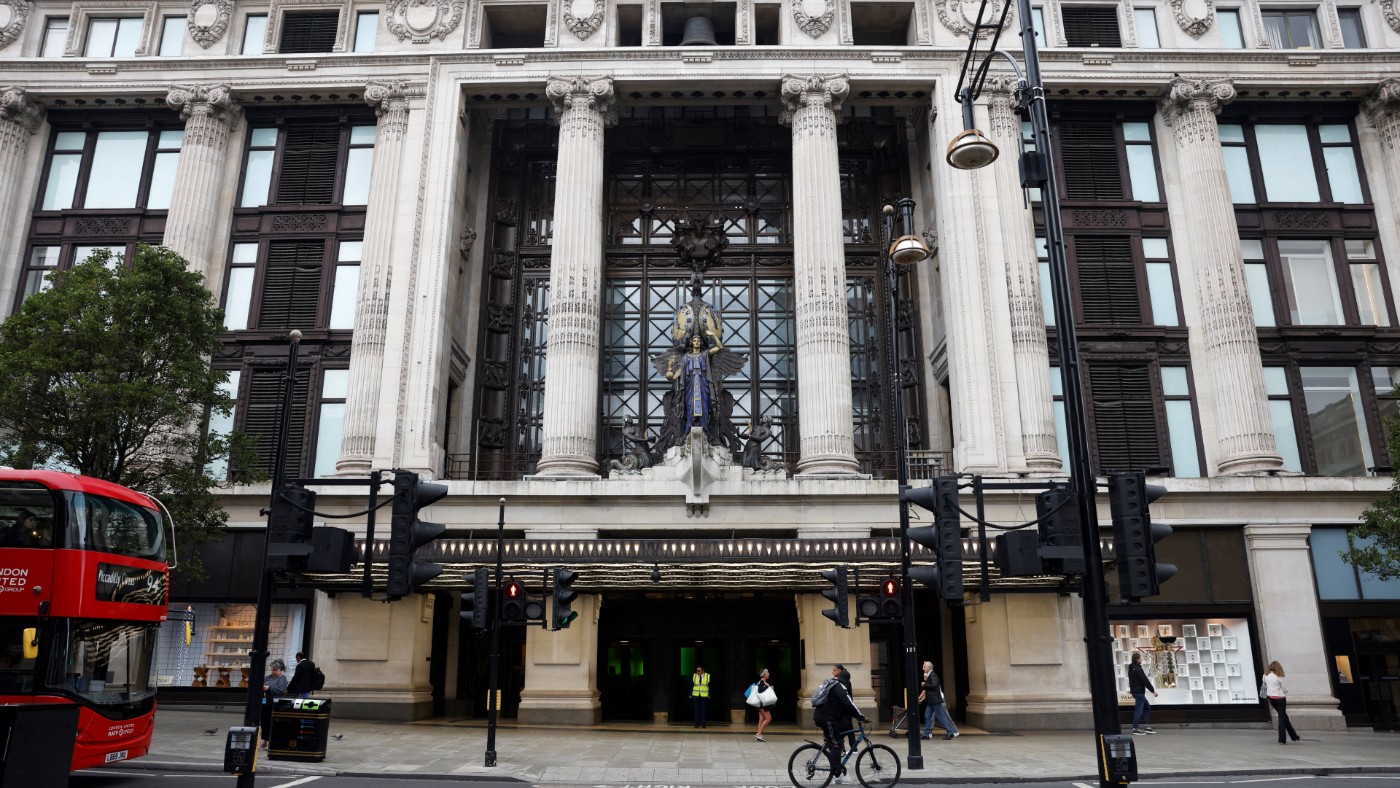
On a sweltering Thursday morning in mid-August 2026, central London’s streets hit an unprecedented 30 degrees Celsius by 10 a.m., marking what climate officials confirm will be the United Kingdom’s hottest summer ever recorded. Just steps from Oxford Street’s iconic Selfridges department store, discarded newspapers carry headlines of spreading wildfires across the British countryside, while a unhoused man calls out for spare change under the unforgiving sun. Inside the cool, air-conditioned building, a Saudi Arabian coffee stand promotes the kingdom, a nod to the Saudi Public Investment Fund’s 40 percent controlling stake in the century-old luxury retailer.
It was here just one week earlier that Sheikh Mohammed bin Rashid Al Maktoum, ruler of Dubai and prime minister of the United Arab Emirates, faced a rare public confrontation during a walk through nearby North Audley Street. A Sudanese protester, shouting across the road at the delegation, called out “UAE is killing people in my country, stop killing my people” over the UAE’s widely reported involvement in Sudan’s ongoing civil conflict. A member of the Sheikh’s large entourage responded by hurling a racial slur at the protester, calling him a “Black bitch”.
As of mid-August, Sheikh Mohammed has remained in London, where he has held closed-door meetings with UAE President Sheikh Mohammed bin Zayed Al Nahyan and been photographed visiting the upscale west London neighborhood of Chelsea. For Gulf’s wealthiest citizens, however, London’s Mayfair district—home to North Audley Street, one of the most expensive addresses in the world, lined with Michelin-starred restaurants, luxury supercar showrooms and five-star hotels—has long functioned as a home away from home.
For Gulf visitors, the annual August pilgrimage to central London blends business, leisure, and familiarity, shaped by decades of historical and financial ties between Gulf states and the UK. Inside Selfridges, 15-year-old Khaled and his 53-year-old uncle Mohammed, visiting from Dubai, framed their regular trip as a natural extension of Gulf investments in the UK. “We come to London because we have a lot of investments here and we like to help them out,” Khaled told Middle East Eye, when asked about the confrontation with Sheikh Mohammed. Dismissing the Sudanese protester as “ignorant,” he added, “We are helping Sudan. We are sending humanitarian aid. It was disrespectful.”
His uncle, who grew up in Dubai before the oil boom transformed the emirate into a global luxury hub, echoed the sentiment. “Yes, you can have freedom of speech, but you can’t say that to a leader; it’s not respectful,” he said, noting that today’s Emirates offer instant access to any service imaginable: “you can get whatever you want within minutes. Someone will bring it to you. You don’t even have to get up.”
The pair are part of a decades-long pattern of Gulf leadership and elite families sending young people to the UK for education, with Sheikh Mohammed bin Rashid, Sheikh Mohammed bin Zayed, and many other senior Gulf leaders all having attended British universities or received military training in the country. Khaled, who plans to enroll at a London university, says he prefers the British capital’s relatively cool summer temperatures to Dubai’s habitual 40-degree August heat, where even daily life is confined to air-conditioned spaces. Like many young Gulf visitors, he keeps his time in London limited almost exclusively to the capital’s most affluent central neighborhoods, avoiding working-class and migrant-heavy outer areas. “We don’t go to the areas where there are roadmen and lots of migrants and stabbings,” he explained, pulling up a phone map marked with what he calls “prime khaleeji hangouts”—all clustered within Mayfair, including high-end restaurants Cipriani, Ivy Asia, Sexy Fish, Supernova and Nobu.
Khaled’s wariness of London outside its elite core is shared by many other young Gulf visitors. A Saudi woman, speaking on condition of anonymity, recalled the reaction of a 15-year-old Saudi student attending a residential summer school in the capital: the teen insists on hiring a personal bodyguard, claiming “people here are so poor they will try to stab me for my Hermes” bag. Even for middle-class Gulf families, London’s central luxury districts function as a self-contained enclave where visitors can easily encounter fellow Gulf citizens. Two teenage sisters from Bahrain, shopping in Selfridges, said they had unexpectedly run into multiple school friends during their trip, a common occurrence in Mayfair. “When we go to Harrods we see people from the Gulf, we see friends and family… It’s not hot, it’s nothing compared to back home where we spend all the time with the AC on,” the 17-year-old sister explained. Still, some aspects of London life remain unfamiliar: “We don’t really have or use public transport in Bahrain. The underground here is very crowded and chaotic. The architecture is different here too.”
Across North Audley Street from Selfridges, at the historic Marlborough pub, temperatures continue to climb through the afternoon. Apart from a small group of regulars drinking pints, the street is dominated by Gulf visitors. Two Kuwaiti fashion and lifestyle influencers, Sarra and Elaf, pose for photos against the street’s Georgian townhouse facades, as a Bugatti supercar roars past. “We mainly spend our time here in Mayfair,” Sarra said. “We come for the weather, the people, the shopping. In our country we can’t find a lot of the brands you have here… For us, it’s good weather. We also come in November because we love the cold, and we love the Christmas vibes.”
For local Mayfair businesses, the annual August influx of wealthy Gulf visitors is not just a seasonal trend—it is the backbone of their annual revenue. At Grays Antique Market, a historic covered market housing more than 80 independent luxury dealers, one senior jeweller says he never takes holiday in August, relying on Gulf shoppers to make his year. “They are an integral part of the business, especially in August; I can’t go away now,” he explained, noting that members of the royal families of Saudi Arabia, Bahrain, and the UAE are all regular customers. “Mayfair is the mecca of the Arab world in a way. They love fine things. The men come here to buy silver jewellery, the women come here because they know they can get brands like Cartier, Tiffany and Bulgari at a steep discount.” He added that young Gulf shoppers regularly spend four-figure sums on small luxury items, and one customer recently purchased an £18,500 piece without hesitation—half the price she would have paid back home.
The jeweller also noted a dramatic shift in the source of luxury capital in London over the past four years. Before Russia’s full-scale invasion of Ukraine, the city was widely nicknamed “Londongrad” for the massive flow of Russian oligarch money into its luxury sector. “I used to deal with a lot of Russians, but they’ve all left like rats from a sinking ship,” he said. “The Russians still here don’t have any money.” Today, that void has been filled by capital from Gulf states, which now own major London landmarks including Selfridges and Harrods, the rival Knightsbridge department store purchased by Qatar’s sovereign wealth fund in 2010.
At the heart of Mayfair sits Grosvenor Square, which housed the United States’ diplomatic mission to the UK from 1785 until 2018. The former embassy building has since been converted into a luxury hotel, home to the Qatari-owned Qinwan Cafe, another popular gathering spot for Gulf visitors, where three small chicken sandwiches sell for £20 and authentic Palestinian dates—familiar to Gulf visitors—are on offer. On a recent afternoon, women in abayas and men in designer polo shirts sat at outdoor tables, scrolling through social media and posting photos of their coffee to Instagram.
For London’s working-class residents, however, Mayfair’s wealth is a distant, often stark contrast to their own economic struggles. Sitting in his delivery van outside the square, Hash, a delivery driver from south London, waited for his next job amid the 30-degree heat. “Mayfair means money,” he said, reflecting on how his own earnings have fallen over the past six years. “There was a time six years ago, when he could make £500 a day driving a delivery to Scotland and back. Now he says he is lucky to earn more than £100 a day.”
A short walk away, long queues of Gulf tourists wait outside Marchesi, the historic 19th-century patisserie, while a Ferrari dealership glints in the midday sun on Berkeley Square. Deep underground at Green Park Underground station, temperatures climb close to 40 degrees Celsius, as station announcements warn passengers of partial line closures and severe delays across the London Underground network—an inconvenience most Gulf visitors never encounter, confined as they are to the air-conditioned comfort of Mayfair’s luxury spaces.