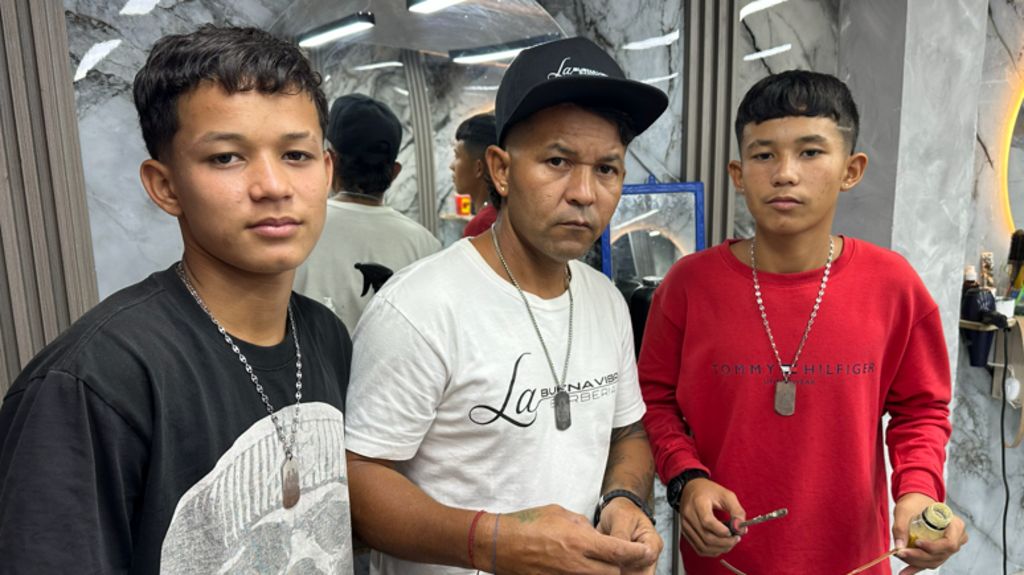
For 15-year-old Deivi Delfín, the nightmare of earthquakes never seems to end. Just months after surviving a catastrophic pair of back-to-back seismic events that destroyed their home and killed three immediate family members in Venezuela, he and his 17-year-old brother Winder thought they had found safety by joining their father in Colombia. Barely three days after arriving, disaster struck again: one of the strongest earthquakes in Colombia’s modern history shook their new city, leaving the brothers already broken by trauma reeling from another terrifying shake.
The Delfín brothers’ tragedy began on June 24, when two massive earthquakes of magnitude 7.2 and 7.5 hit just 39 seconds apart along Venezuela’s Caribbean coast. Their hometown of La Guaira, the region worst impacted by the tremors, would see entire neighborhoods reduced to rubble, with the Venezuelan government reporting a death toll that exceeded 6,300 people to date. To this day, no official count of missing people has been released.
On that fateful evening, the two teenagers had been heading back from a day trip to a nearby Caribbean beach. Winder had begged his mother Yusmani to let their 10-year-old brother Moissés join them, but the young boy had been grounded for misbehavior and stayed home with their mother and grandmother Carmen. When the ground began to roll violently, the brothers clung to each other and shut their eyes, certain they would not survive. When the shaking stopped, a thick cloud of dust and debris obscured everything around them.
When they reached their 12-story apartment building, all that remained was a mountain of tangled concrete: their mother, grandmother, and 10-year-old brother were trapped beneath the ruins. “My world came crashing down,” Winder recalled of the moment he realized what had happened. Their father Deivid, who had already been working in Cali for the family, spent three frantic days searching for his two surviving sons after rushing back to Venezuela, while the teenagers joined rescue efforts, sleeping on the street and going without food for three days straight.
Deivid warned his teenage sons that crawling through the unstable rubble put their own lives at grave risk, but the boys refused to stand down. Smaller and more agile than adult rescue workers, they squeezed through narrow gaps between collapsed concrete slabs, navigating by the faint light of cell phones and handheld torches to flag potential locations of their trapped family to official crews. It was during these weeks of grueling, heart-wrenching searching that both boys say they lost their childhood forever. “I don’t feel like a child anymore,” Deivi told BBC Mundo in an interview.
Slowly, the boys pulled small fragments of their old life from the wreckage: a pair of Moissés’s shorts, their mother’s well-worn Bible, an unfinished handwritten shopping list. One day, Deivi spotted a scrap of patterned fabric he recognized as his grandmother’s floral skirt, leading rescuers to recover her body first. Days later, Winder was the first to identify his mother’s remains: a plastic bag she had been using to dye her hair when the boys left for the beach was still wrapped around her head. When rescue crews lifted the heavy concrete slab that pinned Yusmani’s body down, they made a devastating discovery: little Moissés was still clinging to his mother’s hand. At the sight, Deivid collapsed, overwhelmed with grief. “When his little head fell into my hands… I broke down,” he shared.
After burying their three lost family members, the brothers traveled to Cali to start a new life with their father, who had already settled in a modest working-class neighborhood on the northeastern outskirts of the Colombian city. The boys say they hold onto hope that they can build a quiet life focused on work and study, one that would make their late mother proud. But that fragile new start was shaken to its core just days after they arrived, when a magnitude 7.4 earthquake—Colombia’s strongest seismic event in a century—struck the country, leaving hundreds dead and hundreds more missing across the nation. Cali was once again among the areas hardest hit by the shaking.
Deivi was asleep when the tremor began, and at first thought the gentle swaying was just a nightmare. When the shaking grew more violent, he scrambled out of bed and ran outside, followed immediately by Winder. The brothers clung to a metal street gate as the ground moved beneath them, waiting out the worst of the tremor. Their father, who had been out running errands when the shaking started, immediately ran back home to check on his sons, only to find the house empty. A neighbor told him she had seen the boys run out to the street, and after searching through nearby blocks, he found them waiting outside the barbershop where he works. It was the traumatized teenagers who had to calm their panicking father: “Dad, stay calm. We’ve been through this before,” they told him.
Today, the boys say the memory of the Venezuela quake continues to haunt them, and the second shake in Colombia has only deepened their trauma. But even after unthinkable loss and repeated disaster, they hold onto small hopes for the future, clinging to each other as they rebuild their lives from scratch.