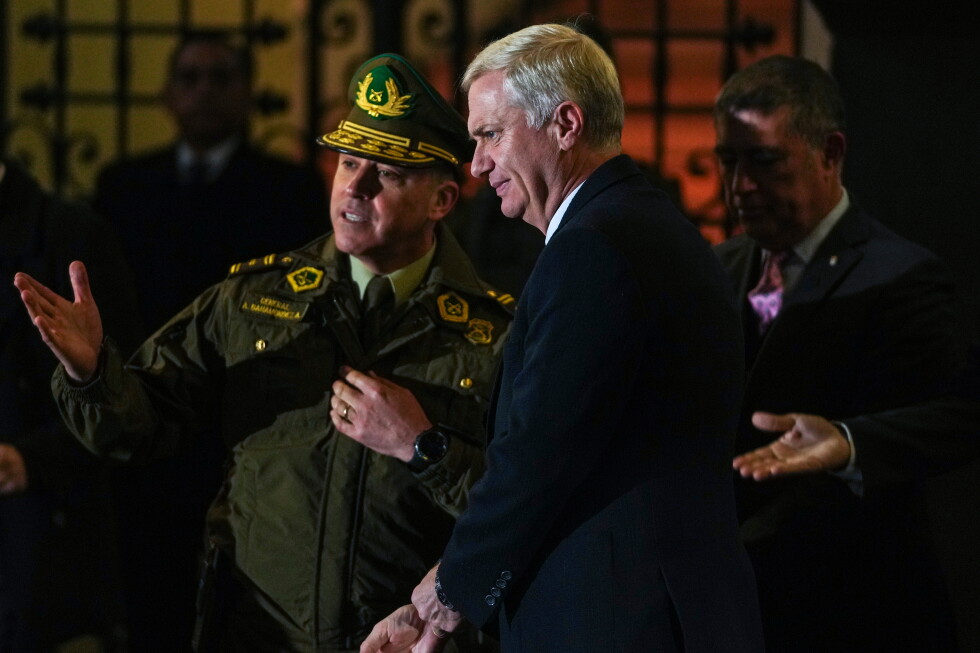
In a high-profile step to advance his signature campaign promise of cracking down on organized crime, Chile’s hard-line President José Antonio Kast oversaw the transfer of 295 high-risk inmates to the newly built La Laguna Prison on Thursday, a move directly modeled on the hardline security strategy that has defined El Salvador President Nayib Bukele’s tenure.
Located roughly 155 miles south of Chile’s capital Santiago, La Laguna counts among the nation’s largest correctional facilities, with total capacity for 2,320 inmates across 13+ units, including dedicated maximum-security wings. The facility was purpose-built to address two longstanding crises in Chile’s correctional system: severe overcrowding in older facilities, and the ability for incarcerated gang leaders to continue directing criminal operations from behind bars. To block unauthorized communications, La Laguna is fitted with 1,500 high-resolution surveillance cameras, full-body scanners for visitors and staff, and cutting-edge technology that jams all cellular signals within facility boundaries. Of the inmates transferred Thursday, 37 are confirmed members of major transnational and domestic criminal organizations, with an additional 100 inmates scheduled to move to the facility over the coming week.
Government-released footage of the transfer showed inmates grouped in rows, feet shackled and heads bowed, a visual presentation that closely mirrors the public broadcasts Bukele has shared on social media throughout his multi-year nationwide security crackdown. Bukele’s aggressive mass incarceration campaign has driven a dramatic drop in violent crime across El Salvador, but it has also sparked widespread condemnation from global and regional human rights groups, which have documented consistent patterns of arbitrary detention, physical abuse of detainees, and widespread erosion of fundamental civil liberties in the country.
Kast, a conservative ally of former U.S. President Donald Trump, has openly framed Bukele as a policy model, joining a growing wave of right-wing leaders across Latin America—including recent candidates and officeholders in Colombia and Peru—that have adopted hardline security rhetoric to win over anxious voters. During his 2025 presidential campaign, Kast traveled to El Salvador to study Bukele’s security framework in person, and even toured the Central American nation’s infamous mega-prison, which operates with no allowed visitation, recreational activities, or inmate education programs.
Speaking at a press conference following Thursday’s transfer, Kast emphasized the symbolic weight of the operation, saying: “It’s a way of sending criminals a clear message that things have changed: We are going to come after you, we are going to find you, you will be prosecuted and we are going to lock you up.”
The high-profile public move comes as Kast works to rebuild momentum for his security agenda after a bumpy first seven months in office. The La Laguna facility itself was actually approved and opened by Kast’s left-wing predecessor Gabriel Boric, and began accepting inmates months before Kast took office following his December 2025 election victory.
Since taking power, Kast has struggled to deliver on the aggressive security promises that propelled his win. He dismissed his first security minister just two and a half months into his term, and has failed to meet pledges for rapid deportations of undocumented immigrants: official data shows his administration has only deported roughly 878 of the estimated 300,000 undocumented immigrants residing in Chile, though an additional 7,501 people left the country voluntarily in the first seven months of 2026. Voters have increasingly voiced frustration that Kast’s security policies have so far delivered little tangible change from Boric’s approach, prompting Kast to unveil a sweeping new security package last week that is now under consideration by Chile’s Congress.
The legislative proposal would expand the Chilean state’s authority to combat organized crime, including provisions for permanent police deployments in the country’s most violence-plagued neighborhoods, harsher mandatory sentencing for gang affiliation, and the creation of a new state agency tasked with seizing and liquidating assets tied to criminal networks. The package also includes measures to loosen legal restrictions on police use of force and a constitutional amendment that would lower barriers to declaring national states of emergency in response to major security threats.
While Chile still ranks as one of the safest countries in Latin America, a recent surge in kidnappings, extortion, and drug trafficking—combined with the expanding presence of transnational criminal gangs like Venezuela’s Tren de Aragua—has stoked widespread public anxiety over rising organized crime. That public unease was a key factor in Kast’s electoral victory last year, and the La Laguna inmate transfer marks his most visible effort yet to convince voters he will deliver on his campaign promises.