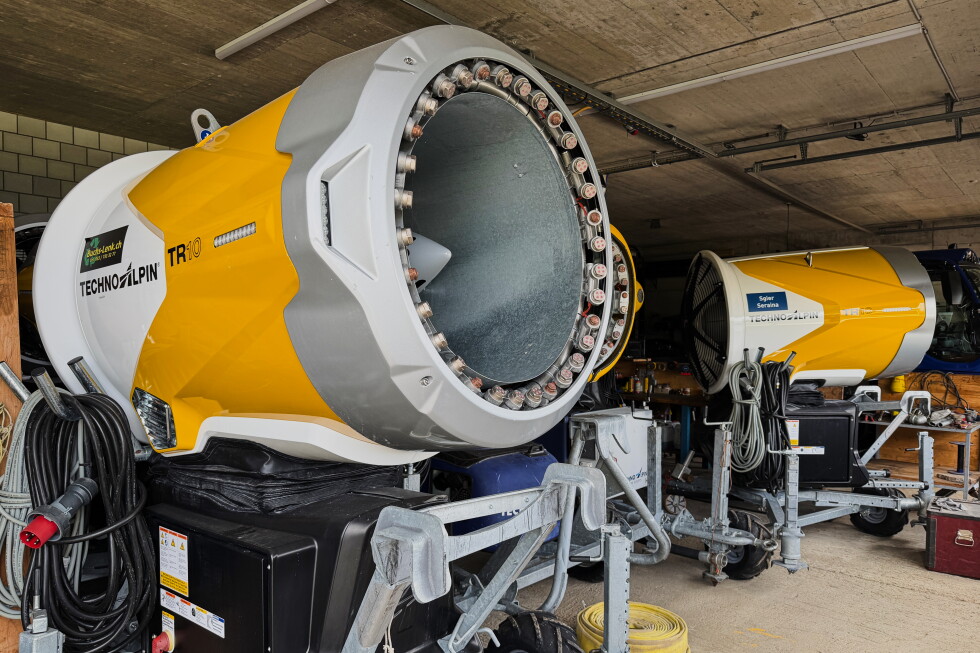
Under the blazing August sun that has settled over the Swiss Alps, the slopes above Adelboden lie bare and golden, with not a patch of natural snow or a single skier in sight. Yet what has long been a winter-only ski infrastructure is being tapped for an urgent new purpose: as Europe grapples with increasingly severe heatwaves and prolonged droughts, the Adelboden-Lenk ski resort is repurposing its massive snowmaking network to help fight the growing threat of wildfires.
Decades of human-caused climate change have transformed the Alpine landscape dramatically. Glaciers across the region and throughout Switzerland are retreating at alarming rates, and natural snowfall has become increasingly sparse and unpredictable. For mid-altitude resorts like Adelboden-Lenk, whose 125 miles of slopes sit between 1,000 and 2,300 meters above sea level, this shift has already forced major adaptation: today, roughly 70% of the snow covering its pistes every winter is produced artificially.
The artificial snow system relies on more than just the visible snow cannons and lances that dot the slopes. Beneath the surface lies an extensive hidden network: tens of kilometers of buried water pipes connected to multiple reservoirs that collect rainwater and glacial melt during warm months, storing the resource to produce snow when winter arrives. Now, resort leaders say this existing infrastructure could be a critical tool for wildfire prevention and response as dry conditions raise fire risk across the country.
“We can provide meaningful support to firefighters through our existing infrastructure,” explained Jürg Klopfenstein, who oversees the resort’s snowmaking operations. “While the snow cannons themselves have limited uses—they can mostly be used to wet down surrounding vegetation and protect nearby infrastructure—our pipes, pumps, and reservoirs offer far more value. Firefighters can tap into our network directly, and helicopter water bombers can refill their tanks from our stored water supplies.”
In the event of an approaching wildfire, the connected system can also be used to create wet fuel breaks, or buffer zones, that slow the spread of flames. This buys valuable time for ground emergency crews and aerial support to reach the remote mountain area, which draws thousands of hikers, mountain bikers, trail runners, and paragliders to the region during the summer months.
So far in 2024, Switzerland has avoided the large-scale destructive wildfires that have devastated parts of neighboring countries across southern and central Europe. But the entire nation, including the Bern region where Adelboden is located, is currently facing severe drought, and official wildfire risk assessments classify most of the country as high risk.
While the Alpine ecosystem does not face the exact same fire risk as the drier Mediterranean regions of southern Europe, resort operations manager Stefan Buchs emphasized that the threat cannot be ignored. “Different vegetation and varying soil moisture mean we can’t directly map southern Europe’s large fire events onto the Alps, but widespread wildfire is still a very plausible scenario here,” Buchs noted. “We’ve worked closely with local fire crews on this plan, and they agree that the risk is growing. Even in spring, conditions get far drier than they used to, not just in the peak of summer.”
Adelboden Mayor Willy Schranz echoed the need for proactive preparation, saying, “We have to get ready now, because this won’t be the last hot, dry summer we face.”
Still, climate experts warn that this adaptive measure is only a short-term solution, not a fix for the broader impacts of climate change. Nathan Solothurnmann, a climate change specialist with the environmental organization Greenpeace, cautioned against overstating the long-term value of repurposing snow infrastructure for wildfire response.
“The system Adelboden is putting in place will certainly help in the near term, but the climate changes we are confronting are far more severe,” Solothurnmann said. “Adaptations like this only buy us time, they don’t address the root of the problem. What’s more, this kind of extensive pre-built water network is rare across Switzerland. Most Alpine forest areas don’t have a ready-made network of underground pipes to tap into when a fire breaks out.”