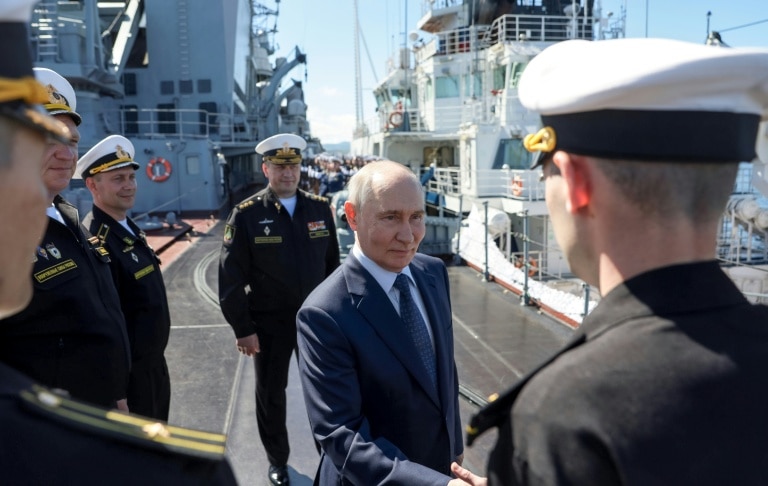
On a Thursday that has injected fresh tension into decades-long territorial frictions between Moscow and Tokyo, Russian President Vladimir Putin made his first official trip to the contested Kuril Islands — a chain of volcanic outposts claimed by both nations, and a flashpoint that has defined bilateral relations for nearly 80 years. The visit immediately drew a formal, forceful objection from Japan, which has laid sovereign claim to the four southernmost islands of the archipelago it refers to as the Northern Territories.
Footage of Putin’s visit was released via the Kremlin’s official channels, with Russian state media confirming the president toured a local fish-processing facility on the islands, where he was presented with a gift of locally sourced caviar. The trip came on the heels of a stop in nearby Sakhalin Island, where Putin oversaw the closing phase of major naval drills conducted by Russia’s Pacific Fleet. During his time in Sakhalin, Putin chaired a high-level briefing focused on safeguarding Russia’s eastern border security, according to reports from Russian state news agency RIA Novosti.
Japan’s Foreign Ministry swiftly issued a public rebuke of the visit, with Foreign Minister Toshimitsu Motegi affirming in an official statement that the Northern Territories are “an inherent part of Japan’s territory both historically and under international law.” The diplomatic row comes amid an already sharp deterioration of Russia-Japan ties, which have plummeted since Moscow launched its full-scale invasion of Ukraine in 2022. In recent years, Russia has simultaneously deepened its strategic partnerships with China and North Korea in the Asia-Pacific, further straining its already frosty relations with Tokyo.
The territorial dispute stretches back to the final days of World War II, when Soviet forces seized the strategically located archipelago, which sits just north of Japan’s northern main island Hokkaido, in August 1945. The Soviet Union declared war on Japan just days after the U.S. atomic bombing of Hiroshima, and only six days before Japan’s formal surrender that ended the global conflict. Following the occupation, Moscow deported the archipelago’s approximately 17,000 Japanese residents, and has maintained a continuous military presence on the islands ever since.
While the four southern islands at the center of the dispute have a harsh, remote climate, they hold significant economic and strategic value. Home to roughly 20,000 Russian citizens today, the islands boast rich fishing grounds and untapped mineral deposits including gold and silver. Throughout the Cold War, the archipelago served as a critical forward operating base for Soviet air and naval forces, positioned directly in the heart of a region that was a key front for geopolitical confrontation between the Soviet bloc and the U.S.-led alliance.
Diplomatic talks between Moscow and Tokyo to resolve the dispute have been intermittent for decades. A small breakthrough appeared possible in 1956, when the two sides normalized diplomatic relations: Soviet leader Nikita Khrushchev offered to return two of the four disputed islands to Japan as part of a formal peace treaty. The deal never came to fruition, however, and while negotiations resumed after the collapse of the Soviet Union in 1991, no tangible progress has been made to settle the standoff.
Putin’s visit marks the first time the sitting Russian president has traveled to the disputed territory, though it is not the first trip by a modern Russian head of state. In 2010, then-President Dmitry Medvedev became the first Russian leader to visit the islands, and he made additional return trips after he stepped into the role of prime minister following his presidency.