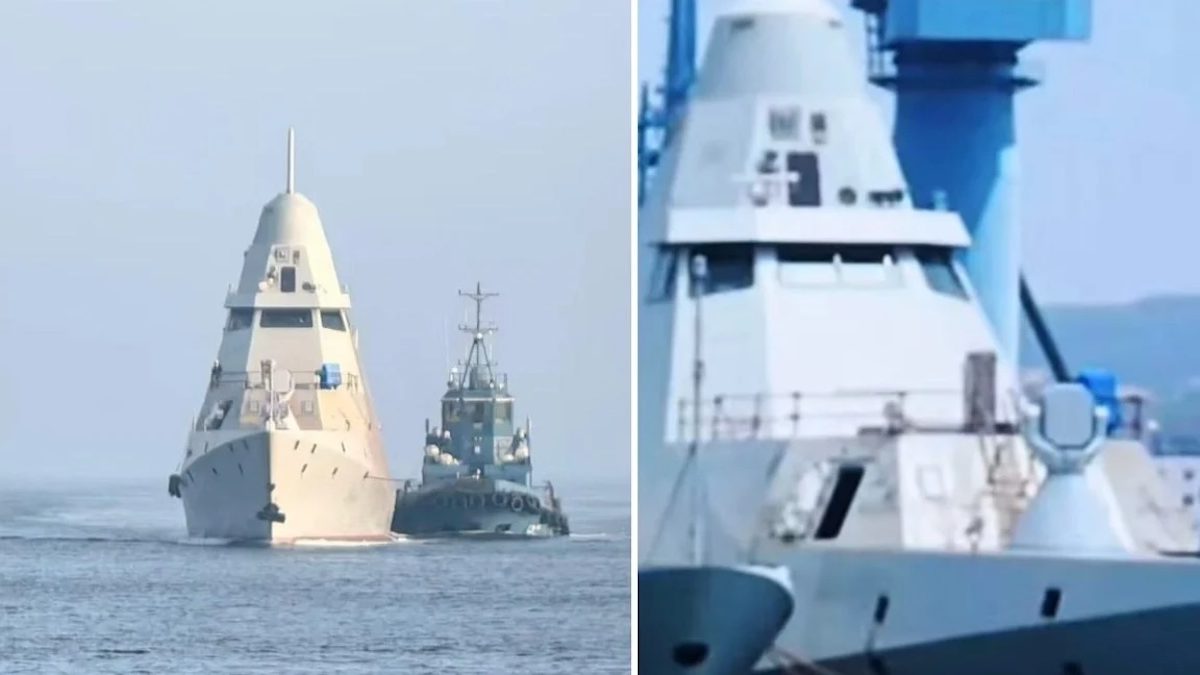
A newly modified mysterious deck-mounted system on China’s experimental stealth corvette has sparked intense speculation among open-source naval analysts, highlighting a growing global naval competition to develop directed-energy weapons for both gray-zone coercion and cutting-edge defense against mass drone attacks.
First spotted at China’s Liaonan Shipyard in 2023, the modified stealth test vessel made headlines this month when Defense Blog reported that a previously installed missile launcher had been removed and replaced with an unknown box-shaped system mounted on the corvette’s deck. Open-source intelligence experts who have tracked the vessel’s development are split into two leading camps over the system’s intended function: one argues it is a ship-borne sonic weapon designed for non-lethal disruption of enemy personnel, while the other contends it is a high-power microwave (HPM) directed-energy system built to disable incoming swarms of drones and unmanned vessels.
Proponents of the sonic weapon theory point to China’s well-documented history of deploying acoustic devices for non-lethal harassment and crowd control operations, including multiple incidents in the South China Sea. In contrast, supporters of the HPM hypothesis note that the system’s boxy form factor and deck placement closely match the design of recently unveiled Chinese land-based HPM weapons, which are engineered to disable the electronics of small unmanned aerial vehicles at ranges exceeding three kilometers.
The War Zone (TWZ) outlined the test corvette’s core design parameters in an August 2024 analysis, noting the vessel features smooth, faceted low-observable hull surfaces purpose-built to minimize its radar cross-section. Its stealth-oriented design includes a main main gun hidden inside a faceted stealth cupola, structural features that suggest space reserved for a vertical launch system, and a modified mounting originally thought to be for an HQ-10 short-range missile system, but now believed to house a single aperture for electro-optical testing, laser trials, or prototype evaluation. The corvette’s streamlined mast and rumored hybrid all-electric propulsion system also reflect its mission to test new technologies for the next generation of Chinese littoral combat vessels.
China has a established track record of deploying non-kinetic and directed-energy tools in its gray-zone territorial operations in the South China Sea, where it uses ambiguous, deniable incremental and hybrid tactics to assert territorial claims without triggering full-scale armed conflict. In January 2025, the China Coast Guard was reported to have used a long-range acoustic device (LRAD) to harass a Philippine Coast Guard vessel, the BRP Cabra, operating in disputed waters. A similar deployment against Philippine fisheries vessels was reported in late 2023, following an early 2023 incident where a Chinese military laser was used against the Philippine Coast Guard ship BRP Malapascua, temporarily blinding members of its crew. Unlike conventional loudspeakers that project sound over a wide area, LRAD systems emit a concentrated, high-intensity sound beam similar to a flashlight’s focused light. While marketed for crowd control and ship-to-ship communication, the device is capable of causing permanent severe injury: a peer-reviewed April 2025 study published in the Chinese Journal of Traumatology confirmed that high-intensity acoustic exposure causes permanent acoustic trauma, eardrum rupture, ossicle fractures, and permanent hearing loss, with infrasound inducing organ resonance, dizziness, and internal organ damage and ultrasound causing thermal burns, blurred vision, internal pain, and bone damage depending on frequency.
China is also widely recognized as a global leader in HPM weapons development, making the theory that the mystery system is an HPM prototype highly plausible. Invisible and difficult to attribute, HPM weapons have already been linked to unexplained health incidents like the so-called “Havana Syndrome”, making them ideal tools for deniable gray-zone coercion. An HPM attack on a rival nation’s law enforcement vessel could temporarily incapacitate the crew, disable all on-board electronics, and force a mission abort, while leaving no clear evidence of attribution and allowing the attacking party to maintain plausible deniability to avoid escalation.
Beyond offensive gray-zone operations, HPM weapons also offer a transformative solution to one of the most pressing modern naval defense challenges: defending against mass drone and unmanned surface vehicle (USV) swarms, which are increasingly capable of overwhelming conventional ship-based missile defenses. Stealth warships may be particularly vulnerable to these swarms, which can use a mix of optical, radar, infrared, magnetic, and acoustic sensors to detect stealth targets across multiple signature types, and large coordinated swarms of attack drones and USVs can often slip through layered conventional defenses, with even a small number of penetrating attackers capable of inflicting severe damage.
Conventional defense against drone swarms requires large stockpiles of expensive interceptor missiles, which creates unsustainable cost-exchange ratios and runs the risk of depleting limited ammunition stocks during extended operations. A June 2026 South Korean military military exercise illustrated this challenge: even eight 20-millimeter Vulcan guns firing 1,000 to 3,000 rounds per minute at close range only managed to destroy 44 out of 50 slow, formation-flying quadcopter drones, with infantry required to eliminate the remaining six using shotguns and hand-held laser devices. In a real combat scenario, drone swarms would not cooperate in slow, predictable formations; they would attack from multiple directions, often combined with anti-ship missiles and USVs to maximize the probability of a successful hit.
Recent incidents have further underscored the vulnerability of large surface combatants to small, low-cost unmanned vessels. In July 2026, private American drone firm Seasats released publicly available footage showing its $240,000 Lightfish USV approaching a Chinese Type 052D guided-missile destroyer at close range in the South China Sea, proving that small, inexpensive unmanned vessels can reach high-value major combatants undetected. Ongoing conflicts, including the Iran War and Houthi attacks on commercial shipping in the Red Sea, have further highlighted the magazine depth and cost challenges of relying on conventional missile interceptors: in both conflicts, naval vessels have been forced to expend large numbers of multi-million-dollar interceptors to destroy cheap, expendable drones, depleting limited stockpiles that are difficult to replace at sea.
Directed-energy systems such as HPM weapons and lasers have long been proposed as a solution to these problems, offering a nearly unlimited number of shots at negligible marginal cost, scalable effect depending on the target, and near-instantaneous engagement speeds.
Regardless of whether the mystery system on China’s stealth test corvette ultimately proves to be a sonic weapon, an HPM emitter, or another emerging technology entirely, its deployment on a purpose-built stealth test bed confirms a broader global trend: directed-energy weapons are moving from theoretical research to sea-based testing, with roles in both deniable gray-zone operations and high-end defense against mass unmanned attacks. While significant technical barriers related to power output, cooling, effective range, and resistance to enemy countermeasures still separate experimental prototypes from reliable combat-capable systems, the shift toward integrating directed-energy into frontline naval design is already well underway.