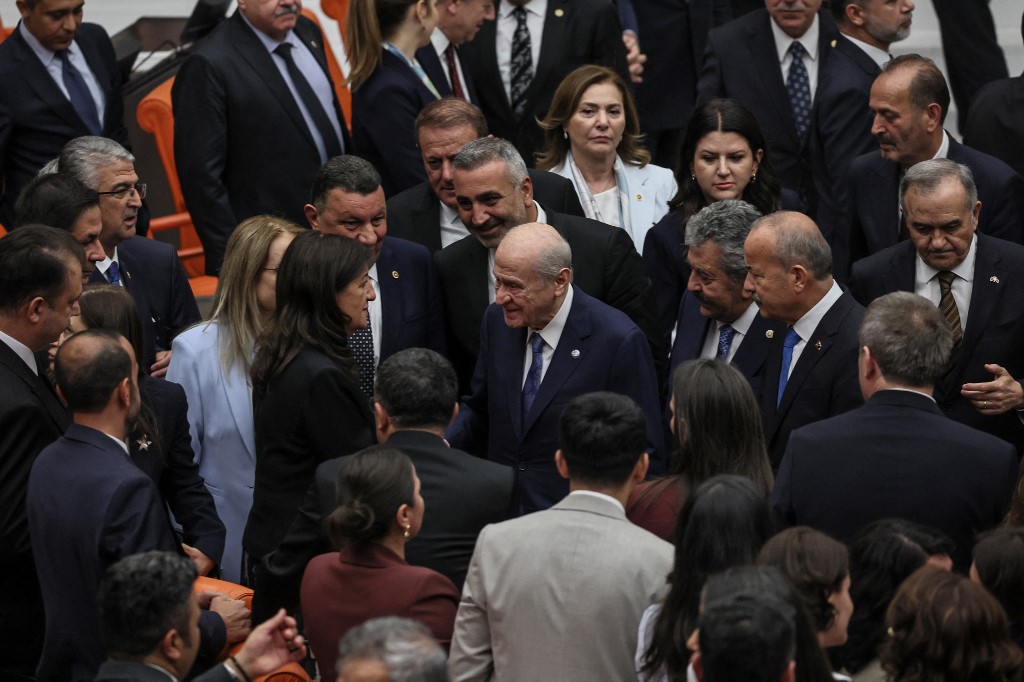
Three years ago, the sight of Turkish ruling coalition lawmakers posing alongside pro-Kurdish and other opposition legislators after passing a partial clemency bill for Kurdistan Workers’ Party (PKK) members would have been unthinkable. Yet this extraordinary scene became reality this week, following a landmark parliamentary vote that marks the first formal government effort in modern Turkish history to end nearly 40 years of armed conflict with the PKK.
The PKK launched its guerrilla campaign against the Turkish state in the early 1980s, a conflict that has claimed the lives of thousands of civilians and security force personnel. Initially organized to demand full Kurdish independence, the group has in recent decades shifted its goals to push for greater political and cultural autonomy for Turkey’s Kurdish population. After two years of quiet negotiations with imprisoned PKK leader Abdullah Ocalan, President Recep Tayyip Erdogan’s Justice and Development Party (AKP) and its nationalist coalition partner, the Nationalist Movement Party (MHP), moved forward with the peace legislation. What makes the process even more remarkable is that it was initiated by MHP leader Devlet Bahceli, a long-time hardline opponent of the PKK who once repeatedly called for Ocalan’s execution, in an October 2024 speech where he unexpectedly positioned himself as a champion of negotiations.
Following months of deliberations by a special parliamentary committee focused on the Kurdish question, and extended talks involving Ocalan, PKK commanders based in northern Iraq’s Qandil Mountains, and exiled PKK leaders based in Europe, the draft legislation was tabled last week and ratified by parliament on Monday.
The new law outlines a clear path toward disarmament and reconciliation: it grants pardons to former PKK members who have never been convicted of violent offenses such as premeditated murder, and allows the immediate release of prisoners jailed for non-violent PKK-related activities. Before any repatriation or pardons can take effect, the PKK must fully lay down its arms, verify its compliance to Turkish authorities, and end all illegal activities including counterfeit and drug smuggling. Repatriation of eligible non-violent PKK members is scheduled to begin in September, with a six-month implementation window; those who fail to apply within this period will lose their eligibility for the clemency program. Turkish intelligence services will oversee the disarmament process, and a formal compliance report will be submitted to Turkey’s National Security Council to trigger the next phase of the process. The law applies to PKK members across all locations, including those based in Europe, and automatically cancels any pending sentences based solely on PKK membership once the organization formally dissolves, clearing the way for former members to resume civilian life in Turkey.
What has stunned observers most is not the passage of the bill itself, but the unprecedented breadth of cross-party support it garnered. Beyond the ruling AKP and MHP, the legislation won backing from the main secular opposition Republican People’s Party (CHP), small right-wing and Islamist groups including the New Welfare Party (Yeniden Refah) and Felicity Party (Saadet), the liberal Democracy and Progress Party (DEVA), and even Huda Par, an Islamist Kurdish party that has long opposed the PKK. Left-wing groups including the socialist Workers’ Party of Turkey (TIP) and multiple smaller left-wing parties also supported the measure. Prominent opposition figures including imprisoned Istanbul Mayor Ekrem Imamoglu and Ozgur Ozel, leader of the New Party and a former CHP dissident who now leads the main opposition bloc inside parliament, also publicly endorsed the bill.
While supporting parties bring a range of differing perspectives and private reservations to the process — Ozel allowed New Party lawmakers a free vote, and many ultimately opposed the legislation — the final tally reflected overwhelming parliamentary backing: 468 of the 600-seat body’s 592 sitting members voted in favor. In his parliamentary address, Ozel emphasized that despite deep disagreements with the Erdogan government over its ongoing crackdown on opposition mayors and its efforts to remove him from his former CHP leadership role, his party would not stand in the way of peace. “We have every right to reject this law, but we will not put that right before the future of this nation,” Ozel told lawmakers. “We will pave the way for peace so that no other mother has to embrace her son’s coffin.”
Even for Ocalan, the legislation does not grant an official formal role in the reconciliation process, but Turkish officials expect his conditions of imprisonment on Imrali Island to be eased substantially once implementation begins. Changes could include upgraded living quarters and expanded access to journalists and public figures, allowing him to communicate more openly with the Turkish public as the process moves forward. It also remains unclear how many PKK members across the organization’s global network — from the Qandil Mountains leadership to branches in Iraq, Syria, and Europe — will choose to take advantage of the clemency terms. Some long-term prisoners who have already served 25 years of their sentences may also qualify for early release under the new law.
In his address, Ozel also raised a key political question hanging over the peace process: a resolution to the Kurdish conflict could clear the way for a new political alliance between Erdogan’s AKP and the pro-Kurdish Peoples’ Equality and Democracy Party (DEM), potentially opening the door for Erdogan to run for a third presidential term in 2028. Erdogan is currently serving his second constitutionally limited term, but a parliamentary vote to call early elections would reset the term count, allowing him to stand again. With backing from DEM and smaller aligned parties, the AKP could secure the parliamentary majority needed to authorize that early vote.