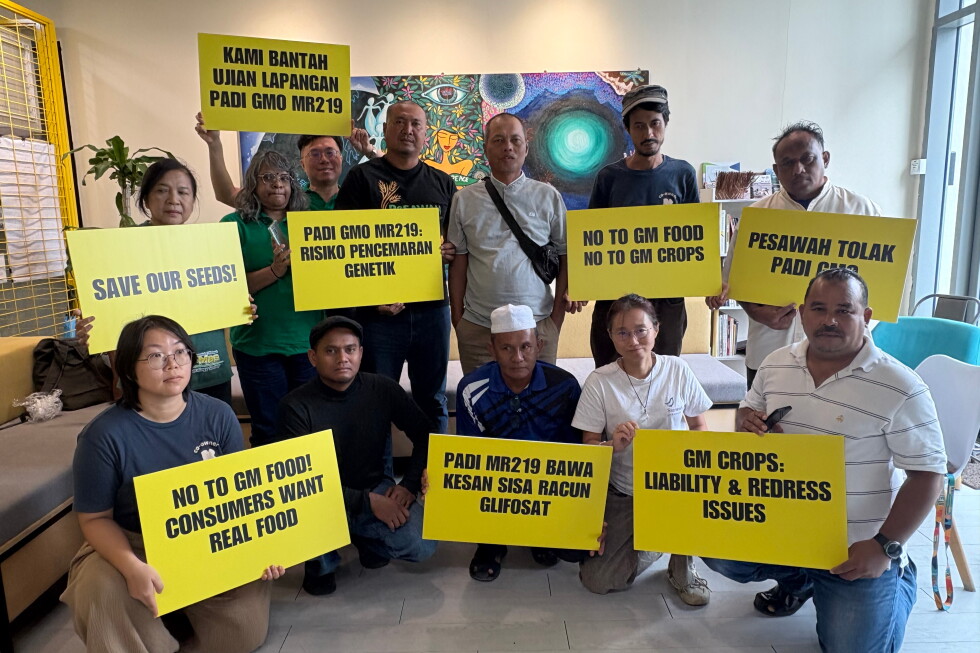
In Kuala Lumpur, a broad coalition of 61 Malaysian farmers’ groups, consumer associations, and environmental advocacy organizations is calling on the country’s National Biosafety Board to turn down an application for a confined field trial of genetically modified (GM) rice, citing widespread risks to public food safety, ecological integrity, and smallholder farmer livelihoods.
The application under review comes from Zen Cropscience, which seeks approval to test a modified version of Malaysia’s widely planted MR219 rice variety in the northern state of Perak. The edited crop is engineered with two key traits: tolerance to the widely used herbicide glyphosate, and built-in resistance to bacterial and fungal crop diseases.
Coalition members confirmed they submitted a formal formal objection to the proposal during a public consultation period that closed last week, reviving arguments they first raised against a nearly identical GM rice trial application submitted for Perlis state in 2019 that was ultimately withdrawn before approval. The group’s core concern centers on the risk of genetic contamination of conventional and wild native rice populations. Unlike the biosafety board’s claim that the risk of cross-pollination is low, coalition members warn that even confined trials carry the possibility of genetic material spreading via wind, insect activity, or human error, and current Malaysian biosafety legislation lacks adequate legal safeguards and compensation frameworks for conventional farmers who would face financial losses if their non-GM crops become accidentally contaminated.
Beyond contamination risks, opponents highlight multiple interconnected hazards tied to the crop’s glyphosate tolerance. Farmers argue the trait will incentivize increased glyphosate application, speeding the evolution of herbicide-resistant “super weeds” that require ever-larger doses or more toxic chemical inputs to control. They also warn that glyphosate residues can persist in harvested grain and enter the national food supply. The genetic modification for fungal disease resistance raises additional food safety alarms, the coalition notes, with potential to alter the rice’s nutritional profile or raise levels of allergens and naturally occurring toxins.
Abdul Rashid Yob, who leads a national farmers association representing 200,000 members across Malaysia, pointed to past industry experience with the herbicide-tolerant Clearfield rice variety as a warning of what could come. While initial yields improved after Clearfield rice was introduced, weeds quickly developed resistance to the herbicide, forcing farmers to spend more on increasing chemical doses that drove up production costs and eroded long-term soil fertility. “GM rice will be much worse. It is not the answer,” Yob said.
Malaysia currently meets only half of its domestic rice consumption through local production, relying on imports to cover the remaining demand, according to official national data. Despite the country’s need to boost food security, coalition members argue there is no justification for GM rice trials, noting that proven non-GM alternatives already exist for weed and disease management, including Japanese robotic weed removal technology that can clear fields efficiently without chemical over-reliance. “There is no need for such a trial. We don’t want GM crops,” said Mageswari Sangaralingam, a representative of the Consumers Association of Penang. Opponents stress that even though the current application is only for a confined trial, not full commercial cultivation, GMO material cannot be fully contained or recalled once it enters the environment, making any trial an unacceptable risk.
The National Biosafety Board has stated that the proposed trial would be conducted in an insect-proof, enclosed net house located on industrial land separated from active agricultural areas, and has acknowledged that long-term toxicological data for the GM rice variant has not yet been finalized. To date, no timeline has been announced for when the board will issue its final decision on the application.
The debate around glyphosate, the herbicide tied to the proposed GM rice, remains divided among global health and regulatory bodies. In 2015, the International Agency for Research on Cancer, the cancer research wing of the World Health Organization, classified glyphosate as “probably carcinogenic to humans,” drawing on limited evidence of cancer links in human populations and sufficient evidence from animal studies. Other leading regulatory agencies have reached opposing conclusions: the U.S. Environmental Protection Agency has ruled glyphosate is “not likely to be carcinogenic to humans,” and the European Food Safety Authority concluded in a 2023 assessment that it found no critical public or environmental health risks from glyphosate use.