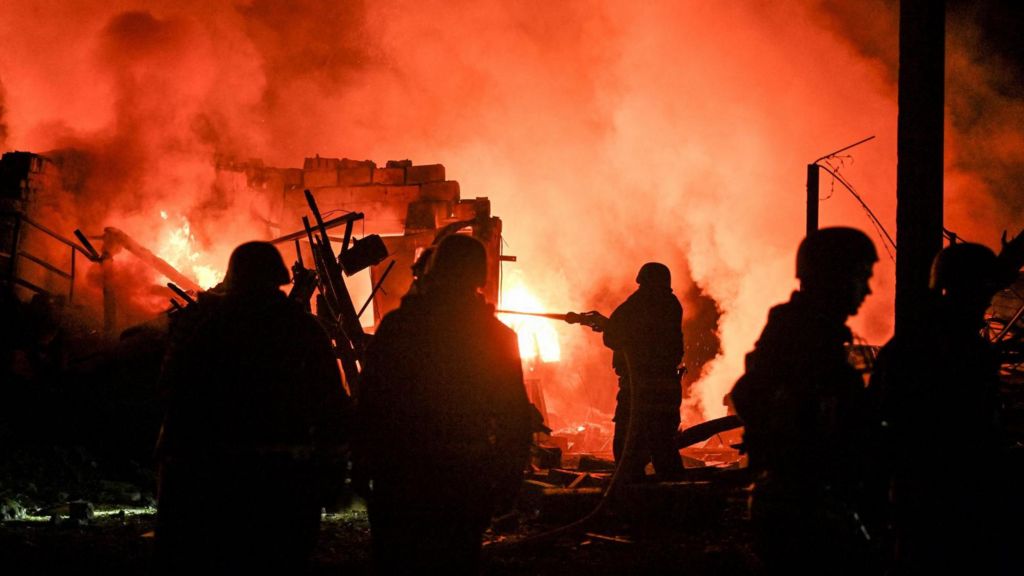
Overnight exchanges of heavy fire between Ukrainian and Russian forces have reignited tensions in the 2.5-year full-scale conflict, with Ukrainian President Volodymyr Zelensky leveling new accusations that Moscow is relying on military support from North Korea to sustain its offensive operations. The latest cycle of violence follows one of the deadliest Ukrainian deep strikes into Russian territory in months, leaving dozens dead and extending the reach of combat far from frontline battle zones.
According to Zelensky, Monday’s Russian missile attack on the southern Ukrainian city of Zaporizhzhia that killed at least six civilians and wounded 19 others used ballistic missiles supplied by North Korea, a close diplomatic and military ally of Moscow. In a Monday evening video address, Zelensky argued that this marked a clear turning point in the conflict, claiming “for the first time” Russia cannot continue its war effort without foreign military reinforcements. He warned that the growing use of North Korean military hardware and planned deployments of North Korean troops poses a growing global threat, noting that battlefield use of these weapons helps Pyongyang refine its missile technology and correct design flaws. This is not the first such allegation from Zelensky; last weekend he warned that up to 50,000 North Korean soldiers could be deployed to fight alongside Russian forces in Ukraine.
Zelensky also celebrated a separate Ukrainian deep strike on a Russian petrochemical facility in western Siberia, calling the operation a “very significant achievement” for Ukrainian forces. He pledged that more long-range strikes on Russian targets will follow, with the goal of forcing Moscow to recognize the necessity of negotiated peace.
Across multiple Ukrainian regions, Russian overnight attacks left a trail of civilian casualties and infrastructure damage. Zaporizhzhia regional governor Ivan Fedorov shared on-the-ground images of burning vehicles and collapsed buildings, confirming that Russian forces used a combination of missiles and guided bombs to target industrial sites, critical infrastructure and non-residential buildings in the city. One civilian was injured in strikes on the outskirts of Kyiv, where air raid sirens sounded twice overnight, and a local hospital suffered structural damage—though all staff and patients had taken shelter and no additional casualties were reported. Strikes on energy infrastructure in Kherson and Kharkiv triggered widespread power outages across both regions, while a Russian drone strike on Sumy injured two women aged 52 and 66, who received on-site medical treatment, Sumy City Military Administration head Sergiy Kryvosheenko confirmed in a Telegram post. The attack also damaged civilian vehicles, local warehouses and public infrastructure.
Ukrainian air force officials reported that Russia launched more than 120 drones and an unspecified number of different missiles in overnight attacks—marking the first time officials have declined to release a full breakdown of missiles fired and intercepted. This disclosure comes one day after the Ukrainian Air Force issued a public request for media to avoid sensationalized coverage and unnecessary spread of pessimism amid reported shortages of air defense interceptor missiles.
On the Russian side, Ukraine targeted key commercial infrastructure in the southern Russian region of Voronezh, which shares a border with Ukraine. Local reports confirmed large fires and explosions at a logistics warehouse operated by Wildberries, Russia’s largest e-commerce retailer, often called the “Amazon of Russia” for its dominant position in the country’s online retail market. While Wildberries has not yet formally confirmed the strike, the company announced it had evacuated all staff from its facilities in the region. This is not the first time Wildberries infrastructure has been targeted; in July, a series of Ukrainian drone strikes on multiple Wildberries warehouses disrupted operations for thousands of small and medium-sized Russian businesses that rely on the platform. Kyiv has stated that it targets these logistics hubs because they are used to process and ship supplies to Russian military forces, including military equipment purchased by Russian entities.
The latest cross-border strikes come just one day after a Ukrainian drone attack on the Russian republic of Tatarstan, located more than 1,100 kilometers (680 miles) from the Ukrainian border, killed at least 13 people including one child and injured 75 more. That attack ranks among the deadliest strikes on Russian territory since the start of the full-scale invasion in February 2022. The Uzbek consulate in Tatarstan confirmed that seven of the people killed in the strike were citizens of Uzbekistan. Verified social media footage from the attack showed large plumes of black smoke billowing into the sky over the city of Nizhnekamsk, with constant air raid sirens audible in the background. Ukrainian armed forces confirmed they targeted the Tanevo oil refinery in the city, a critical piece of Russia’s energy infrastructure.