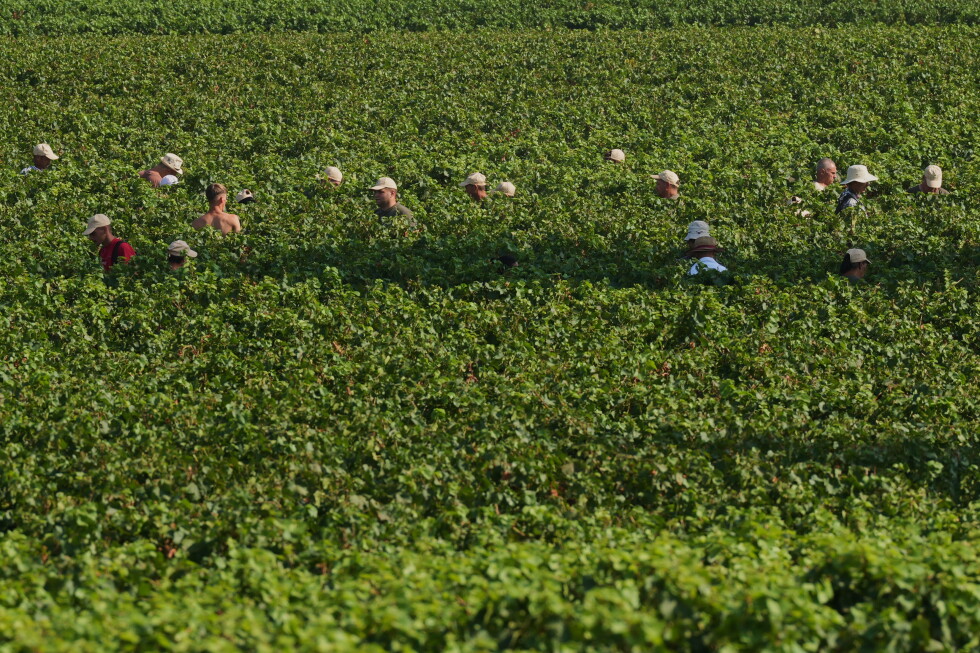
CORTE FRANCA, Italy — Long before the first rays of sun creep over the rolling hills of Italy’s iconic Franciacorta wine region, teams of harvest workers spread across sunbaked vineyards, clipping plump grape clusters destined for one of the country’s most celebrated sparkling wines. This year’s harvest began a full 10 days earlier than most producers projected, and a full month earlier than average harvest times recorded just three decades ago — a dramatic shift that industry leaders and climate experts attribute to the record-breaking scorching temperatures that have reshaped traditional agricultural calendars across Europe.
The accelerating ripening of wine grapes, driven by rising global temperatures, has dramatically narrowed the narrow window of time winemakers have to harvest at peak quality. For producers of premium sparkling wine like Franciacorta, where a delay of just two or three days can mean the difference between a world-class vintage and a batch unsuitable for production, the pressure to adapt has never been more urgent.
“These are delicate, frantic moments, and everything has to work perfectly,” explained Arturo Ziliani, CEO of Berlucchi, the region’s oldest and largest Franciacorta producer. Ziliani’s father Franco made history in 1961 as the first winemaker in the hilly Franciacorta region to produce sparkling wine using the classic secondary fermentation method developed by France’s Champagne producers. “We did not expect such an early harvest or such an acceleration in ripening,” Ziliani added.
Weeks of sustained high temperatures between 37 and 38 degrees Celsius (99 to 100 degrees Fahrenheit), paired with rainfall well below the region’s seasonal average, pushed this year’s harvest start to the earliest date on record — 10 days earlier than 2023’s already early harvest. Experts note that multiple climate-linked factors have combined to force the early timeline: a unusually mild winter allowed grape vines to bud weeks earlier than the historical norm, while severe hailstorms earlier in the growing season damaged portions of the overall yield, reducing the load on remaining vines and speeding their maturation.
Even as late as the end of July, Berlucchi had planned to begin harvesting on August 10. But when sugar levels in Pinot Nero grapes, used for the winery’s sparkling blends and rosé, spiked far faster than projected, it was clear the fruit was already ripe. Within 48 hours, the winery mustered its harvest team, prepped its presses and launched the harvest.
Extreme midday heat has forced additional changes to work schedules: regional Italian labor regulations mandate a pause in outdoor work between 12:30 p.m. and 4 p.m. to prevent heat-related illness, and temperatures have remained dangerously high even after the midday break. To get grapes to the cooling presses before they overheat and lose critical acidity, Berlucchi launched its harvest at 4 a.m., with workers picking clusters under the bright glow of mobile floodlights.
“The grapes are perfectly healthy,” said Ferdinando Dell’aquila, Berlucchi’s technical director and head oenologist. “We just have to work as quickly as possible, harvest them and preserve their acidity.”
Franciacorta is far from the only Italian wine region facing this unprecedented shift. Winemakers in Sicily began harvesting still wine grapes in late July, while small sections of Tuscany and nearly all of Italy’s other sparkling wine regions have also reported early harvest starts.
The stakes are particularly high for producers of Champagne-style sparkling wines like Franciacorta, which require an extremely precise balance of high fixed acidity, low pH and low sugar levels — a very different profile than that required for still red or white wines. “Early-ripening varieties such as Chardonnay require great care, because a delay of just a couple of days can leave you with grapes unsuitable for sparkling wine. Sugar rises too quickly and acidity falls too quickly,” noted Attilio Scienza, professor emeritus of viticulture at the University of Milan.
After harvest, high ambient temperatures mean grapes must be rapidly cooled before they can be gently pressed in stainless steel equipment to extract the high-quality free-run juice that forms the base of premium sparkling wine. This critical step cannot be rushed, so Berlucchi now runs up to 24 presses a day, often operating deep into the night, to process the unexpectedly early harvest.
Today, Berlucchi produces roughly 4 million bottles of Franciacorta annually, accounting for 20% of the Franciacorta consortium’s total annual output of 20 million bottles. Roughly 90% of the winery’s product is sold within Italy, with the remaining 10% exported to key markets including Germany, Switzerland, the United States and Japan.
Industry leaders note that this early harvest trend is not unique to Italy. “Climate change and the African weather systems settling over Europe are bringing extraordinary temperatures and forcing early picking, not only in Italy, but also in France and Germany,” said Paolo Castelletti, secretary general of the Italian Wine Union trade organization.
As earlier harvests become the new normal across Italian wine country, producers are being forced to rewrite centuries-old harvest calendars. Winemakers say they will need to start monitoring vine conditions much earlier in the growing season to catch the optimal harvest window before it passes.
Despite the upheaval, Castelletti expressed confidence that producers can adapt to the new climate reality: “A good oenologist can manage situations like this. I can say with confidence that wine quality is not compromised. It simply requires a different organization of work than in past years.”