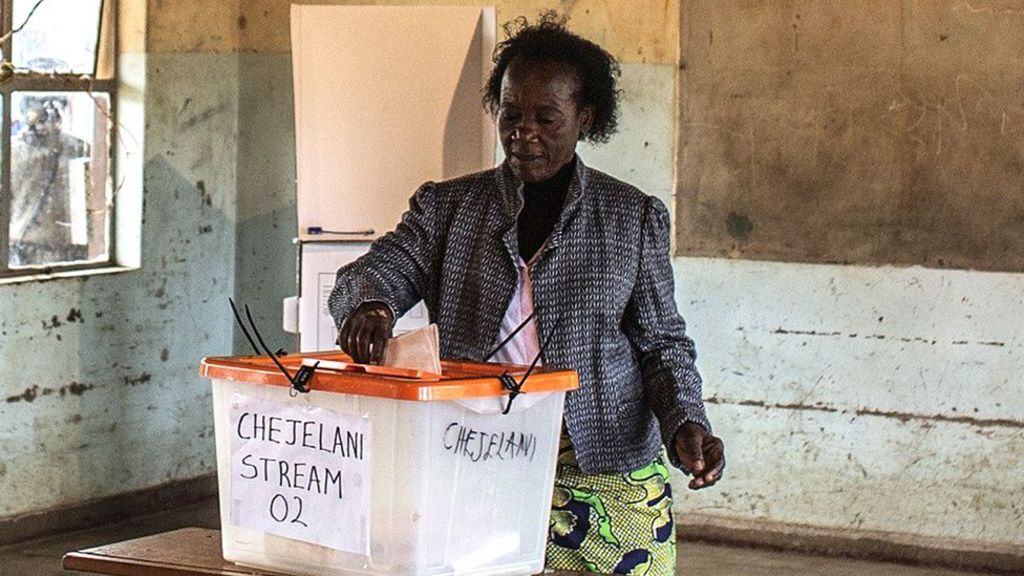
As Zambia prepares for its general election on 13 August, the Southern African nation faces one of its most unpredictable electoral contests in modern history, shaped by an unresolved political dispute, widespread economic frustration, and sweeping constitutional reforms that have redefined the race.
At the center of the campaign’s lingering tension is the legacy of former President Edgar Lungu, who died in South Africa over a year ago. More than 12 months after his passing, Lungu’s body remains unburied, trapped in a bitter public standoff between incumbent President Hakainde Hichilema and the Lungu family. The dispute has sharpened deep political divides across the country, reinvigorating opposition momentum in regions that were once strongholds of Lungu’s Patriotic Front (PF).
When Lungu first passed away, court rulings had already barred him from seeking another term due to term limits, and his death initially appeared to clear a smooth path to re-election for Hichilema, who defeated Lungu by a landslide in the 2021 contest on a platform of systemic economic change. Instead, the PF fractured after Lungu’s passing, with dozens of politicians and loyalists defecting to opposition groups. This fragmentation accelerated the consolidation of a unified opposition bloc behind Brian Mundubile, a 55-year-old lawyer, accountant, and former government chief whip under Lungu.
Running as the presidential candidate for the opposition National Reconciliation Party for Unity and Prosperity (NRPUP) as part of the broader Tonse-Pamodzi Alliance, Mundubile has seen a meteoric late surge in popularity just months after filing his nomination papers in May. He has tapped into long-held loyalty to Lungu in the country’s northern strongholds and widespread public anger over stagnant living standards to build his campaign. Mundubile’s running mate, Makebi Zulu, is a lawyer closely linked to the Lungu family, and the candidate has publicly pledged to arrange a dignified burial for the former president if he wins office – a promise that has resonated deeply with voters frustrated by the ongoing impasse.
Mundubile has centered his campaign on generational inclusion, framing his candidacy as a break from the old guard of Zambian politics. “We are moving the women and the youth from the margins to the centre of policy and economic transformation,” he told the BBC. “We believe the youths have solutions to most of their challenges. What they don’t have is a big brother, what they don’t have is a caring government to be able to assist them achieve their objectives and goals. So I’m positioning myself as president as big brother to the youth.”
For Hichilema, the contest is a fight to defend his administration’s record as he seeks a second five-year term leading his United Party for National Development (UPND). When Hichilema took office in 2021, Zambia was crippled by sovereign debt distress, with the government defaulting on billions in external payments. His administration spearheaded a landmark restructuring of more than $13 billion in foreign debt, unlocking roughly $1.9 billion in annual savings that the president says have been redirected to public investments including free primary and secondary education.
Under Hichilema’s term, copper production – Zambia’s core economic backbone – has rebounded sharply, foreign currency reserves have climbed to record highs, annual inflation has fallen to 6.6% (its lowest level in eight years), and the kwacha has strengthened against major global currencies. The administration has also hired thousands of new teachers and health workers, sharply increased constituency development funding, and cut the national unemployment rate from 13% to 11% over four years. After a severe 2024-2025 drought slashed hydropower generation and triggered nationwide blackouts lasting up to 20 hours a day, the government ramped up costly electricity imports and accelerated utility-scale solar projects, easing outages in recent months.
Supporters argue the president has laid solid macroeconomic foundations for long-term growth that will deliver widespread benefits over time. “I think opportunities have been increased, looking at the number of people who have been employed – it has increased amongst civil servants. And, opportunities have just increased,” one young woman hoping to join the teaching profession told reporters.
Yet for millions of ordinary Zambian voters, these macroeconomic gains have not translated into tangible relief from daily economic pressure. Across Lusaka’s busy city markets, on street corners, and in shared minibus taxis, the dominant conversation remains the crippling cost of living. Global post-pandemic inflation and geopolitical shocks have sent food and energy prices soaring across the continent, and Zambia has not been spared. For example, cooking oil prices have jumped more than 70% over the past five years.
Given Kangwa, a 27-year-old flour mill worker in Lusaka City Market, explained that his 3,000 kwacha ($157) monthly salary is barely enough to cover basic expenses for his household. “The cost of living, I cannot say is okay,” he said. “Where I work, for example, the money we are getting paid is not enough and we cannot sustain our lives.” Theresa Zulu, a street-food vendor, echoed that frustration, saying bluntly: “Money has become so hard to come by. We are trying to stay strong to survive, but things have become really hard for us.”
Memories of the months-long blackouts also remain fresh for many voters, even as outages have eased. Critics of Hichilema add that the benefits of economic recovery have yet to reach most working-class families, and civil society groups have raised concerns that the administration has silenced opposition voices, with several opposition figures convicted of hate speech in recent years. Even some voters who reject a return of the old PF government cite ongoing economic hardship as a reason to question backing the incumbent. “Because we gave them a chance to rule the country and we saw what they did,” Edith Muntanga, a voter in her late 30s, said of the previous government, but added that daily costs remained a top concern.
This 2026 election is also the first to be held under sweeping constitutional reforms enacted in late 2025, designed to increase representation for underrepresented groups in parliament. The amendments created a mixed-member proportional system for the National Assembly, expanding total constituency seats from 156 to 226, and adding 40 additional reserved seats: 20 for women, 15 for youth under 35, and 5 for people with disabilities. Despite the reforms to boost gender representation in national politics, just one of the 14 cleared presidential candidates on the 13 August ballot is a woman: independent candidate Given Katuta.
With 14 candidates vying for the presidency, political analysts widely predict that no candidate will cross the 50%+1 vote threshold required to win outright in the first round, triggering a second round runoff within 37 days of the initial vote. Civil society organizations have also raised questions about the integrity of the electoral process, with prominent human rights activist and former Law Association of Zambia president Linda Kasonde arguing that multiple electoral commission members have close ties to the ruling UPND, undermining public confidence in the body’s independence. “In terms of the constitution of the electoral commission itself, a number of the members of the commission are actually politically aligned to the incumbent ruling party and are not seen to be independent,” Kasonde said. The electoral commission has repeatedly rejected claims of bias, asserting it operates strictly within its constitutional mandate and upholds core principles of transparency and independence.
For weeks, the streets of Lusaka have been saturated with campaign energy: the hum of daily market activity is layered over the sound of opposition and ruling party campaign jingles, and candidate posters line lamp posts, shop fronts, and towering billboards across the capital. More than 8.2 million registered voters are eligible to cast their ballots on 13 August, choosing not just a president but a new 266-seat parliament. Zambia has a long, proud history of peaceful elections and democratic transfers of power, a legacy all parties have invoked repeatedly on the campaign trail. But this year, a combination of economic frustration, lingering political tension over Lungu’s unburied remains, and questions about institutional integrity have created a deeply fragmented race with an outcome that remains too close to call. As voters weigh the macroeconomic gains of the last five years against the daily struggles that shape their households, Zambians will deliver their verdict on 13 August.