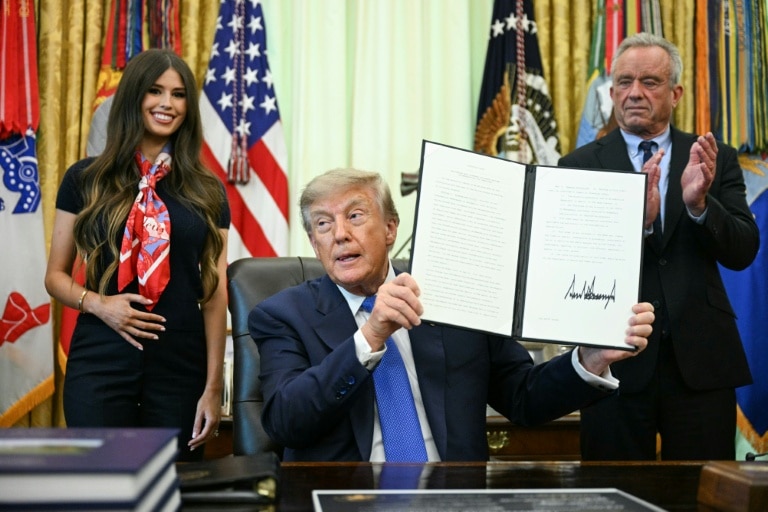
On a Monday afternoon in the Oval Office, U.S. President Donald Trump signed an executive order calling for a sweeping review of childhood vaccine mandates for K-12 schools, doubling down on a long-debunked call to split the combined measles, mumps, and rubella (MMR) vaccine into three separate single-disease shots. The signing ceremony was attended by Health and Human Services Secretary Robert F. Kennedy Jr., a longstanding anti-vaccine advocate who built his public profile around spreading false claims of a link between childhood immunization and autism, a claim that has been thoroughly disproven by decades of peer-reviewed clinical research.
Critics across the medical and public health communities have quickly decried the order as scientifically unfounded and a direct threat to decades of successful public health progress. The policy push also faces immediate structural limitations: the federal government holds no direct authority over school vaccine requirements, which are set independently by individual U.S. states and territories. As outlined in the text of the order itself, the Trump administration can only advise state and local governments to revisit their existing immunization rules for school enrollment, making the measure largely symbolic rather than immediately enforceable.
The order does include one actionable provision: it directs the Department of Health and Human Services to convene a new interagency task force to work with private pharmaceutical manufacturers and international partners to develop and approve separate MMR vaccines, while retaining the existing combined shot as an option. Even if the task force moves forward immediately, leading pediatric health experts warn that full regulatory approval and widespread distribution of separate shots would take more than a decade to complete.
“This entire order is rooted in politics and conspiracy theories, not evidence-based public health,” Alister Martin, New York City’s Health Commissioner, said in a public statement following the signing. “Vaccination recommendations should not be set by the president, and thankfully, they are not. Cities and states retain authority to set their own rules, and here in New York City, we will continue to follow science-based guidance, not politically motivated misinformation.”
Decades of large-scale clinical trials and population-level data consistently confirm that the combined MMR vaccine is safe for children. Public health experts note that the combined formulation delivers faster, broader protection against three dangerous contagious diseases, while also reducing logistical burdens for families who may face barriers to scheduling multiple doctor’s appointments for separate shots. Despite this overwhelming consensus, President Trump used the signing ceremony to repeat a series of inflammatory, unsubstantiated claims contradicting established medical guidance.
Leading national medical organizations have uniformly rejected the administration’s proposals. Andrew Racine, president of the American Academy of Pediatrics (AAP), emphasized that the development process for separate MMR vaccines would take more than 10 years to complete under the best of circumstances. “We are advising all pediatric providers and parents to continue following the existing schedule, which uses a vaccine that has 70 years of proven safety data behind it,” added Aaron M. Milstone, a member of the AAP Committee on Infectious Diseases.
Even some members of the president’s own party have publicly denounced the move. Senator Bill Cassidy, a physician whose decisive vote confirmed Kennedy’s controversial appointment as Health Secretary, posted to social media platform X that the order would only worsen existing vaccine hesitancy and put American children at greater risk of preventable disease. “This executive order is wrong,” Cassidy wrote. “The President does not have the medical expertise to make these changes. Vaccines are overwhelmingly safe. Vaccines are effective. Vaccines DO NOT cause autism.”
The latest policy push comes as the Trump administration already saw a prior attempt to overhaul federal vaccine policy blocked by a federal court earlier this year, after major medical organizations successfully argued the administration’s actions violated federal law. A judge issued a stay on the changes pending ongoing legal proceedings.
Monday’s order arrives at a critical moment: as children across the United States prepare to return to in-person schooling for the new academic year, the country is currently grappling with the worst measles outbreak it has seen in 35 years. Public health officials widely blame rising vaccine hesitancy, fueled in large part by anti-vaccine misinformation spread by Kennedy and other allies of the president, for the resurgence of the once-eliminated disease.
Recent polling shows a majority of American voters support evidence-based childhood vaccination requirements, and both Kennedy and Trump had softened their anti-vaccine rhetoric in recent months amid fears that hardline anti-vaccine positions would hurt Republican candidates in the upcoming November midterm elections. Monday’s signing makes clear that rolling back existing vaccine policy and advancing anti-vaccine misinformation remains a core priority of the administration’s public health agenda, as both men continue to endorse the thoroughly debunked claim that immunization causes autism.