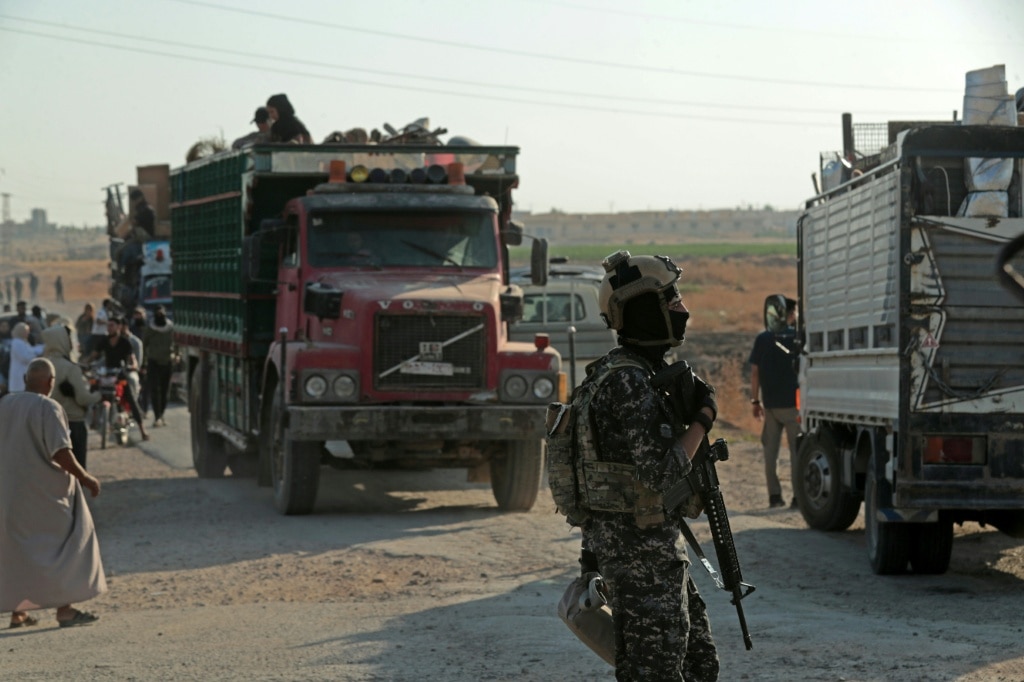
Months after a landmark reconciliation deal between Kurdish factions and Syrian national authorities that paved the way for the return of hundreds of thousands of displaced people, plans to repatriate Kurdish residents to their northeastern hometown of Ras al-Ain have been thrown into chaos. The process was suspended just hours after the first cohort of returnees departed for the border town, following a targeted attack on the convoy that ignited mass protests across Kurdish-majority regions of northern Syria.
On Monday morning, hundreds of families loaded their remaining belongings onto trucks at staging areas outside the provincial capital of Hasakeh, with many telling Agence France-Presse reporters they had waited years for the chance to go home. Among them was 37-year-old Nora Khodor, who described the long-awaited return as “like a dream” after half a decade of displacement. Thirty-nine-year-old Rawda Mohammed added that even confirmation her former home had been completely destroyed did not dim her excitement: “we’re happy to return, and when we get there we’ll see what we can do.”
Jawan Isso, a representative of the Ras al-Ain Displaced Persons Committee, confirmed that roughly 2,500 people made up the first repatriation batch, with a second group scheduled to depart in the following days. In total, more than 100,000 displaced residents from the Ras al-Ain region have submitted applications to return to their pre-war homes. But within hours of departing, the convoy came under attack by unidentified armed groups, Isso said.
In response to the violence, Mahmud Khalil Ali, deputy head of Hasakeh province’s security forces, announced the immediate suspension of all repatriation trips as a precautionary safety measure. “Several of those involved in the attacks were arrested,” Ali said, adding that “these trips will resume as soon as the situation stabilises and full protection is provided for the returnees.”
The attack quickly sparked widespread anger across northern Syria’s Kurdish communities. In the nearby city of Qamishli, an AFP correspondent witnessed hundreds of angry protesters attempt to storm a local security forces headquarters, only to be pushed back by Syrian security officers. Further west in the Kurdish-majority town of Kobane, Syrian state television reported that protesters targeted government administrative buildings and removed the national flag from outside the local security headquarters. Authorities subsequently imposed a full curfew on Kobane as they launched a manhunt for the attack organizers.
Mazloum Abdi, leader of the Kurdish-led Syrian Democratic Forces (SDF) who signed the January reconciliation deal with Damascus, condemned the attack on returning families in a post on X. “We understand the angry reactions in the Kurdish street in response to this assault,” Abdi wrote. “At the same time, we call on our people to exercise self-restraint, refrain from being drawn into any irresponsible acts, and preserve our civil and security institutions.”
Ahmad al-Hilali, deputy governor of Hasakeh province, issued a unified condemnation of both the original attack on returnees and the subsequent attacks on state institutions across the region. “A number of rioters have already been arrested in several areas,” al-Hilali said, vowing that there would be “no leniency” toward any actors that threaten “civil peace.”
The current unrest has its roots in the 2019 Turkish cross-border offensive that pushed Kurdish forces out of a 120-kilometer strip of Syrian territory along the Turkish-Syrian border, including Ras al-Ain (known as Sari Kani to Kurds). The operation displaced tens of thousands of Kurdish residents from the region, and international human rights groups have documented widespread looting and seizure of abandoned Kurdish homes by pro-Turkish armed groups, many of whom have since relocated their families to the formerly mixed-ethnicity area. Turkey launched multiple successive offensives against Kurdish-led forces in northern Syria before the December 2024 collapse of Bashar al-Assad’s government, which saw new Islamist-led national authorities extend central control across all formerly autonomous regions of the country, including Kurdish-held territories.
Today, more than 13 years after the start of Syria’s civil conflict, the United Nations estimates that 5.5 million people remain internally displaced across the country, many of whom have spent years waiting for the chance to return to their pre-war homes.