A growing wave of protests led by hundreds of students and government job aspirants has swept through India’s eastern state of Jharkhand, centered on widespread allegations of fraud and procedural misconduct in state-run recruitment examinations. What began as scattered demonstrations in late July has escalated into a sustained mass movement, drawing national attention and forcing political leaders to respond to the demonstrators’ core demands.
Protesters are calling for two key actions: the immediate cancellation of the preliminary civil service examination held this past April, followed by a full re-administration of the test, and a formal probe into suspected malpractice across multiple state recruitment drives by India’s top federal investigative agency, the Central Bureau of Investigation (CBI). They have also added demands for a fast-track special court to hear all cases tied to the alleged irregularities, to speed up accountability for those involved.
The current unrest erupted after the release of the April preliminary exam results last month. Candidates raised red flags when answer sheets circulated online showed that many top-scoring applicants had answered far fewer questions correctly than lower-ranked candidates, stoking widespread suspicions of deliberate score manipulation and pre-exam leaks. These initial claims have since expanded into broader accusations of systemic corruption across Jharkhand’s entire government recruitment system.
Government roles remain one of the most sought-after career paths in India, with hundreds of thousands of candidates competing annually for the fixed salaries, job security, and benefits that civil service positions provide. For many young aspirants, fraud in these exams blocks the only viable path to economic stability, deepening public anger over the allegations.
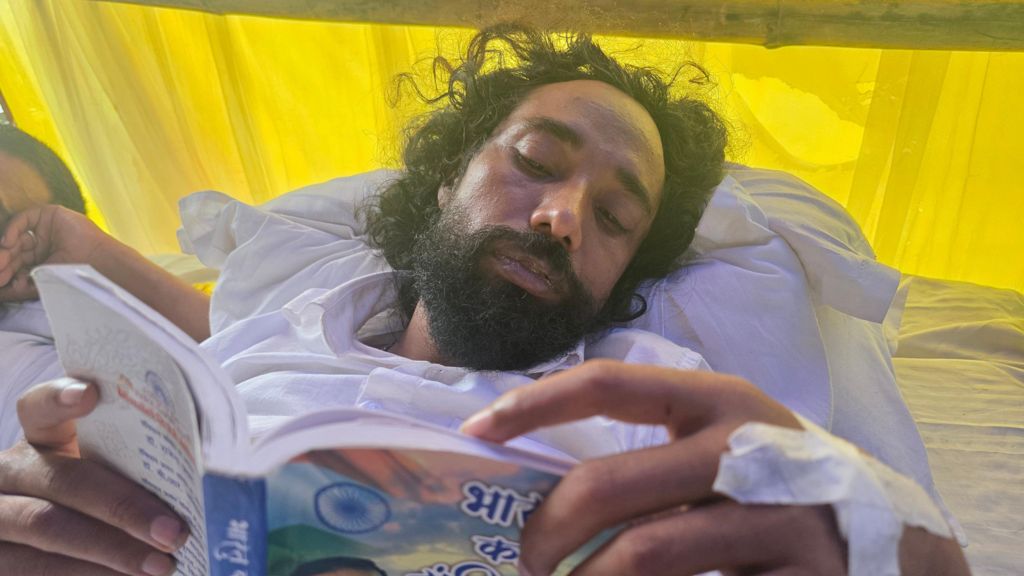
The protests first launched on July 25, and gained major momentum four days later when thousands of demonstrators gathered at a stadium in Ranchi, Jharkhand’s capital, to launch an indefinite sit-in. As of this week, several protesters have escalated their demonstration to a hunger strike, including veteran political activist Devendra Nath Mahto, who ran in the state’s most recent election as a candidate for the Jharkhand Loktantrik Krantikari Morcha party. Mahto began his indefinite hunger strike this past Sunday, adding new urgency to the movement’s demands.
State Chief Minister Hemant Soren, who leads the ruling Jharkhand Mukti Morcha (JMM) in a coalition government with the national Indian National Congress, has acknowledged the gravity of the allegations. He confirmed that the state’s Criminal Investigation Department (CID) has launched an active probe, which is currently examining claims that the exam contract was awarded to a private agency that had previously been accused of recruitment irregularities. To date, more than a dozen individuals suspected of involvement have been arrested in connection with the case. Even before the protests began, Jharkhand Public Service Commission chairman L Khiangte resigned on July 22, and the commission has postponed the scheduled main civil service examination indefinitely.
The protests have quickly ignited a major political firestorm in Jharkhand, where Prime Minister Narendra Modi’s national ruling Bharatiya Janata Party (BJP) holds the opposition position. At the national level, the Congress party is the main opposition to Modi’s government, and it has framed the Delhi exam leak protests and subsequent police crackdown on demonstrators as a key critique of the Modi administration. Congress has publicly expressed its full support for the Jharkhand protesters. On the opposition side in Jharkhand, the BJP has organized its own demonstrations outside the state assembly against the ruling coalition, and several BJP lawmakers have met with Jharkhand’s protesters to announce their backing for their demands.
This movement comes on the heels of a much larger youth-led protest in the national capital Delhi last month, which was organized over widespread exam paper leak allegations and ultimately forced the resignation of a federal union minister. That high-profile incident put national pressure on the Jharkhand government, and the Delhi-based youth movement that organized the capital’s protests, the Cockroach Janta Party (CJP) — which is an independent grassroots movement, not a registered political party — has already pledged its full public support to the Jharkhand demonstrators.