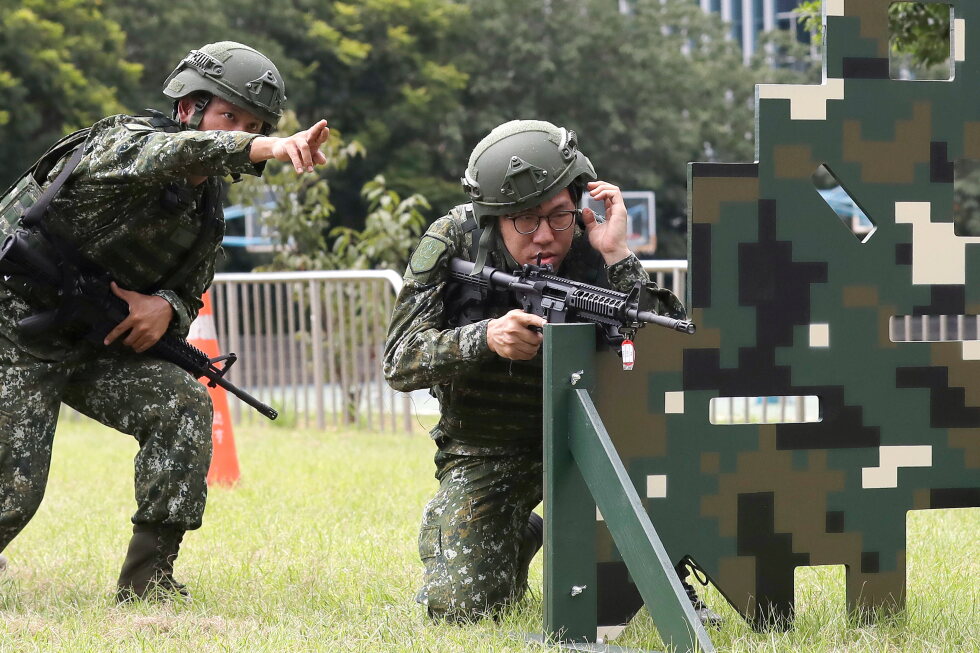
Against a backdrop of sustained military pressure from Beijing, Taiwan’s annual large-scale military exercise, the Han Kuang drills, has adopted a dramatically different framework this year, prioritizing operational adaptability and societal resilience over the traditional display of cutting-edge military hardware. Defense analysts say the restructured exercises offer clear evidence of deepening operational collaboration between Taipei and Washington, as both sides adapt to growing cross-strait instability.
The 2025 iteration of the Han Kuang drills launched Wednesday, with training activities spread across multiple locations across the island and scheduled to run through August 14. The live-fire segments of the exercise are designed to test Taiwan’s armed forces’ capacity to maintain continuous 24-hour defensive operations and counter Beijing’s so-called “gray-zone tactics” — incremental coercive actions that fall below the threshold of full-scale open conflict.
The cross-strait context for the drills remains longstanding but highly volatile: China claims the self-governing democratic island of Taiwan as part of its sovereign territory, and has repeatedly refused to rule out the use of military force to achieve unification. Taiwan, for its part, rejects Beijing’s territorial claims and maintains that it is a fully sovereign independent state. While the United States does not formally recognize Taiwan as an independent country, it views any coercive action against the island as a critical threat to regional stability, and is legally bound by domestic legislation to provide Taiwan with the defensive capabilities to protect itself.
Speculation about quiet U.S. military training assistance to Taiwan has circulated for decades, but operational cooperation between the two forces has become far more visible in recent months. A core innovation of this year’s Han Kuang drills is the integration of a U.S.-developed military communication practice known as backbriefing, in which frontline subordinates walk commanders through their planned execution of assigned missions.
Analysts note that this revised communication framework is explicitly designed to empower lower-level frontline troops to operate more independently and effectively in combat, particularly if chain-of-command structures are disrupted during an attack. William Yang, senior Northeast Asia analyst at the International Crisis Group, explained that the adoption of American-style training methodologies is the most significant new development in this year’s exercise. Unlike previous iterations of Han Kuang, which focused heavily on performative displays of firepower, Yang said the 2025 drills center explicitly on building practical, real-world combat capabilities.
A second major priority of this year’s exercise is the mass mobilization of reserve forces, with local media reporting that roughly 20,000 reservists will take part — one of the largest reserve mobilizations in the drill’s modern history. Taiwan’s Defense Ministry has not officially confirmed the total number of reservists participating, but analysts say the increased focus on reserve forces directly addresses the stark military asymmetry between Taiwan and China. Beijing maintains the world’s largest standing active-duty military, with more than 2 million active personnel — nearly nine times the size of Taiwan’s entire active-duty force.
The drills also place a renewed emphasis on urban resilience and civil defense, a longstanding priority for Taiwanese defense planners. Civil defense drills will be held in three major population centers: the capital Taipei, the central city of Taichung, and the southern port city of Kaohsiung. As part of these exercises, mobile internet speeds will be throttled for approximately 30 minutes to simulate the telecommunications interference and network disruption that would accompany a large-scale attack on the island.
Lev Nachman, a political science professor at National Taiwan University, explained that the focus on combat readiness and civilian preparedness aligns with President Lai Ching-te’s policy priorities, even as he faces significant domestic political constraints. Lai originally proposed a $40 billion special defense budget earmarked for U.S. arms purchases and expanded domestic defense manufacturing, but the opposition-controlled legislature only approved a scaled-back $24.8 billion version of the budget.
“Given that Lai has been constrained on his ability to pass a budget that could even supply the kinds of weapons he would want to test, he has had to look to what he is able to do given the domestic political gridlock,” Nachman noted.
Despite the growing military cooperation, significant uncertainty remains around U.S. security commitments to Taiwan. A $14 billion arms sales package negotiated during the Trump administration still awaits formal presidential approval, and Trump’s recent comments have sparked anxiety on the island. After a May visit to China, Trump described potential arms sales to Taiwan as a “very good negotiating chip” to use with Beijing, and added that he does not want to “travel 9,500 miles (15,300 kilometers) to fight a war” over Taiwan.
Against that uncertain backdrop, Nachman said the visible U.S. influence on this year’s Han Kuang drills offers a small sign of continued commitment from Washington. “Even though Trump and those close to him have flip-flopped on supporting Taiwan, the connection between the two militaries remains strong, enough to at least ensure that Taiwan is still able to learn at a high level from the U.S.,” Nachman said.