In the hushed, damaged warehouses of Odesa’s main Black Sea port, Svitlana Halchenko still carries the physical and emotional scars of the day Russia brought war directly to her workplace. A Russian ballistic missile strike took two of her colleagues, one just five meters from where she stood. Shrapnel remains embedded in her leg and back, leaving her with a permanent limp, but she refuses to abandon her post as a warehouse shift manager. Her quiet courage stands in stark contrast to the once-bustling port that now sits largely idle, a casualty of Moscow’s escalating campaign to choke off all Ukrainian commercial access to the Black Sea.
Halchenko’s trembling composure — twisting a crumpled tissue as tears well behind her glasses, even as she forces a brave smile — mirrors the broader trauma facing Ukraine’s entire Black Sea coastline. Over the past weeks, attacks have grown more frequent and deadly than at any point since the full-scale invasion began. Ukraine’s port administration recorded 57 separate Russian strikes on civilian vessels in July alone, 22 of them at sea, alongside 67 hits to critical port infrastructure. The intensity of these attacks marks a stark escalation: never before have Russian strikes targeted international commercial shipping at this scale.
One of the deadliest incidents came on July 19, when three Russian missiles struck the Turkish-owned cargo vessel *Golden Leo*, which was carrying Ukrainian corn. The attack killed nine Indian and Syrian crew members and one Ukrainian pilot; the ship sank off the Odesa coast a week later. Data from global shipping industry journal Lloyd’s List now confirms what dock workers and sailors have experienced firsthand: the Black Sea has become the most dangerous waterway for commercial shipping on the planet, with July 2026 ranking as the deadliest month for merchant seafarers since Russia’s full-scale invasion began.
For the workers who keep these ports running, the daily risk exceeds even the danger faced by frontline military troops. Oleg Grygoriuk, Chairman of the Marine Transport Workers Union of Ukraine, says many long-time veteran workers openly admit working in the Odesa port is more terrifying than serving in combat. Odesa’s proximity to Russian-occupied Crimea leaves dock workers with almost no time to escape incoming attacks: a missile fired from occupied Crimea reaches the port in just one minute, but it takes a crane operator three and a half minutes to climb down from their cab and reach a shelter. For many, there is simply no time to flee.
A rare on-the-ground visit to one of the region’s major ports — granted by military authorities on condition of anonymity to avoid aiding further Russian targeting — paints a clear picture of the collapse of activity. Hundreds of meters of commercial berths sit completely empty. Towering gantry cranes that once loaded and unloaded ships around the clock stand motionless, with only a tiny skeleton crew on site to conduct basic maintenance. Two damaged cargo vessels are moored nearby, their superstructures, bridges and crew quarters heavily battered by explosions. Only one lone freighter was spotted moving toward the port during the visit, a far cry from the pre-war days when ships would queue for miles off the coast waiting for a berth.
A senior unnamed port manager summed up the sudden collapse of normal operations: “My heart is broken. Normally there’s a queue, even out at sea, waiting for a berth.” He traces the current crisis back to the end of the UN-brokered Black Sea Grain Initiative, the 2022 agreement that established safe corridors for Ukrainian agricultural exports after Russia’s initial blockade. While Russia withdrew from the deal in mid-2023, the systematic large-scale attacks on port infrastructure and shipping only began in recent weeks. Today, the strikes are continuous and coordinated.
Midway through the port tour, air raid sirens cut through the quiet, forcing the entire group to take shelter for several minutes as a Russian jet-powered Shahed drone passed overhead. Weary dock workers waited silently, checking their phones for all-clear updates, a routine they now repeat multiple times a day. The manager says frequent alerts have forced the port to shut down operations for 15 out of every 24 hours. Technically, all Odesa-region ports remain officially open to commercial traffic, with no official ban on vessels attempting to dock. But the risk of attack is so extreme that nearly all shipowners have refused to send vessels into the dangerous corridor.
Andrey Stavnitser, co-owner and CEO of one of the region’s largest port operations, explains the market reality: “There is barely anybody who wants to call because there is a huge problem with people getting killed. We can see that the whole supply chain is on hold.” Stavnitser notes the current escalation is almost certainly Russian retaliation for Ukraine’s recent successful targeting of Russian shipping, including sanctioned oil vessels and ships ferrying military supplies to occupied Crimea. Ukraine’s Operation MoLoChKa, which translates roughly to “Moscow will fall through Crimea,” has used drones to strike roughly 200 Russian vessels, bringing almost all commercial traffic in the strategic Sea of Azov to a standstill. Ukrainian officials reject any equivalence between the two campaigns, pointing out that Kyiv is targeting military and logistical assets to weaken Russia’s occupation, while Moscow is deliberately targeting civilian grain exports to disrupt global food supplies.
The timing of Russia’s port blockade could not be worse, as Ukraine is in the middle of its critical summer grain harvest. Volodymyr Slavinskyi, trading director for leading Ukrainian grain exporter Nibulon, explains the urgency for producers: “It’s the most sensitive period. Farmers need to quickly harvest grains from the fields, not to lose the crop. They need to be able to sell the crop they harvested and reinvest money in the next production cycle.” A prolonged shutdown of Black Sea exports carries severe consequences for both Ukraine and global food markets. Before the full-scale invasion, Ukraine was one of the world’s top grain exporters, accounting for roughly 6% of global wheat exports and 10% of global corn exports. Its total export capacity has already dropped by at least a third since 2022, and the Greater Odesa ports still handle more than 73 million tonnes of maritime exports annually, 38 million tonnes of which are grain. With almost no vessels moving through the corridor, exporters are already losing hundreds of thousands of tonnes of product. Slavinskyi estimates that Ukraine has already lost the ability to deliver between 500,000 and 700,000 metric tons of grain and oilseeds to global customers.
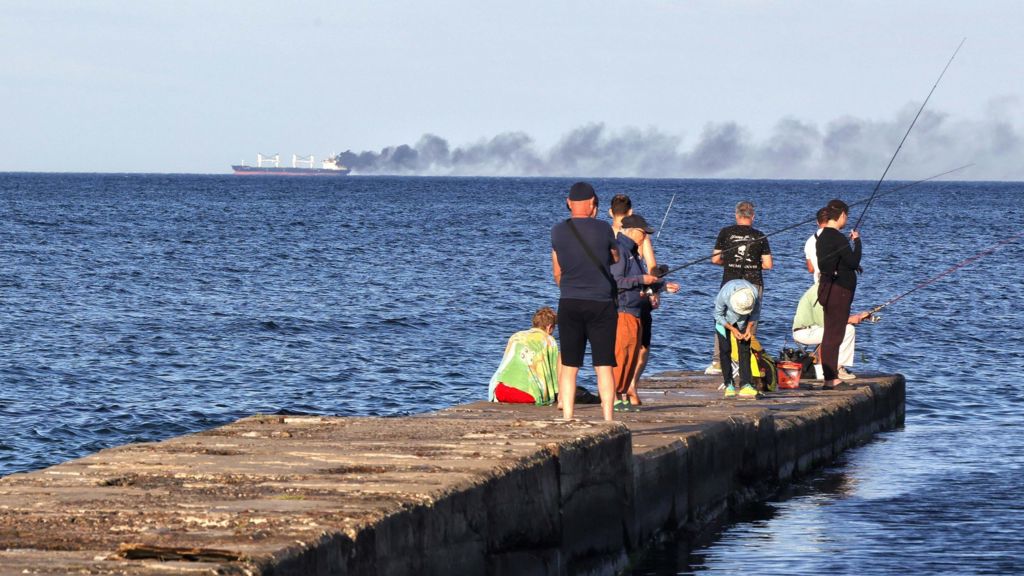
Away from the silent docks, life in Odesa continues against all odds, a testament to the city’s resilience. The summer tourist season is in full swing, and beaches draw visitors from across Ukraine, who sunbathe and walk the promenade even as sirens wail and distant explosions rumble. Buskers perform on the iconic Potemkin Stairs, and locals have adapted to the constant threat: in one viral recent video, swimmers calmly pulled an intact Russian drone out of the water while onlookers watched. But the risks are ever-present: in late June, 26-year-old Daria Kravchenko was killed when shrapnel from an intercepted Russian drone landed on a crowded Odesa beach. Just this week, a similar incident killed seven people, including three children, on the Russian-held Black Sea coast when an intercepted Ukrainian drone crashed onto a busy beach.
The expanding conflict at sea and along the coast has left a trail of accidental casualties far beyond port facilities and commercial vessels. Just outside Odesan, 83-year-old Andrii Dudik surveyed the mangled wreckage of his home and garden just hours after a stray drone from a port attack shattered his routine afternoon nap. He walked away without physical injury, and even joked about the disruption: “I was lying there, wondering what I was going to do this afternoon. Now I know.” When asked if he considered himself an accidental victim of Russia’s port campaign, he did not hesitate. “Absolutely. And I won’t forget it.”