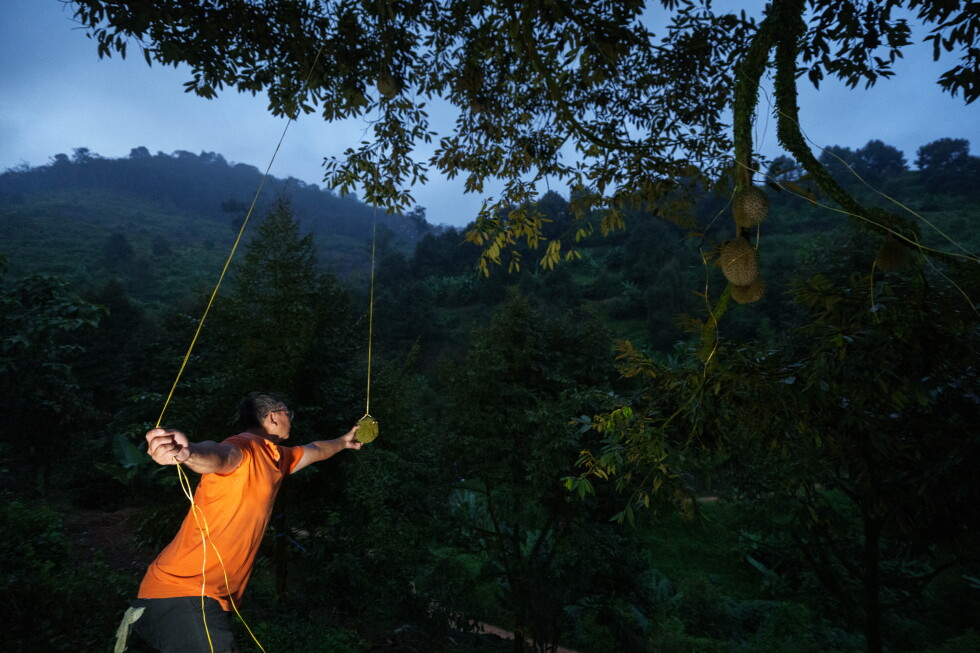
Deep after midnight in the rolling hills outside Karak, a small Malaysian town an hour’s drive from Kuala Lumpur, farm workers don glowing headlamps as they trudge through durian orchards, hunting for the fully ripened, spiky fruits that have become a cultural obsession for millions of Chinese consumers. For orchard owner Stephen Chow, this grueling overnight labor is just the start of a growing battle to stay in business — one shaped by rising costs, extreme weather, and cutthroat global competition that has put many small Malaysian growers on the brink of loss.
Malaysia’s premium durian varieties, including the famously creamy, bold-flavored Musang King and sought-after Black Thorn, are prized by durian connoisseurs around the world, especially in China, where demand for the pungent, creamy fruit has exploded over the past decade. But that growing global warming, driven by the burning of fossil fuels, has pushed production costs sharply higher, while more frequent extreme weather has ravaged yields and eroded fruit quality. Combined with fierce competition from Thailand and Vietnam, which dominate China’s booming durian import market, the pressures are pushing many small Malaysian operators struggling to turn a profit.
Chow’s own orchard has borne the brunt of climate disruption in recent years. In 2021, catastrophic flooding triggered by unprecedented heavy rainfall destroyed roughly 100 mature durian trees and wrecked critical farm machinery. In the three years that followed, consistent unseasonable rain during the critical flowering season prevented successful pollination, slashing his total annual output. This year brought new challenges: while favorable flowering conditions, afternoon temperatures between 33 and 35 degrees Celsius paired with overnight rain, encouraged producers like Chow to ramp up care — increasing watering, upgrading fertilization, and pruning to prevent stunted or deformed fruit. But soaring fuel and fertilizer costs, exacerbated by geopolitical conflict in Iran, have pushed the price of these adaptations far higher than projected.
Adding insult to injury, a nationwide oversupply of Malaysian durians, driven by new orchards reaching maturity and unexpected growing conditions, has sent market prices plummeting. In early July, top-grade Musang King from Chow’s orchard sold for just $8.6 per kilogram, half the price recorded in the same period one year earlier, and only one-third of the peak price reached in 2024. “Breaking even would already be very good. Most likely there’ll be a loss this year,” Chow told reporters.
The current crisis comes amid an unprecedented industry expansion driven by Chinese demand. Official Malaysian data shows the country’s total durian cultivation area reached 92,100 hectares in 2024 — a nearly 40% increase from 2016, and an area larger than the entire landmass of Singapore, the city-state just off Malaysia’s southern coast. Over the same period, total national durian production grew nearly 90% to 568,800 tonnes.
This boom was triggered by policy shifts: China first allowed imports of whole frozen Malaysian durians in 2019, and expanded access to fresh Malaysian fruit in 2024, part of a broader “durian diplomacy” push that has opened China’s massive market to multiple Southeast Asian producers. UN Food and Agriculture Organization data shows China absorbed roughly 95% of global durian exports between 2020 and 2022. 2025 Chinese customs data puts total fresh durian imports at 1.87 million tonnes, worth $7.5 billion — a six-fold increase in volume over the past decade. For Chinese consumers, durian has become a staple treat: 30-something Shanghai resident Song Xiaohua says she would eat the fruit once a week, instead of once a month, if not for its high calorie count, comparing the experience of eating durian to celebrating Lunar New Year.
While Thailand and Vietnam hold the largest share of China’s durian import market, Malaysian producers have staked their reputation on superior quality, choosing to harvest only naturally fully ripened fruit rather than picking early to extend shelf life. But that commitment to quality is becoming harder to maintain as the climate warms.
Malaysia’s Meteorological Department records show Peninsular Malaysia has seen an average temperature increase of 0.24 degrees Celsius per decade between 1969 and 2025, a rate that aligns with global warming trends. Extreme heat, floods, and irregular rain patterns are now the norm, not the exception, forcing growers to adapt or go out of business.
Veteran grower Ooi Teik Hock, who owns an orchard in Perak state near the Thai border, recalls that 20 years ago, when temperatures were cooler, quality issues were far rarer. A decade ago, concerned about rising heat, he relocated his entire operation from lowland plains to cooler highlands, where overnight temperatures remain lower and humidity is higher. Even there, however, climate change has brought new threats: once-rare pests have become widespread, forcing Ooi to increase pesticide use, while pesticide prices have jumped 30% in just three years. This year, for the first time in decades, Ooi saw no fruit bats — the primary natural pollinator for durian — on his orchard during flowering season, a shift he attributes to extreme heat and expanded pesticide use.
Lim Chin Khee, an industry adviser to the Durian Academy, a Malaysian organization that trains durian growers, explains that weather shifts have an outsize impact on fruit quality, especially for the temperature-sensitive Musang King variety. Too much rain during the critical rapid growth stage causes discolored white and gray patches on the fruit’s signature golden flesh, while drought during the same period leads to unappealing black spots, rendering premium grades unsellable.
In response to growing climate instability, some growers have turned to modern technology to protect yields and quality, while industry experts are helping producers prepare for more extreme weather ahead. With climate forecasts predicting El Nino-driven record high temperatures between March and May each year, Lim advises farmers to expand water storage capacity and install backup tube wells to protect against pond drying during heat waves. He notes that while extreme weather will cut overall national supply, that shortage will push up market prices, creating opportunity for growers who prepare effectively. “So for those farmers who are well prepared, actually when any disaster strikes, that is an opportunity,” Lim said.
Third-generation grower Kie Kim Hwa, who manages a family orchard on Penang Island off Malaysia’s west coast, has adapted traditional farming methods with modern monitoring. He installed a network of sensors throughout his orchard, placed in tree lines, grassy areas, and deep below the soil, to track real-time data on rainfall, humidity, wind speed, and soil conditions, all synced to a cloud server that he can access from anywhere. He also combines high-tech monitoring with low-tech checks, such as examining water bucket surfaces to track pest populations. The data lets him address growing problems early, helping him maintain consistent quality and adjust output to match market demand. “We live and die by the weather,” Kie said. “But we can still prepare.”
This reporting on climate and agriculture from the Associated Press received funding from multiple private foundations, with AP retaining full editorial control over all content.