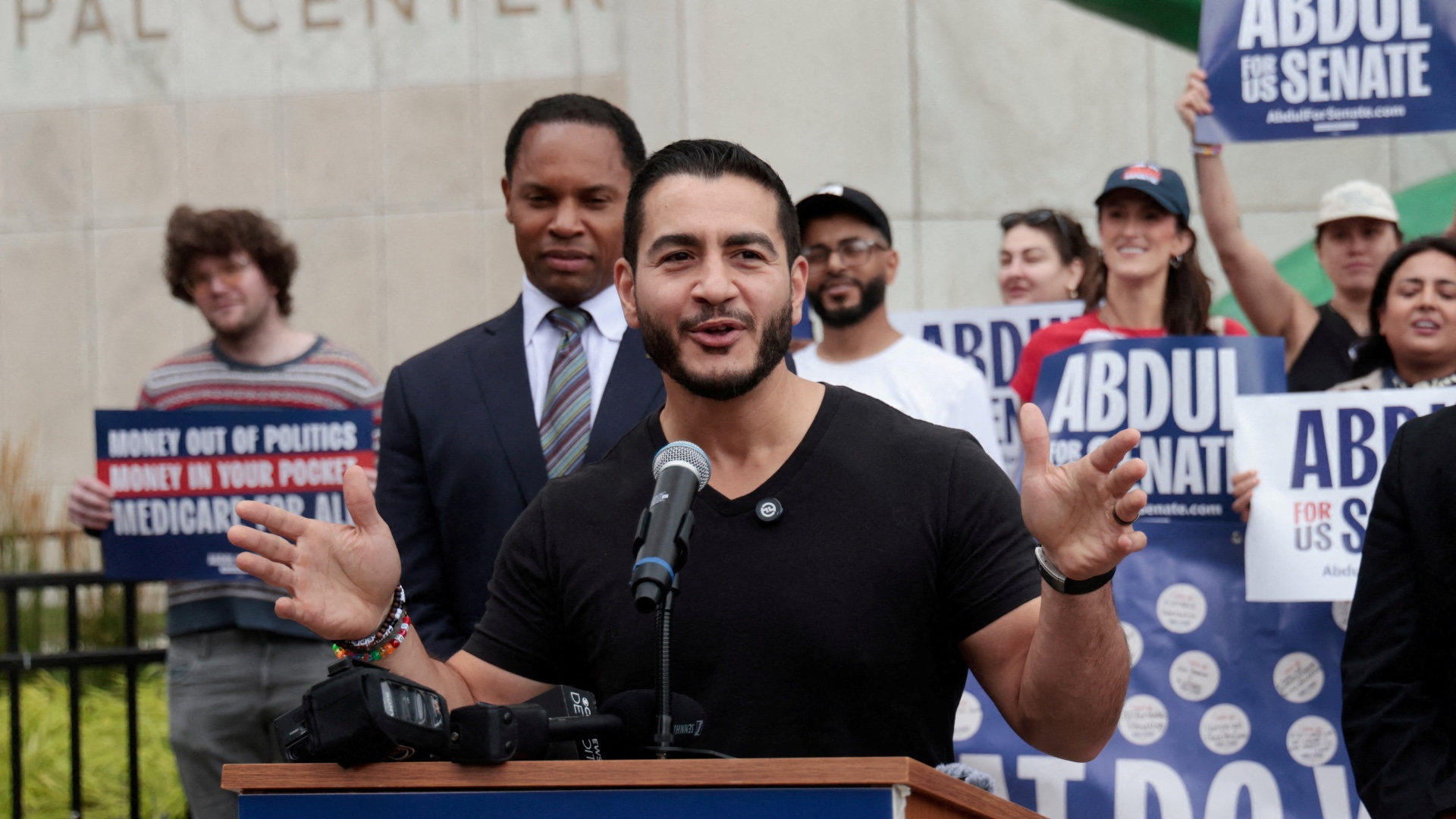
A political earthquake shook Michigan’s Democratic Senate primary on Wednesday, as progressive challenger Abdul El-Sayed pulled off a stunning one-point victory over pro-Israel incumbent Congresswoman Haley Stevens — in a race that became the most expensive Democratic primary contest in U.S. history, fueled by more than $60 million in total outside spending, $30 million of which came from leading pro-Israel lobbying group the American Israel Public Affairs Committee (AIPAC).
The upset marks a major defeat for AIPAC, which has built a reputation for ousting candidates it views as critical of Israel across both major U.S. parties. In 2022, the group spent heavily to unseat veteran Democratic lawmaker Andy Levin in Michigan over his support for sanctions on violent Israeli settlers in the occupied West Bank; on Wednesday, Levin celebrated El-Sayed’s win, writing on Instagram, “Out with all the big money, dark money and corporate and special interest control of our politics. We the people hunger for authenticity.” Earlier this year, AIPac poured more than $4 million into defeating Republican Thomas Massie in Kentucky’s primary, after Massie voted against U.S. foreign aid to Israel, as part of a $9 million coalition effort against the incumbent.
Now, following its $30 million investment in Stevens that ended in defeat, AIPAC has confirmed it will shift its support to the Republican candidate in the November general election. The group’s statement underscored its longstanding approach to U.S. politics: prioritizing its pro-Israel policy agenda over partisan ideological loyalty. “Our members remain determined to ensure that voters reject Dr El-Sayed and his radical anti-Israel agenda,” the statement read. “Our community is proud to support pro-Israel Democrats and Republicans who stand for our values.”
El-Sayed, an Egyptian-American Muslim and former Detroit public health official who has never held elected office, ran a grassroots campaign defined by small-dollar donations and opposition to corporate and special interest influence in politics. According to campaign finance data from OpenSecrets, El-Sayed out-raised Stevens in small-dollar contributions in the final quarter before the primary. His campaign calculated that outside groups spent an average of $95 per vote against El-Sayed, more than 10 times the $9 per vote average of his own campaign spending.
Critics of unlimited outside spending note that this lopsided spending is the result of U.S. campaign finance law, which allows unlimited independent expenditures by groups that do not coordinate directly with candidate campaigns. “In 95 percent of U.S. electoral races, whoever spends the most, wins,” explained Craig Holman, government affairs lobbyist for non-profit consumer advocacy group Public Citizen. “Yes, money buys elections. It’s very effective, and that’s why these candidates work overtime continually raising money.”
El-Sayed’s campaign gained momentum not just from his stance on Israel, but from his focus on kitchen-table issues impacting Michigan voters. He has publicly described Israel’s nearly three-year military campaign in Gaza as genocide, a framing that aligns with statements from leading human rights organizations, genocide scholars, and the United Nations, but rejected by Israel and most sitting U.S. lawmakers. This position resonated deeply with Michigan’s large Arab-American community, which played a pivotal role in driving protest votes against former President Joe Biden in the 2024 presidential election over his unwavering support for Israel amid mounting Palestinian civilian casualties that have killed tens of thousands of people. In that election, even as Wayne County backed Kamala Harris by 62 percent, heavily Arab-American suburbs of Detroit swung overwhelmingly to Donald Trump, helping Trump carry Michigan by just over one percentage point.
Sally Howell, an Arab American Studies expert at the University of Michigan-Dearborn, noted that El-Sayed’s support rose when he shifted his messaging from critiquing AIPAC’s spending to a broader platform of getting big money out of politics and addressing local concerns. “He started talking about not getting money from DTE, the energy company here in Michigan… and this issue of the AI data centres, and how they would drive up our water bills,” Howell said. “These are issues that really matter to Michiganders across the political spectrum.”
State Representative Alabas Farhat, who endorsed El-Sayed, said the candidate’s appeal stemmed from voter frustration with the status quo. “People in Michigan, they’re looking for leaders that are going to call out bold solutions and that are going to try and speak out against the status quo because the status quo hasn’t been working,” Farhat said. “The status quo has led to our state being 49th in unemployment. It’s led to us being 47th in third grade literacy. It’s led to our middle class having less wealth than they did in previous years. Trump came along, and he sold a false bag of goods, but he was at least willing to say things were wrong. Now comes Abdul El-Sayed, somebody who has made truth and justice two central pillars to his campaign.”
Support for El-Sayed also came from groups advocating for Palestinian rights: the IMEU Policy Project, a three-year-old advocacy organization, contributed $400,000 to his campaign. Turnout for the primary hit historic highs, with half a million more Democratic voters turning out than in previous low-turnout primaries, according to Michigan Democratic Party Chair Curtis Hertel.
In his victory speech, El-Sayed announced he had spoken with Stevens and secured her commitment to endorse him in the general election, where he will face former Republican Congressman Mike Rogers. Hertel emphasized that the party is now united to defeat Trump-backed candidates in November, a race that will decide control of the U.S. Senate. If El-Sayed wins in November, he will become the first Muslim ever elected to the U.S. Senate, and could tip the chamber’s majority to Democrats for the final two years of Trump’s second term.
Former President Trump reacted to El-Sayed’s primary win on his social platform Truth Social, calling the challenger “a Communist loser who hates Jews and Israel,” while also framing the result as “great news for the Republican party,” claiming El-Sayed will be an easy general election opponent. Howell predicts the general election will bring a sharp, divisive campaign focused on identity rather than policy. “I think that it’s going to go a lot darker than the negative campaigning we’ve seen, and it’s going to be very anti-Arab and a lot more Islamophobic,” she said.
For his part, El-Sayed pushed back against expected identity-based attacks in a post-win address to supporters. “It’s like, wow, he’s different,” he said, describing the likely Republican line of attack. “That’s the best you got? You can’t actually talk about what you want to do? My name is not raising your gas prices. My name is not taking us to war. My name is not the reason you can’t afford your groceries.”
El-Sayed’s win follows a growing pattern of upsets for establishment-backed candidates by progressive Democrats across the country, from New York to New Jersey, Pennsylvania and Colorado, signaling a growing grassroots movement challenging special interest influence in U.S. elections.