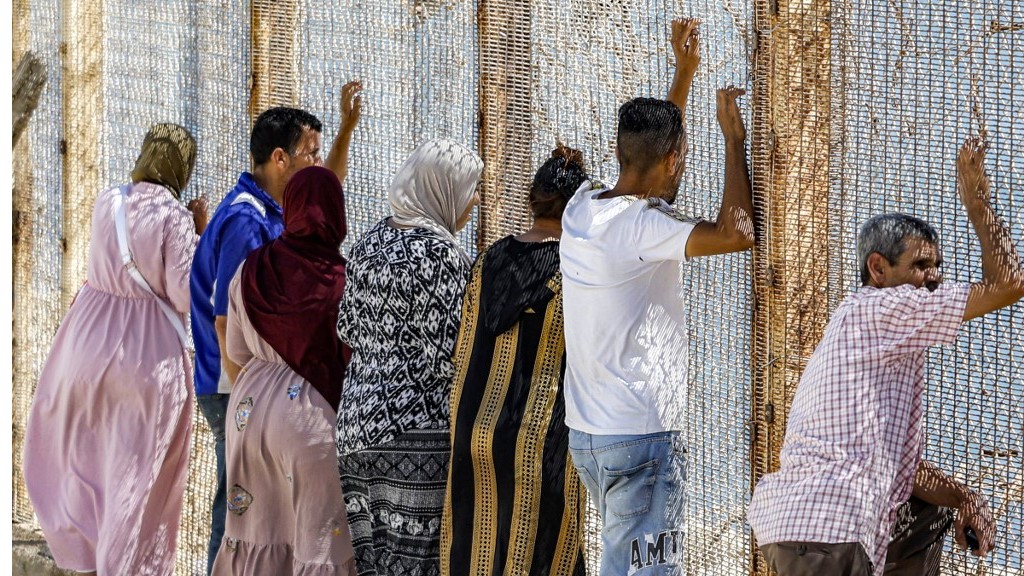
A catastrophic mass migration event following the opening of a border gate between Morocco and Spain’s North African enclave of Ceuta has become the deadliest migration disaster in Morocco’s modern history, with an estimated death toll reaching at least 141 people.
The crisis unfolded last Thursday, when Moroccan officials opened the Tarajal crossing gate, allowing more than 72,000 migrants to cross into Ceuta between July 30 and 31, according to Spanish Interior Minister Fernando Grande-Marlaska. In the chaotic aftermath of the mass crossing, dozens of migrants died while attempting treacherous sea voyages, their bodies washing up on both Moroccan and Spanish shorelines.
As of Tuesday, migrant rights group Caminando Fronteras reported that 63 bodies had been admitted to hospitals across northern Morocco, a figure that has not yet been officially verified by the Rabat government. Separately, Spanish officials confirmed to local broadcaster Cadena SER that another 78 bodies had been recovered from waters controlled by Spain. Combined, these figures push the total death count to 141, far surpassing any prior migration-related fatalities recorded along the Morocco-Spain border. For comparison, the 2022 Melilla border crush killed 23 people per official counts, while rights groups put the toll at 37, and 15 migrants died at Ceuta’s Tarajal Beach in a 2014 incident.
The recovered remains are currently held by medical facilities in four northern Moroccan cities: Tetouan, Tangier, Fnideq and M’diq. Most of the victims are identified as young Moroccan men between 20 and 30 years old, but Sub-Saharan African migrants, women and children are also counted among the deceased. One high-profile victim is Faten Ben Omar El Azizi, a female footballer who played for Moghreb Atletico Tetuan. Ahead of her daughter’s burial, her mother publicly demanded accountability in a video circulated by local outlet Al Ayoum 24, saying: “The youth are lost… Who opened the door the first time? Why did they open it so that our children could be killed?”
Spanish authorities have activated the rare “multiple victims” emergency protocol, a framework reserved exclusively for large-scale mass casualty events such as major train collisions and plane crashes. In the weeks following the crossing, Spanish officials have repatriated roughly 70,000 of the migrants who entered Ceuta back to Morocco, leaving approximately 1,000 unaccompanied minor migrants stranded in the enclave with no clear path forward.
Public anger has surged across Morocco in response to the government’s decision to open the border and the widespread lack of official accountability for the hundreds of lives lost and disrupted. On the international front, the European Union has publicly commended Spain for what it calls the country’s “swift response” to the crisis. Irish Justice Minister Jim O’Callaghan confirmed the bloc’s full support for Spain, noting that irregular migration across the Mediterranean requires a coordinated, unified European policy response to prevent future tragedies.