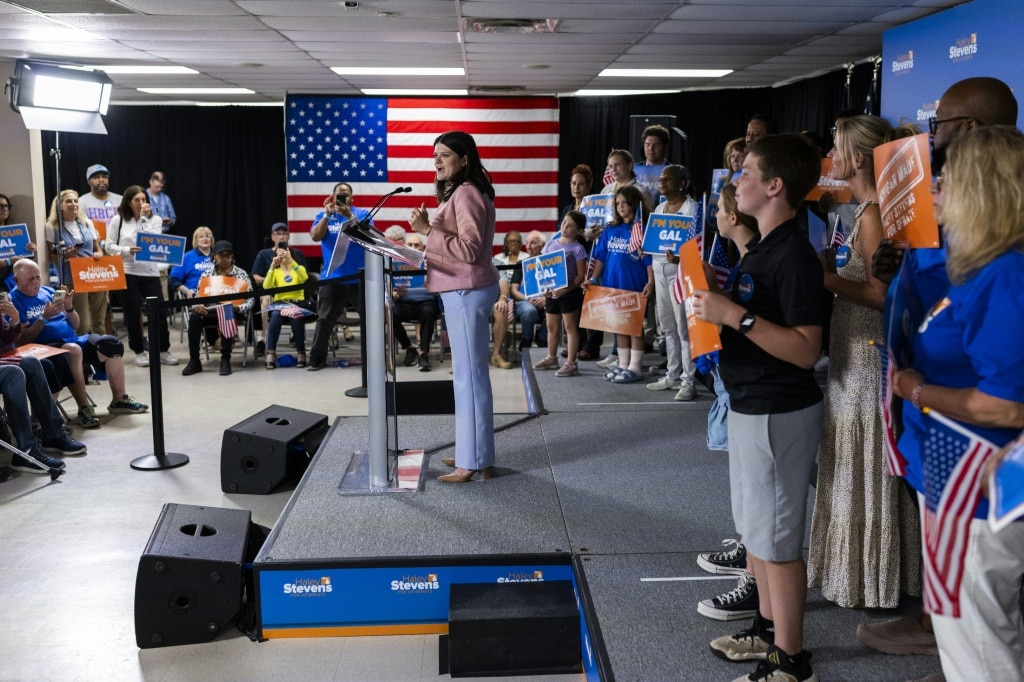
On Tuesday, voters across Michigan headed to the polls for one of the most closely watched Democratic Senate primaries in recent memory, a contest that has escalated into a proxy battle shaping the ideological future of the national Democratic Party, its stance on the Israel-Gaza conflict, and its fight to win control of the U.S. Senate. The seat up for grabs was left open by retiring Democratic Senator Gary Peters, and the winner will go head-to-head with former Republican Congressman Mike Rogers in the general election this November. For Democrats, the path to Senate majority hinges on this race: the party must hold onto the competitive Michigan seat while flipping four currently Republican-held districts to claim control of the upper chamber, turning a local primary into a high-stakes national contest. Michigan has emerged as a key swing state in recent presidential and congressional elections, making the outcome of this primary far more than a purely ideological exercise.
Political analysts broadly agree that the results will answer a critical question facing national Democrats: can the rising leftist wave currently reshaping the party break out of deep-blue safe seats and win competitive battleground states, or will the long-standing Democratic establishment retain its grip on power in critical swing regions? The race features two starkly different candidates, each backed by competing wings of the party.
Abdul El-Sayed, the former director of the Wayne County Health Department, has earned endorsements from high-profile progressive leaders including Senator Bernie Sanders and Representative Alexandria Ocasio-Cortez. He has positioned his campaign as a movement for working-class Michiganders, framing himself as an outsider prepared to challenge corporate power, establishment party leadership, and the increasingly unpopular pro-Israel donors that shape national Democratic politics. His opponent, Haley Stevens, a four-term incumbent congresswoman representing Detroit’s suburban districts, has centered her campaign around proven governing experience, support for Michigan’s critical manufacturing sector, and broad electability in a general election. She boasts backing from top establishment figures, ranging from Senate Democratic Leader Chuck Schumer to popular Michigan Governor Gretchen Whitmer.
Recent public polling has shown El-Sayed holding a narrow lead, a shift that has raised the possibility of a landmark progressive victory in a 2024 primary season already defined by a string of anti-establishment wins. El-Sayed’s allies argue that the grassroots volunteer energy fueling his campaign proves progressives can build a winning statewide coalition without relying on Washington’s traditional, big-money donor networks. For her part, Stevens argues that her core base of support – including Black voters, older Democratic voters, and voters without college degrees – is significantly underrepresented in public opinion polling. After casting her own ballot in Birmingham, a small city northwest of Detroit, Stevens told reporters that her campaign’s outreach remained strong. “We’re still getting a ton of votes. We’re firing people up,” she said. “My phone’s been ringing off the hook with people who are excited to go to the polls, to see a campaign like mine go forward for November.”
The deepest and most bitter rift between the two candidates centers on U.S. policy toward Israel. Stevens has defended longstanding U.S. military support for Israel and has rejected claims that Israel has committed genocide against Palestinian civilians in Gaza. El-Sayed, by contrast, has called for an end to unconditional U.S. military aid to Israel, openly criticized the lobbying power of the American Israel Public Affairs Committee (AIPAC), and stated that Israel should not exist exclusively as a Jewish state. With a large Arab American population that has expressed widespread anger over Israel’s military campaign in Gaza, and AIPAC spending more than $90 million on advertising and outside spending to influence the race, Michigan has become another national test of how much power the pro-Israel lobby holds over Democratic primary outcomes.
The campaign has devolved into increasingly personal attacks: El-Sayed has labeled Stevens “the least capable candidate in America,” while Stevens has accused El-Sayed of unfairly scapegoating Jewish Americans for political gain. Longtime Michigan Democratic Congresswoman Debbie Dingell, who has remained neutral in the primary, has warned that the “brutality” and “ugliness” of the contest could leave lasting divisions that make it harder for the party to unite ahead of the general election. Both campaigns, however, maintain that their candidate offers the strongest chance of beating Rogers in November. Stevens points to Michigan’s long history of electing pragmatic, centrist Democrats, while El-Sayed argues that grassroots enthusiasm will drive higher turnout among working-class and younger voters, key blocs for Democratic success in the state.
The stakes of a divided party are already clear: Michigan narrowly voted for former President Donald Trump in the 2024 presidential election, even as Democratic candidate Elissa Slotkin won a narrow victory over Mike Rogers in that year’s Senate race, underscoring both the state’s status as a highly competitive toss-up and the real risk that internal division could cost Democrats the seat in November.