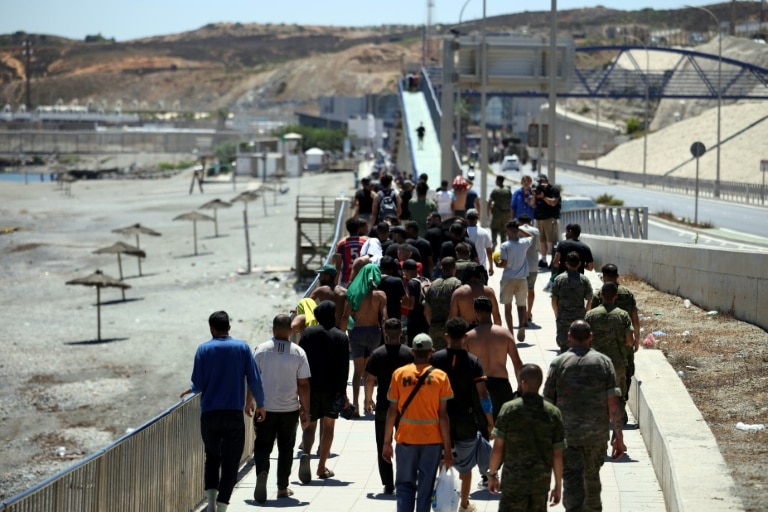
A weeks-long migration dispute that exposed deep internal divisions within the European Union has been de-escalated, after EU interior ministers reached a fragile compromise during tense talks in Brussels this Tuesday. The conflict was triggered last week when more than 72,000 migrants crossed from Morocco into Ceuta, a Spanish sovereign enclave on the North African coast, triggering one of the bloc’s worst border security crises in recent years. Speaking to journalists after three hours of closed-door negotiations, Magnus Brunner, the EU’s top migration official, framed the incident as a major stress test for three core pillars of European integration: the bloc’s external border management, its ability to counter disinformation, and the principle of solidarity between member states.
Brunner claimed that the bloc ultimately emerged from the challenge successfully, stating, “It was a crisis, but now fortunately, it has been resolved.” Spanish authorities have moved rapidly to repatriate the vast majority of the new arrivals, confirming Tuesday that just 2,000 of the 72,000 crossers remain in Ceuta. Officials also updated the death toll for the crossing Tuesday, raising the confirmed number of migrants who died attempting to reach the enclave from 72 to 75.
Images of tens of thousands of migrants flowing across the border became immediate political fodder for right-wing groups across Europe and North America, who framed the crisis as proof that the continent faces an existential threat from uncontrolled immigration. The incident left the Spanish government of Prime Minister Pedro Sanchez isolated within the bloc, with 22 of the 27 EU member states backing a joint statement calling for stricter action on irregular migration that implicitly blamed Spain’s more open migration approach for the crisis. Hardline governments including Italy and Denmark even called for Spain to be suspended from the Schengen Area, the bloc’s border-free travel zone – a proposal that Madrid rejected firmly, noting that such a suspension is not permitted under existing EU law. Sanchez lashed out at other member states over the weekend in a letter to EU institutional leaders, calling their response to the crisis selfish.
Many had expected Tuesday’s meeting to devolve into an acrimonious public showdown, but leaders across the bloc instead moved to downplay divisions and emphasize unity. Spanish Interior Minister Fernando Grande-Marlaska described the tone of the talks as “absolutely constructive”, while French interior official Laurent Nunez echoed that “all member states, without exception, affirmed their solidarity with Spain”. France had previously refused to join the 22-nation statement, arguing it exploited the crisis for domestic political gain.
Hardline states struck a more conciliatory tone as well: Denmark’s immigration minister Morten Bodskov said his country was “very satisfied” with Spain’s handling of the emergency, though he reiterated that the event underscored the need for strict control of the EU’s external borders. Italian Prime Minister Giorgia Meloni has been one of the most vocal critics of Sanchez’s policy, particularly its plan to grant legal status to undocumented migrants already residing in Italy. Still, Italian Interior Minister Matteo Piantedosi opened his remarks by expressing “sincere solidarity” with Spain before doubling down on his government’s call for stricter migration rules.
Over the past several months, pressure from hardline governments including Italy has pushed the EU to tighten its migration framework significantly, including new rules that allow member states to transfer failed asylum seekers to off-shore “return hubs” outside the bloc’s borders. Piantedosi used Tuesday’s meeting to push for a broader expansion of this model, calling on all EU states to adopt the framework of Italy’s recent deal with Albania to host off-shore return centers. He also argued that the bloc should use trade leverage to pressure Morocco, which he accused of failing to cooperate on migrant repatriation while benefiting from preferential trade access to the European single market.
The final joint statement issued after the meeting praised Spain for its “swift and effective” response to the crisis, noting that no migrants had moved onward from Ceuta to mainland Spain or other EU member states. However, the statement also implicitly acknowledged missteps in the bloc’s collective response, admitting that cross-member communication during such crises could be made “more coherent”, confirming that the EU’s initial response fell short of this standard.