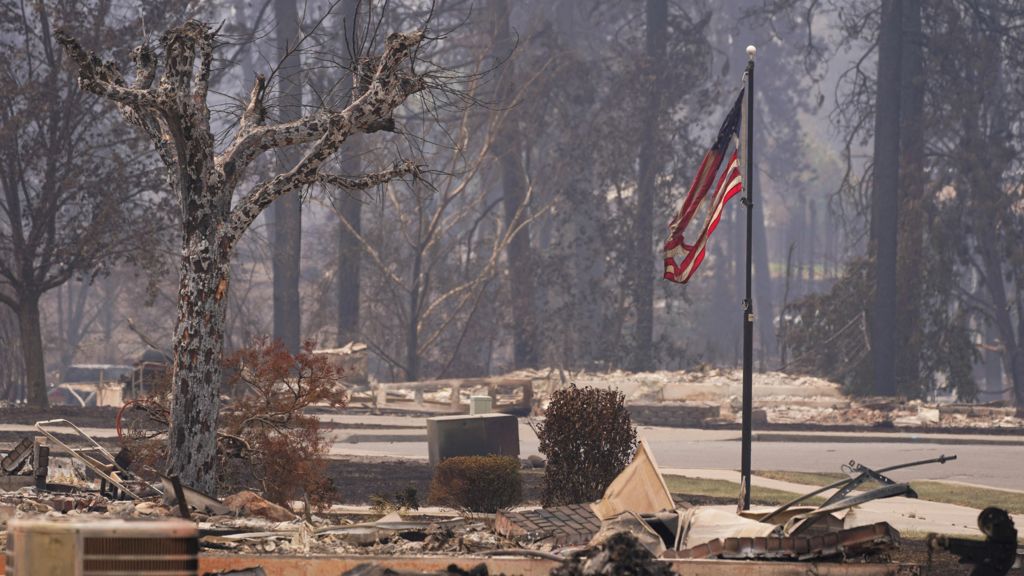
In what Washington Governor Bob Ferguson has called the worst natural disaster in Spokane’s recorded history, a series of fast-moving wildfires burning across Washington state’s second-largest city have displaced more than 60,000 residents, destroyed hundreds of structures, and led to the arrest of a local man on suspicion of arson for the largest blaze.
Three major wildfires — named Old Trails, Fairview and Autumn Lane — ignited around Spokane over the weekend, part of a total 16 active wildfires burning across the northwestern U.S. state, according to the Washington State Department of Natural Resources. As of Tuesday, firefighters continued working to contain the spread, after making incremental progress on two of the three main blazes. While forecast lighter winds and cooler temperatures were expected to bring brief relief on Tuesday, officials warn rising temperatures later in the week will likely reintroduce dangerous fire conditions.
Thirty-seven-year-old Aaron Farinacci, a Spokane resident with a prior manslaughter conviction, has been charged with first-degree arson in connection with the Old Trails fire, the largest of the three blazes. Spokane County Sheriff John Nowels told reporters witnesses saw Farinacci kneeling near dry grass at the fire’s starting point, and responding law enforcement later found him in possession of matches and a lighter. He is currently being held on a $1 million bond.
The damage to Spokane communities has been catastrophic. Before-and-after imagery of the burn zone confirms widespread destruction: hundreds of homes and vehicles have been reduced to ash, with more than 700 buildings confirmed destroyed and another 400 structures still awaiting damage assessment. Thousands of acres of dry, brush-covered land have also been consumed by the flames.
As of Tuesday morning, no deaths or injuries have been officially confirmed, though 14 people remain unaccounted for via mobile phone. Authorities emphasize that the 14 people have not been classified as missing, noting most may have evacuated successfully but lost cellular connectivity or drained their phone batteries during escape. Spokane Mayor Lisa Brown warned that the risk of fatalities remains high, and it is still too early to estimate when evacuated residents will be able to return to their homes.
Local residents who escaped the flames shared harrowing accounts of the destruction. Anna Andreachi, who lost her entire home in the fire, told reporters that all her personal belongings — including mementos of her recently deceased father, still stored at the property — were gone. Another resident, Joe Cvancara, managed to save his home by digging a defensive fire line around the property, but he described feeling intense survivor’s guilt after his neighbor’s home burned to the ground. Cvancara added that he and his family are opening their home to displaced neighbors, noting that the long process of rebuilding will take months, if not years. Photographs from the disaster zone show residents recovering small, intact personal items — including a stone angel statue salvaged from the wreckage of a burned-out home.
In response to the crisis, Governor Ferguson has issued a statewide ban on all open outdoor fires to prevent new ignitions. More than 900 firefighters are already assigned to the state’s active wildfires, with additional reinforcements scheduled to arrive from neighboring states in the coming days. Commissioner of Public Lands Dave Upthegrove emphasized that firefighting resources are already stretched beyond capacity across the state, warning that the tinder-dry landscape leaves the entire region vulnerable to new blazes. “Our firefighters are already stretched thin across the state, and with more heat and wind expected this weekend and for the rest of the summer, any new spark on our tinder dry landscapes can lead to another devastating wildfire. I’m urging all Washingtonians to not be that spark,” Upthegrove said.
The disaster aligns with longstanding warnings from climate scientists, who have documented that human-caused climate change amplifies the warm, dry conditions that create ideal wildfire fuel, while also increasing the frequency and intensity of summer heatwaves and droughts across the Western United States.