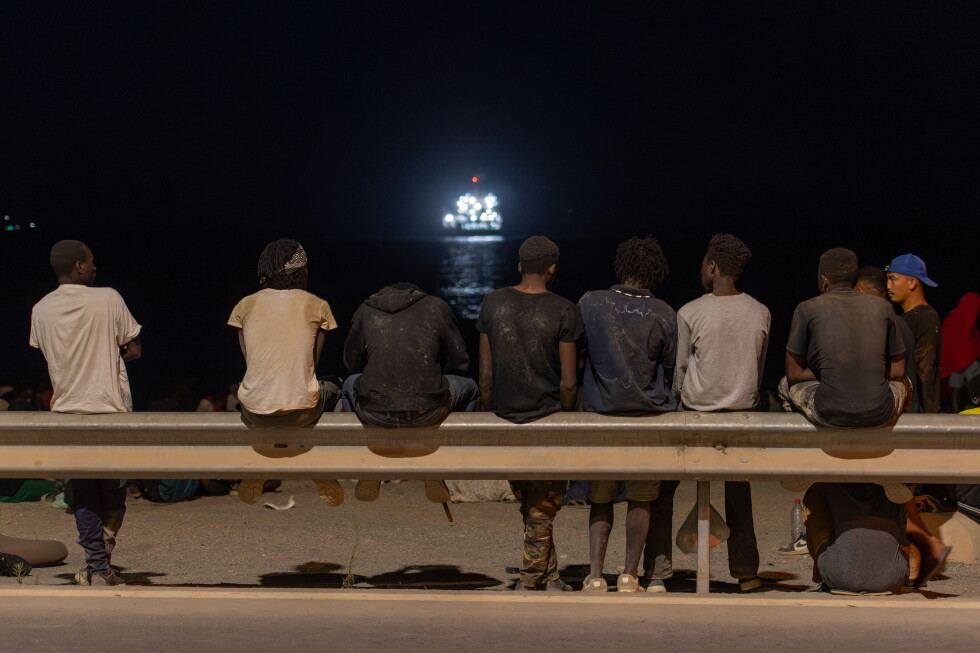
When European Union leaders gathered in Brussels this Tuesday, one topic dominated closed-door discussions and public sparring: the dramatic migrant surge that hit Spain’s North African territory of Ceuta just one week prior, and the deep divisions it has laid bare across the 27-nation bloc over how to handle irregular migration.
Last Thursday and Friday, between 50,000 and 60,000 migrants crossed into Ceuta in an unprecedented rush, triggering an immediate humanitarian emergency on the small border outpost. Spanish and Moroccan authorities confirmed more than 80 migrants died in the crossing, with many drowning or killed in a deadly stampede as crowds pushed to break through a concrete breakwater barrier. By the time the crisis stabilized, the vast majority of arrivals had been pushed back across the border, but the political aftershocks reverberated across the continent almost instantly.
Within days, 22 EU national leaders signed an open letter leveling sharp criticism at Spanish Prime Minister Pedro Sanchez and his government’s progressive approach to migration. The letter pinned the Ceuta crisis on a recent ruling from Spain’s Supreme Court, which held that migrants arriving by sea (rather than crossing physical land barriers or climbing Ceuta’s border fence) cannot be summarily deported without formal due process. The signatories, which included leaders from Finland to Malta, argued the ruling amounted to an attack on the EU’s joint migration and asylum system, and called for new mandatory border checks across all sea, air and land entry points into the bloc.
Sanchez quickly pushed back with his own public letter, accusing his critics of twisting the facts of the court ruling. He explained that people smuggling networks intentionally misrepresented the Supreme Court decision to convince thousands of migrants to swim around Ceuta’s existing border fence, rather than climbing it. He also reminded his detractors of Spain’s longstanding record of solidarity with other EU member states facing migration pressures, noting that Spain accepted relocated migrants that arrived at Belarusian borders with Eastern Europe in 2021 and at Italy’s Lampedusa island in 2023. His government has further framed the criticism as politically motivated, pointing out that most arrivals were expelled within hours in close coordination with Moroccan authorities, while receiving almost no practical support from other European nations.
Italian Prime Minister Giorgia Meloni emerged as the most vocal critic of Sanchez’s response, going so far as to announce new air and sea border controls between Italy and Spain. But political analysts in Rome noted the move was largely symbolic: Matteo Villa, an analyst at the Italian Institute for Political Studies, pointed out that Ceuta’s remote geographic location makes it extremely unlikely that migrants arriving there would go on to reach Italy, and only 2% of all migrants entering Europe ultimately settle in Italy. Observers also noted Meloni has used the Ceuta crisis to push forward Italy’s controversial joint plan with Albania to move all migrant screenings outside EU territory, a proposal that has already drawn widespread legal pushback.
Sanchez hit back at Meloni directly, calling her stance “contrary to European law, humanitarian law, and the principles of solidarity that bind us together.” In a public post on X, he also challenged Italy’s record, noting that since 2021, Italy has received twice as many migrants as Spain: 478,000 compared to Spain’s 234,000.
The public feud between Sanchez and his critics is just the most visible sign of a deeper divide that has reshaped European politics in recent years. Right-wing political coalitions have won elections across much of the bloc by campaigning for harsher restrictions on migration, and they enacted those promises last year through the controversial European Migration and Asylum Pact, which overhauled the bloc’s previous widely discredited migration framework. The new rules grant EU national governments expanded powers to surveil, detain and deport migrants to so-called “safe third countries” such as Morocco, or to offsite “return hubs” located outside EU borders. But the reforms have faced fierce skepticism from human rights organizations, which warn that external detention centers could quickly become overcrowded long-term holding facilities where asylum seekers are trapped in permanent legal limbo.
Michele LeVoy, director of the Brussels-based Platform for International Cooperation on Undocumented Migrants, condemned what she called political posturing over the Ceuta crisis. “On Ceuta, political games are being played over the lives of people on both sides of the border,” she said, criticizing Europe’s longstanding failure to address the root causes of irregular migration. “We need regular pathways for people to move in safety and dignity,” LeVoy added.
For many policy analysts, the disunity on display over migration highlights a broader pattern of European fragility at a time of mounting global pressures. Alicia García-Herrero, chief economist for Asia Pacific and the Middle East at financial firm Natixis, argued that regardless of the outcome of Tuesday’s leaders’ meeting, the public feud demonstrates deep damaging divisions within the bloc just as it faces security threats from Russia, strained transatlantic relations with the U.S. and growing economic tension with China. “Europe has shown weakness again,” she said. “Massive weakness.”
Official data from the EU’s border agency Frontex shows that overall irregular migration flows to the EU have dropped dramatically since their 2015 peak, when 1.8 million people crossed into the bloc, mostly via the Balkans and the Eastern Mediterranean. In the first half of 2026, total crossings fell 37% year-over-year to around 49,000, a trend Frontex Executive Director Hans Leijtens attributed to sustained cooperation with partner countries in North Africa and the Middle East.
Even at the highest levels of EU institutions, there has been little consensus on how to respond to the Ceuta crisis. European Commission President Ursula von der Leyen initially expressed shock at the surge and called for the bloc to double down on its hardline approach to border security. But in a shift last Monday, she sent a private letter to Sanchez praising his government’s handling of the emergency. Commission spokesperson Arianna Podesta said the letter called for a formal lessons-learned process to strengthen the bloc’s overall resilience, preparedness and response to future migration surges. “What happened in Ceuta has made it clear that we must do more to further strengthen external borders, for example with vigilant monitoring and where needed the use of physical barriers,” Podesta said, reflecting the letter’s core message.
This report contains contributions from reporting by Samuel Wilson in Barcelona, Spain, and Elara Barry in Rome, with additional reporting from Renata Brio in Barcelona.