Against a backdrop of rising geopolitical friction with China and depleting U.S. military stockpiles fueled by ongoing conflict in the Middle East, a small U.S. startup is stepping into a gap that has long left American defense supply chains vulnerable to external control. Phoenix Tailings, a small refinery based in Exeter, New Hampshire, is pioneering a new approach to domestic critical mineral production by extracting high-value rare earth elements from legacy mining waste, also known as tailings, a solution that could cut years off the timeline to build a sovereign U.S. supply chain.
For decades, China has held a near-monopoly over the processing and separation of critical minerals—inputs essential to everything from advanced fighter jets to precision-guided missiles, electric vehicle batteries, and radar systems. Even as the U.S. has raced to unwind this dependence by developing domestic mining operations, most new projects are still years away from full production. Extracting usable minerals from existing mine waste, however, offers a near-term bridge to meet soaring demand, industry leaders say.
Phoenix Tailings currently operates out of a modest office park facility, but the company has secured a $500 million loan from the U.S. Pentagon to construct a massive new expansion called the Freedom Facility, named for its mission to free the U.S. and its Western allies from Chinese influence in the rare earth sector. Construction of the new plant will take 14 to 18 months, and when fully operational, it will boost the company’s annual production capacity from just 200 kilograms to 120 tons of processed critical metal—enough to meet a large share of U.S. defense demand for high-priority minerals like samarium.
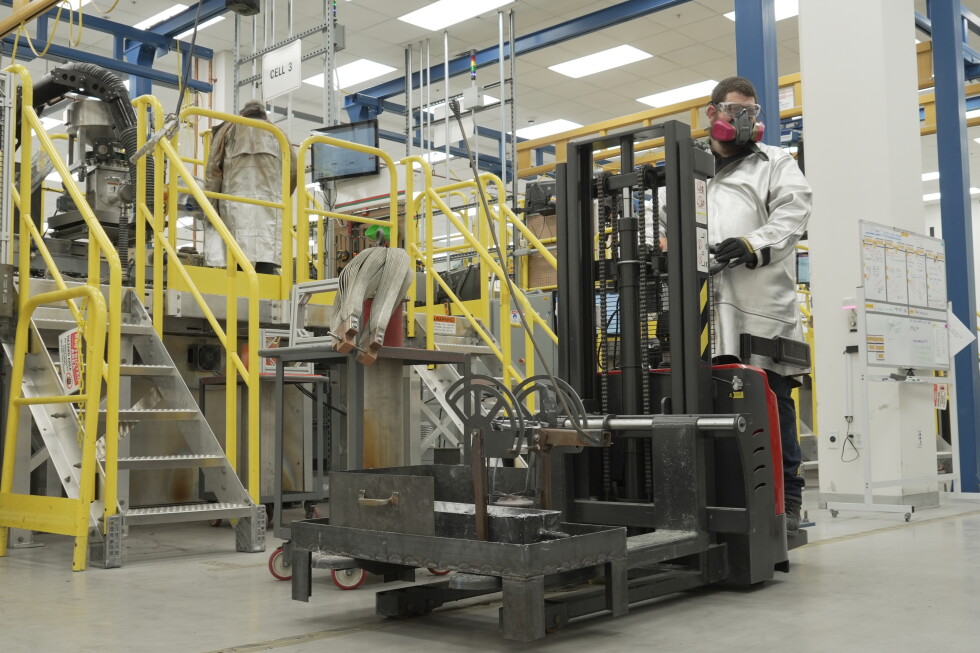
Inside the company’s current facility, technicians clad in heat-resistant hazmat suits and sealed face masks use a low-emission electrolysis process to separate pure rare earth metals from mining waste powder. The end product, a grayish mixture of neodymium and praseodymium, is used to manufacture high-strength permanent magnets that power F-35 fighter jets, Tomahawk cruise missiles, THAAD missile defense systems, military drones, and radar arrays. As Anthony Balladon, Phoenix Tailings co-founder and chief commercial officer, puts it: a $150 million advanced weapons system is entirely useless without the $20,000 to $30,000 in critical minerals it requires.
The urgency of this supply chain overhaul has accelerated sharply in recent months. Ongoing conflict in the Middle East has drawn down U.S. munitions stockpiles at an unprecedented rate, and the newly escalating tensions with Iran have further stretched already thin inventories. A May 2025 analysis from the Center for Strategic and International Studies (CSIS), a Washington-based think tank, warns that it could take at least three years to replenish stockpiles of key systems such as Tomahawk cruise missiles, Patriot interceptors, and THAAD defense systems. Shortfalls not only leave the U.S. and its Middle Eastern allies more vulnerable in the current conflict, but also leave the U.S. with diminished firepower for any potential future confrontation with China.
Last month, former President Donald Trump added new pressure to the sector with an executive order tightening restrictions on defense contractors sourcing critical mineral components from China. The order also curtails the Pentagon’s ability to issue waivers for contractors that claim domestic supplies are unavailable, making it mandatory for all critical materials used in U.S. military equipment to be sourced from the U.S. or allied nations. “It is the policy of the United States that not only the finished equipment deployed by our military, but also the critical materials and components necessary to manufacture, maintain, sustain, and repair that equipment, are sourced domestically or from allied nations,” the July 20 order states.
Major defense contractors have signaled they are working to adjust their supply chains. Lockheed Martin, the world’s largest defense contractor, said in a statement that it “continuously assesses the global rare earth supply chain to ensure access to critical materials that support our customers’ missions.” Other leading firms including Raytheon Technologies and Northrop Grumman declined to comment on their supply chain adjustments to AP.
Balladon acknowledges that scaling domestic production to meet demand in the required timeline is a significant challenge. “It will be a tall order and a challenge to replenish these stocks and scale up in the time frame needed to meet defense demand and regulations,” he said. Still, the company is moving forward quickly, with plans to boost output to 5 tons within three months, and reach full 120-ton capacity by 2027 or 2028 at the latest.
Phoenix Tailings is not the only firm shifting supply chains away from China. Rochester, New York-based magnet manufacturer Arnold Magnetic Technologies, which supplies critical components for precision-guided weapons, has for years relied on Chinese-sourced samarium. Today, the company is sourcing its samarium from a restarted rare earth operation in La Rochelle, France, where Belgium-based chemical firm Solvay has resumed processing rare earths from legacy mining waste that was abandoned when China dominated the global market in the 2000s. After China weaponized its rare earth monopoly in 2025 by restricting exports during the U.S.-China trade war, Solvay restarted processing operations at the site, ramping up output to meet growing demand from both European and North American defense and industrial clients. While Solvay’s materials come at a higher cost than Chinese alternatives, Arnold CEO Matt Blake notes that the magnets represent a tiny share of total weapons system costs, making the price increase negligible.
Not all critical mineral supply gaps are close to being filled, however. Brodie Sutherland, CEO of Patriot Critical Minerals Corp., which is developing domestic tungsten mining operations in the U.S., warns that the U.S. remains fully dependent on imports for tungsten, with China controlling roughly 80% of global mine supply and an even larger share of downstream processing. With a 2027 Pentagon deadline to eliminate Chinese tungsten from defense supply chains approaching, Sutherland says U.S. production will take years to ramp up, leaving the Department of Defense reliant on existing stockpiles, recycling, and limited alternative sources in the near term.
Despite these headwinds, Balladon remains optimistic that U.S. companies and allied partners can meet the challenge. “Ultimately, with the right support and partners across the industry, we think we can make it happen,” he said.