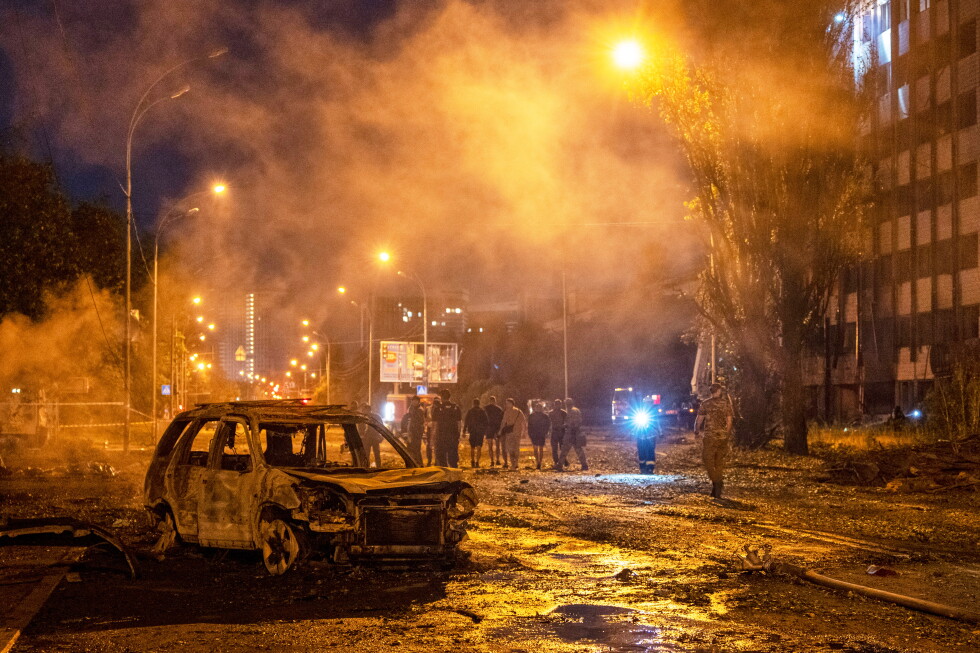
A devastating aerial assault on residential neighborhoods in southern Ukraine’s Zaporizhzhia has left one civilian dead and dozens injured, marking the latest in a years-long pattern of Russian use of largely uncountered heavy weaponry against Ukrainian population centers, regional officials confirmed Monday.
Over a 90-minute window Sunday evening, Russian warplanes deployed eight powerful guided glide bombs across four districts of the city, Zaporizhzhia regional governor Ivan Fedorov announced. The attack killed a 71-year-old woman and left 31 people wounded, among them a 16-year-old girl. At least 22 multi-unit apartment buildings suffered significant damage in the strike, adding to the massive toll of civilian infrastructure destruction from Russia’s full-scale invasion, which entered its fifth year this year.
Glide bombs, a weapon Russia has relied on heavily since the beginning of its invasion, are modified Soviet-era munitions fitted with modern guidance systems that give them increased accuracy. Each weapon can carry up to 3,000 kilograms of high explosive, enough to leave massive craters and level entire city blocks. Critically, Ukraine currently lacks operational defense systems capable of reliably intercepting these weapons, leaving civilian communities vulnerable to repeated devastating strikes.
The deadly assault came on the heels of a wider wave of long-range Russian attacks across Ukraine that unfolded over the weekend and into Monday. In an overnight barrage from Sunday to Monday, Russia launched 181 long-range strike drones at targets across the country, Ukraine’s Air Force reported. While Ukrainian air defense teams managed to jam and shoot down 163 of the unmanned aerial vehicles, 18 penetrated defenses, damaging infrastructure at 13 separate locations.
The continued onslaught of ballistic missile and glide bomb attacks has pushed Ukrainian President Volodymyr Zelenskyy to issue another urgent appeal to Western allies for additional air defense capabilities, specifically U.S.-manufactured Patriot systems. The Patriot platform is the only weapons system currently in Ukraine’s arsenal that can reliably intercept Russian ballistic missiles, but stockpiles of Patriot interceptors have been stretched dangerously thin globally amid ongoing conflicts including tensions in the Middle East tied to the Iran war.
“The world has Patriot missiles. What matters now is for our partners to make the political decision to provide the necessary packages,” Zelenskyy stated in a social media post Monday. “The United States knows what we need. Europe knows what we need. Anti-ballistic missiles must protect people — not sit in stockpiles.”
The plea comes amid uncertainty over U.S. support for Ukraine’s defense industrial capacity. Last week, U.S. President Donald Trump walked back an earlier indication that he would approve a license to allow Ukraine to produce its own Patriot interceptors domestically, telling reporters Friday the issue remains under active review and no final decision has been reached.
In response to this delay, Zelenskyy has floated an alternative proposal: that tech entrepreneur Elon Musk allow Ukraine to use his Starlink satellite internet network to enable targeting of Russian ballistic missile launch sites located inside Russian territory. As of Monday, Ukrainian officials have not publicly confirmed whether the plan is moving forward.
Russian officials have meanwhile reported their own set of alleged strikes and Ukrainian counterattacks over the same 24-hour period. The Russian Defense Ministry claimed its forces hit four bulk cargo ships carrying military supplies for Ukraine, three of which were located in Black Sea waters and one docked in the Ukrainian port of Mykolaiv, though no independent verification of the claim has been provided.
Russian-installed authorities in Crimea, the Ukrainian peninsula illegally annexed by Russia in 2014, said three people were killed and two wounded in an overnight Ukrainian attack on the region. No further details on the strike were released by the Kremlin-appointed head of Crimea, Sergei Aksyonov.
Ukrainian drone strikes have also continued targeting Russian logistics infrastructure, hitting a key warehouse operated by Wildberries, Russia’s largest e-commerce retailer, in the Vladimir region, located east of Moscow. The strike sparked a large fire at the facility, the company confirmed Monday. Three people were injured in the attack, regional governor Alexander Avdeyev said. This latest incident is part of a sustained Ukrainian campaign that has hit more than a dozen Wildberries distribution hubs across Russia, causing significant disruption to the company’s national operations.
On Monday, the Russian Defense Ministry said its air defense forces intercepted 131 Ukrainian drones overnight across multiple Russian regions, annexed Crimea, and the Black Sea, matching the scale of the largest recent cross-border drone offensives by Ukraine.
This ongoing cycle of attack and counterattack underscores the continued intensity of fighting across the front lines and deep behind enemy lines more than four years after Russia launched its full-scale invasion of Ukraine.