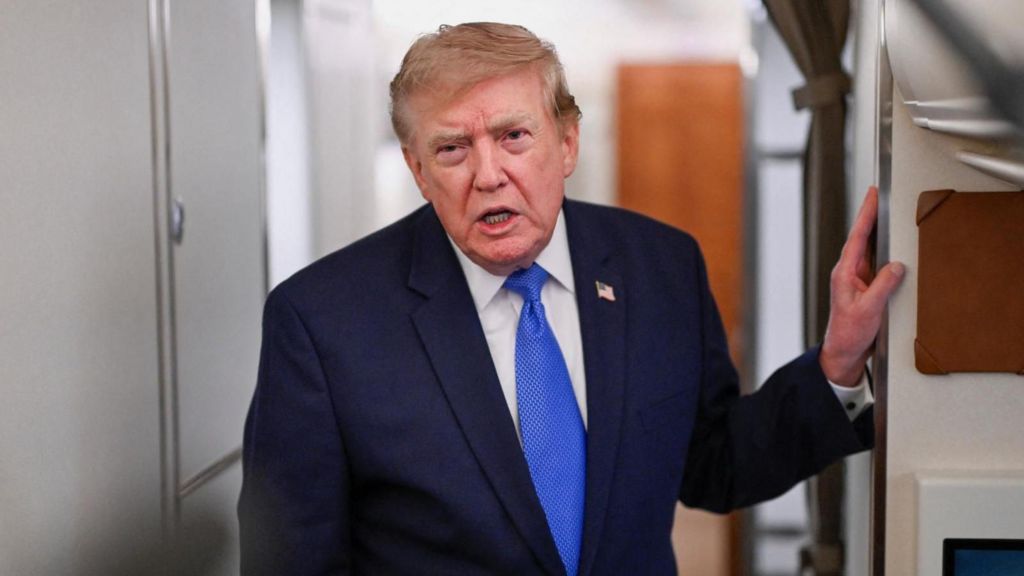
On a Sunday flight aboard Air Force One, U.S. President Donald Trump made a sweeping announcement that new negotiations with Iran will kick off Monday afternoon, just days after he abruptly called off what he described as a “massive, unprecedented” military strike against the Islamic Republic that was already positioned and ready to launch.
Speaking to reporters traveling with him, Trump confirmed that Iranian officials and key U.S. Middle Eastern allies had formally requested he delay the planned attack after preliminary agreement on core parameters for a potential diplomatic deal had been reached. “They saw the attack building, so they knew exactly how large it would be,” Trump told reporters. “Negotiations start tomorrow afternoon, and we will see how they progress. I’m not setting an artificial deadline for an agreement. We are fully prepared to resume military action at any moment if talks fall apart, but that is not the outcome I want – I have no interest in loss of life.”
The U.S. leader specifically named Saudi Arabia’s Crown Prince Mohammed Bin Salman, alongside United Arab Emirates and Qatari leaders, as key regional partners that urged him to hold off on weekend strikes. “We were completely locked and loaded to go,” he said. “They asked to hold off because they believe a deal is within reach. We already have a framework for an agreement on Strait of Hormuz shipping, and we will reach a deal on Iran’s nuclear program as well.”
Trump also emphasized that calling off the strike, which he claimed would have been the largest U.S. military attack on a single target since World War II, was necessary to preserve the fragile path to diplomacy that has opened after months of escalating conflict. When pressed if the planned strike had targeted Iranian energy infrastructure – a move that international law experts have warned would qualify as a war crime that endangers civilian energy access – Trump declined to comment.
However, Tehran has pushed back directly against Trump’s narrative. Iran’s semi-official Mehr News Agency dismissed the president’s claim that Iran requested a delay to strikes as “nothing but a new lie.” Despite that denial, Iranian state media reported Sunday that Iranian Foreign Minister Abbas Araghchi confirmed negotiations mediated by Oman focused on securing a Strait of Hormuz shipping agreement are “on track for finalization.”
Iran’s acting Defense Minister Majid Ibn al-Reza reiterated Tehran’s position that all American military threats are taken seriously, regardless of whether they are framed as psychological warfare. “We will not be caught off guard, and we will not remain passive in the face of any aggression,” he stated.
Following Trump’s announcement of incoming talks, global energy markets reacted positively in early Monday Asian trading. International benchmark Brent Crude dropped 4.5% to $83.98 per barrel, while U.S. West Texas Intermediate crude fell 4.6% to $80.74 per barrel. Energy prices have swung wildly since the latest conflict between the U.S. and Iran began in February, driven by investor fears over disruptions to shipping through the Strait of Hormuz, a chokepoint that carries roughly 20% of the world’s total crude oil and liquefied natural gas supplies.
Trump’s shift from aggressive military rhetoric to diplomacy follows a well-established pattern of the president’s approach to the conflict. Just this past Saturday, he posted to Truth Social warning that the U.S. was prepared to launch an attack on Iran “at levels of Military Terror, Strength, and Power not seen since World War II,” only to reverse course hours later and announce he was cancelling the strike for “the future benefit of the world and, likewise, the survival of a successful and prosperous Iran.”
This back-and-forth is not new. Back in April, Trump issued an extreme warning that “a whole civilisation will die tonight” if Iran refused to enter peace talks, while also threatening to destroy Iranian civilian infrastructure and power plants. That threat did eventually lead to historic face-to-face negotiations in Pakistan led by Vice President JD Vance, but those talks ultimately failed to produce a binding agreement.
To date, the Trump administration has not released details on where Monday’s talks will be held, nor who will represent the two sides in the negotiations. The ongoing conflict and its economic fallout have become increasingly unpopular with U.S. voters, according to multiple national polls, including disapproval from a large share of Republican voters. The low approval ratings for Trump’s handling of the conflict have sparked growing concern among conservative political strategists ahead of the November 2026 midterm elections. This report includes additional reporting from Peter Hoskins.