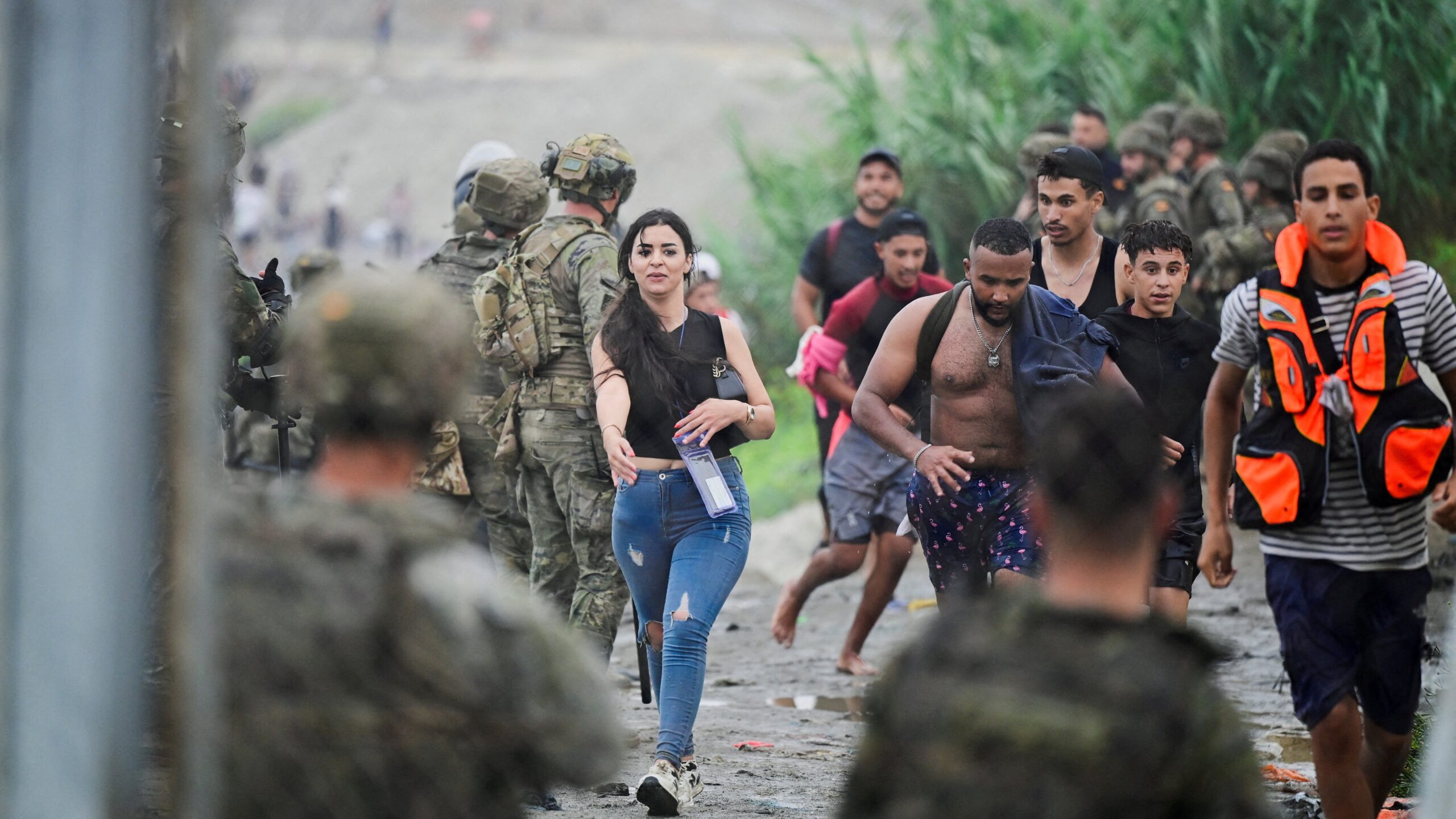
A sudden, unprecedented wave of mass migration has pushed Spain into urgent action to secure its North African enclave Ceuta, after tens of thousands of people crossed into the territory from Morocco in one of the largest border breaches in recent decades. Local authorities in Ceuta confirm that roughly 60,000 people successfully entered the Spanish territory, with around 8,000 of the arrivals recorded as children, according to estimates from Spain’s central government in Madrid. By Friday, Spain’s interior ministry announced that approximately 13,000 of the new arrivals had already been repatriated to Morocco.
Videos shared across social media platforms captured the risky crossing: migrants swam around the reinforced border barrier separating Ceuta from Morocco, many wearing only swimsuits and relying on simple flotation rings to complete the dangerous aquatic journey. For many who completed the crossing, the arrival brought overwhelming relief. “We’re really happy to be here,” shared Jadid Zacaria, one of the migrants who entered Ceuta. “It’s been a very tough experience to go from the ocean. The [Moroccan] police officers tried to stop us, but through our will and determination, we could [make it] here.” Many migrants were filmed chanting “viva Espana” — long live Spain — immediately after setting foot on Spanish soil.
Ceuta and the neighboring Spanish enclave of Melilla, both located on Morocco’s Mediterranean and northern coasts respectively, hold unique geographic significance: they are the only land borders connecting the European Union to the African continent. Both territories, each with a permanent population of roughly 85,000, have long faced periodic surges in attempted crossings by people seeking access to Europe and better opportunities. But the scale of this week’s influx is almost unprecedented, marking the largest single arrival of migrants in Ceuta since May 2021, when thousands crossed amid a heated diplomatic dispute between Madrid and Rabat over the contested Western Sahara territory.
The mass crossing has already sent shockwaves through the European Union, sparking division and immediate policy shifts among member states. France has announced it will ramp up security checks along its own border with Spain, while Italy has issued a formal threat to suspend Spain from the EU’s Schengen Area, the bloc’s internal open-border scheme that allows unrestricted movement between participating countries.
On the Moroccan side of the border, security forces have moved aggressively to stem the flow of new arrivals. Moroccan authorities deployed water cannon to push back crowds gathered at the Ceuta border gates, and clashes between security forces and migrants left a bus and seven cars burned in the area nearby, according to Reuters reporting.
Spanish officials have committed to expelling all migrants who entered the territory illegally as quickly as possible, even amid a legal barrier: a recent court ruling has imposed new restrictions on the special “border rejection” rules that previously allowed for immediate expulsions directly from the enclave.
Unlike most crossing attempts, which see migrants travel several kilometers along the coast to avoid heavily fortified sections of the fence, this wave of migrants faced surprisingly little resistance when approaching the border barrier. Many initially walked along the rocky sea wall to bypass the fence, while the majority swam around the barrier to reach Ceuta’s beaches on the Spanish side.
To date, no definitive explanation has emerged for what prompted this sudden, large-scale wave of attempted crossings. Spain’s Territorial Policy Minister Angel Victor Torres has suggested the surge may be linked to a recent ruling from the Spanish Supreme Court issued earlier this month, which barred authorities from summarily returning migrants intercepted at sea attempting to reach Ceuta or Melilla under the previous special border rules. Jamila El Abboudi, an activist with the Moroccan Association for Human Rights (AMDH), echoed this analysis in comments to French outlet Le Monde, noting that the court decision directly encouraged migrants to travel to Ceuta by sea.
Other political analysts have pointed to a separate diplomatic context: growing tension between Morocco and Spain following Spanish Prime Minister Pedro Sanchez’s recent visit to Algeria, Morocco’s long-standing rival and Spain’s largest natural gas supplier. The Sanchez visit was part of an effort by Madrid to de-escalate tensions that emerged after Spain backed Morocco’s 2022 autonomy plan for Western Sahara, a disputed territory claimed by the Algeria-backed pro-independence Polisario Front.
Even after the initial mass crossing, thousands of prospective migrants have gathered in the Moroccan border town of Fnideq, despite heavy reinforced security deployments that have blocked most new crossing attempts. Though the main border access points are now effectively sealed, small groups continue to move along the coastline searching for unfortified gaps in the barrier, with many already preparing to attempt the dangerous swim. “I was late,” 32-year-old Brahim, who only provided his first name, told Reuters after traveling from Tangier to attempt the crossing, only to find the border fully blocked. Among those still waiting to cross are women and children from both Morocco and multiple sub-Saharan African nations.