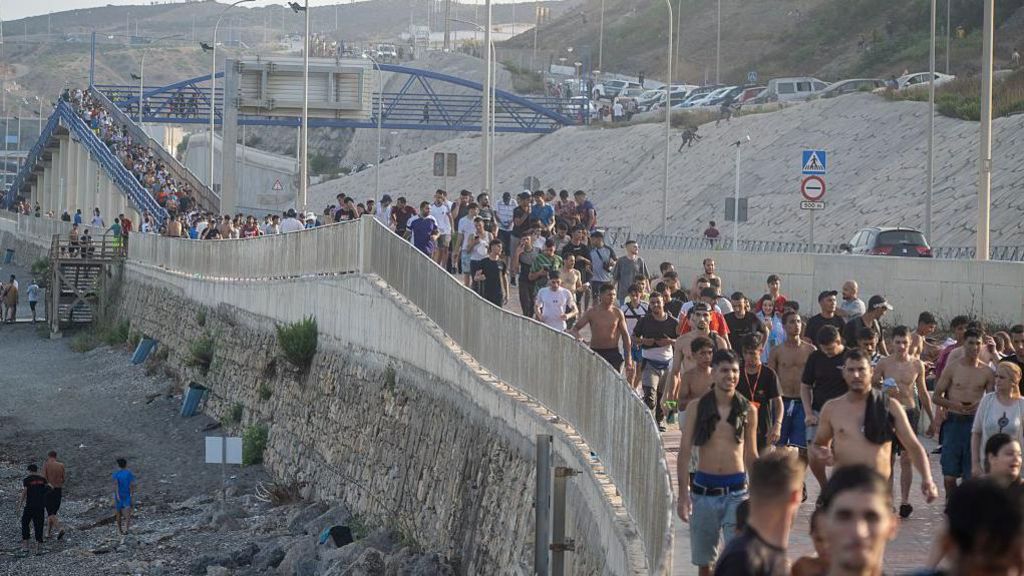
In the days following an unprecedented mass crossing of 60,000 migrants into the Spanish North African enclave of Ceuta, the immediate crisis has started to ease as most arrivals gradually trickle back across the border into Morocco. The surge, which saw six times more people breach Ceuta’s boundary barriers in less than 24 hours than the last major incursion in 2021, has left Spanish Prime Minister Pedro Sánchez facing intense political and diplomatic pressure, though that pressure is expected to soften as reinforced military and police deployments secure the border and authorities process and return migrants who do not qualify for the right to remain and do not leave voluntarily.
Unlike the sub-Saharan migrants who undertake dangerous cross-Sahara treks or risky sea crossings to reach Spain’s Canary Islands, most of those who crossed into Ceuta in this latest event were local Moroccan residents with no preparation for long-distance migration. At least 57 people lost their lives during the crossing attempt, with many confirmed drowned, underscoring the extreme risks migrants took to reach the EU territory.
Sánchez traveled to Ceuta within hours of the surge, accusing human traffickers of exploiting a recent Spanish Supreme Court ruling that limits the government’s authority to immediately deport newly arrived sea migrants. But observers and diplomatic analysts point to a far larger geopolitical trigger for the event: Morocco’s deliberate decision to allow its border forces to step aside and permit the mass crossing, a tactic the kingdom has used before to retaliate against Spanish diplomatic moves tied to the long-running Western Sahara dispute.
The Western Sahara conflict has shaped Maghreb diplomacy for more than 50 years, ever since Spain ceded control of Spanish Sahara to then-Moroccan King Hassan II, while Algeria threw its support behind the indigenous Polisario Front, which claims independence for the territory. The dispute has left Morocco and Algeria locked in a bitter diplomatic cold war, with a UN peacekeeping force still deployed to monitor the fragile ceasefire between Moroccan forces and Polisario guerrillas.
For decades, European governments attempted to maintain neutrality on the issue to avoid angering either Rabat or Algiers. But in 2022, Spain broke with longstanding policy to back Morocco’s plan for Western Sahara autonomy, rejecting independence for the territory—a move that infuriated Algeria. Sánchez’s recent diplomatic trip to Algiers, intended to repair strained ties with Algeria, preceded this latest migrant surge, leading analysts to connect the event to Moroccan retaliation for Spanish diplomatic outreach to its regional rival. This is not the first time Morocco has used migration pressure against Spain: the 2021 Ceuta incursion followed Spain’s decision to allow Polisario leader Brahim Ghali to receive COVID-19 treatment on Spanish soil.
Geographically, Ceuta and its sister enclave Melilla are millennia-old settlements that have been Spanish territory since the 16th century, making them the only EU territory with a direct land border on the North African coast. This unique position leaves Spain uniquely vulnerable to migration pressure leverage from Morocco.
Domestically, Sánchez has faced fierce criticism from Spain’s mainstream conservative Partido Popular and far-right Vox party over the surge. Internationally, several European governments have raised alarms, with Italy even floating the idea of suspending Spain’s Schengen Area membership. However, analysts note that concerns over unrestricted access to the rest of the Schengen zone are overblown: Spain already operates strict internal border controls for all flights and ferries traveling from Ceuta and Melilla to the Spanish mainland, limiting movement into the wider open borders area.
Beyond the immediate geopolitical context, the event has also highlighted a policy divide between Spain and much of the rest of the EU. Sánchez has pursued a notably pro-immigration agenda that stands in stark contrast to the restrictive policies adopted by most other EU member states and the UK, including launching a seasonal worker program that brings thousands of Senegalese laborers to Spain’s horticultural sector each year. The long-term political and economic sustainability of this approach remains untested, but it has already created unease among other European governments, which helps explain their sharp reaction to the Ceuta crisis, notes Chatham House Africa Programme consulting fellow Paul Melly.