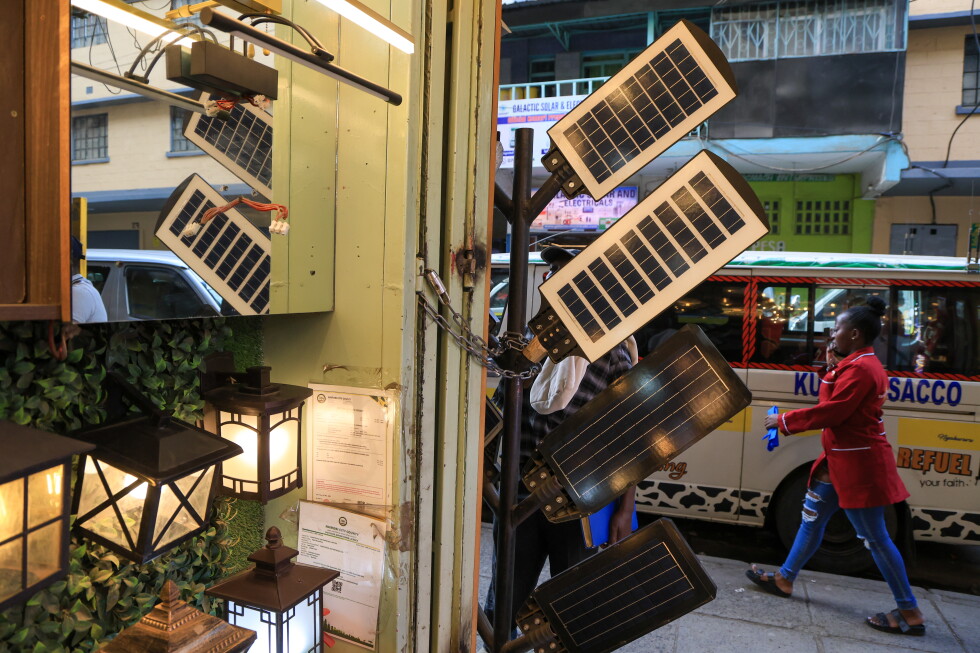
Across sub-Saharan Africa, over 600 million people still live without access to consistent, reliable electricity, leaving millions of households reliant on dangerous, polluting energy sources like kerosene. Now, two of the continent’s biggest off-grid solar companies have closed historic fundraising deals that are sparking cautious optimism that mainstream private capital markets could finally step in to accelerate universal electrification across the region.
In June, affordable clean energy provider d.light issued a $50 million green bond earmarked for off-grid solar projects, while industry competitor Sun King secured $286 million in securitized debt, set to close mid-2025. Together, these transactions represent the largest-scale test yet of whether large institutional investors will back the sector’s popular pay-as-you-go (PAYGo) business model at a commercial level.
Both companies operate on the PAYGo framework, which allows low-income households to purchase small-scale solar home systems and appliances in incremental, affordable installments — usually paid via mobile money apps — rather than requiring the full upfront cost that puts systems out of reach for most. To unlock immediate new capital for expansion, the companies bundle the stream of future customer repayments, called receivables, and use them as collateral to issue bonds or other securities sold to outside investors.
Sun King Global CFO Krishna Swaroop described the twin deals as pathbreaking for the entire African off-grid solar industry. “They demonstrate the entry of a serious scale of commercial capital, investors and instruments not seen before in this sector,” he said. But Swaroop also warned that the transactions are built on years of operational and repayment data that most smaller off-grid firms have not yet had the time to accumulate. Most mainstream investors require five to seven years of consistent repayment performance data before committing to this kind of structured financing, a bar many early-stage startups cannot clear.
While securitization — the financing tool Sun King used, which is already common in global mortgage and auto loan markets — can reduce long-term borrowing costs for large established firms, the process requires expensive legal work, regulatory compliance, and credit guarantees. These fixed upfront costs make the strategy unworkable for smaller companies with smaller receivables portfolios. Swaroop added that the biggest ongoing barrier to attracting more mainstream capital remains portfolio quality risk: many off-grid firms still struggle to present their repayment performance data in a standardized format that institutional investors understand and trust.
The financing tools deployed in these deals are still relatively new to emerging market climate investment. D.light’s green bond, structured similarly to a traditional fixed-income security that pays regular interest to buyers, is backed by a special-purpose entity that holds thousands of d.light’s PAYGo customer receivables, with all proceeds going toward new environmentally beneficial solar installations. Sun King’s securitization structure, by contrast, repackages future customer repayments the same way banks bundle home mortgages to sell to investors, turning years of future scheduled payments into immediate expansion capital today.
Industry leaders say the deals prove that the African off-grid solar market has matured after decades of reliance on donor funding and development finance. Years of incremental improvements to product quality, independent third-party certification, and consistent repayment track records have turned customer receivables into an increasingly attractive asset class for global investors, explained Sarah Malm, executive director of GOGLA, the global off-grid solar industry association. “These deals are proof that the model works,” Malm said. “Today, PAYGo receivables are rated, listed and bought by institutional investors in London and New York.”
Data from GOGLA’s 2025 Investment Data Report backs up this trend: African off-grid solar companies are drawing in more sophisticated financing than ever before, with local-currency investment hitting a record high of 47.2% of total sector funding, with the remainder denominated in U.S. dollars. The report also counted 18 first-time investors entering the space, including commercial banks based in Nigeria, Kenya, Tanzania, and Madagascar.
Wangari Muchiri, founder and CEO of Africa-based clean energy transition advisory firm RE.Think Energy, called the transactions an important tipping point for the sector, rather than just one-off isolated successes. “Every successful transaction reduces perceived risk and makes the next one easier to finance,” Muchiri said. She added that broader adoption of this financing model will require building a larger pipeline of investment-ready companies, creating standardized financing frameworks, improving public performance data collection, and enacting pro-electrification regulatory policies across African markets.
Industry analysts still note that both current deals rely on significant credit enhancements to reduce risk for investors. D.light’s green bond, for example, is fully guaranteed by Green Guarantee Co., an organization that mobilizes private capital for climate investment in emerging markets, which substantially de-risks the investment for buyers, according to Penny Herbst, senior energy adviser at the Rabia Transition Initiative, a nonproift energy transition research organization. Herbst added that because the bond was privately placed, key details including pricing and guarantee terms remain confidential, limiting transparency for the broader sector.
If this kind of private commercial financing becomes more widespread, supporters say it could fundamentally reshape Africa’s electrification efforts. Technological advances have already reduced costs and improved reliability: lithium-ion batteries used in home solar systems now last up to 10 years, and battery prices have fallen more than 90% since 2010, Malm noted. Widespread independent product certification, consumer warranties, and local repair networks have further reduced risk for investors by turning unpredictable household payments into a consistent, well-understood financial asset.
Even with this progress, sector leaders warn of one key unresolved challenge: ensuring that the push for commercial market returns does not push companies to serve only higher-income, lower-risk households at the expense of the poorest, hardest-to-reach communities that need electricity access most. “Theoretically, capital markets and institutional investors can provide cheaper and longer-tenured capital,” Swaroop said. “But we also need to ask whether chasing capital-market-level returns leads companies toward larger, more creditworthy customers and away from the hardest-to-reach, lowest-income segment.”
This coverage of climate and energy issues from The Associated Press is supported by funding from multiple private foundations, with AP retaining full editorial control over all content.