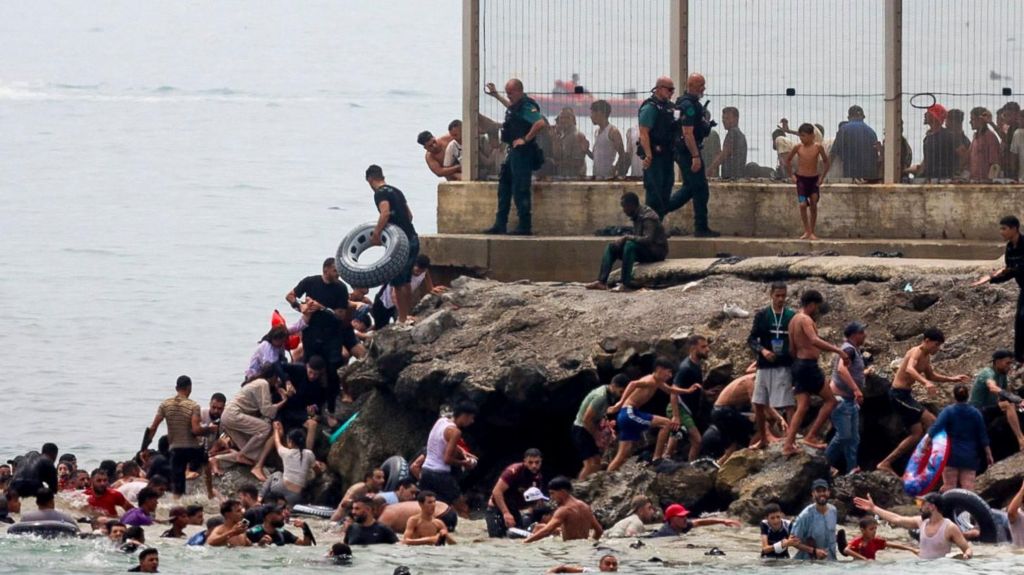
A sudden and dramatic surge of irregular migrant crossings into Spain’s North African enclave Ceuta has triggered a full-blown humanitarian and security crisis, with local authorities warning that existing resources have been stretched far beyond their capacity over the past week.
Juan Jesús Vivas, the president of the Ceuta territory, confirmed that hundreds of migrants have successfully crossed from Morocco into the enclave since the start of the week, with conflicting reports putting the total number of recent arrivals anywhere between hundreds and 3,000. Visual footage captured on Thursday shows migrants using inflatable rings and other makeshift flotation devices to swim across the short stretch of water separating Morocco from Ceuta, while other groups simply breached a gap in the fortified border fence and ran across the boundary.
As the EU’s only land border with Africa, Ceuta and its neighboring enclave Melilla have long served as primary entry points for migrants seeking to reach mainland Europe and other European Union member states. The recent surge in crossings follows a landmark ruling earlier this month from Spain’s Supreme Court, which prohibits the immediate summary return of migrants intercepted at sea while attempting to reach Ceuta or Melilla back to Morocco. Spanish interior ministry officials have stated that criminal human smuggling networks are actively exploiting this ruling to encourage more undocumented migrants — most of whom are young people — to attempt the crossing.
Discrepancies persist over the total scale of the latest influx. Spanish national news agency Reuters cited local media estimates putting Thursday’s arrivals alone at between 2,000 and 3,000, though Spain’s national Guardia Civil has not formally verified that figure. Spain’s public broadcaster RTVE, by contrast, has reported that “hundreds” crossed on Thursday, and that more than 1,500 migrants, the vast majority of them young Moroccan nationals, have arrived in Ceuta over the past two weeks.
Vivas has drawn urgent attention to the escalating human cost of the crisis: RTVE reports he confirmed 60 bodies of migrants who died attempting the crossing have been recovered from surrounding waters in recent months. He added that the enclave’s migrant reception infrastructure is on the brink of collapse, with facilities specifically designed to house unaccompanied minor migrants currently operating at multiple times their maximum intended capacity. The current crisis has already prompted comparisons to the mass crossing event of May 2021, when roughly 8,000 migrants entered Ceuta over a period of just a few days, sending bilateral diplomatic relations between Spain and Morocco into a sharp downward spiral.
Despite years of Spanish investments in upgraded border security — including enhanced surveillance systems, reinforced border barriers, and coordinated migration control efforts with the Moroccan government — irregular attempts to cross into the enclave have never stopped. Following the latest surge, both Madrid and Rabat have reaffirmed their commitment to strengthening joint action to address the crisis, including an agreement to process handovers of all irregular migrants who entered Ceuta unlawfully as quickly as possible. Spain’s Interior Minister Fernando Grande-Marlaska is scheduled to visit the enclave on Friday to assess the situation firsthand.
The crisis has now drawn political backlash across the European continent, with Italian Prime Minister Giorgia Meloni calling for Spain to be suspended from the Schengen Area. In a public post on the social platform X, Meloni said the widely circulated images of mass crossings from Ceuta were deeply striking, and argued that unmanaged irregular migration represents a tangible threat to the security of all European borders. She added that Italy is ready to implement extraordinary emergency measures to protect its own borders and the safety of its citizens.