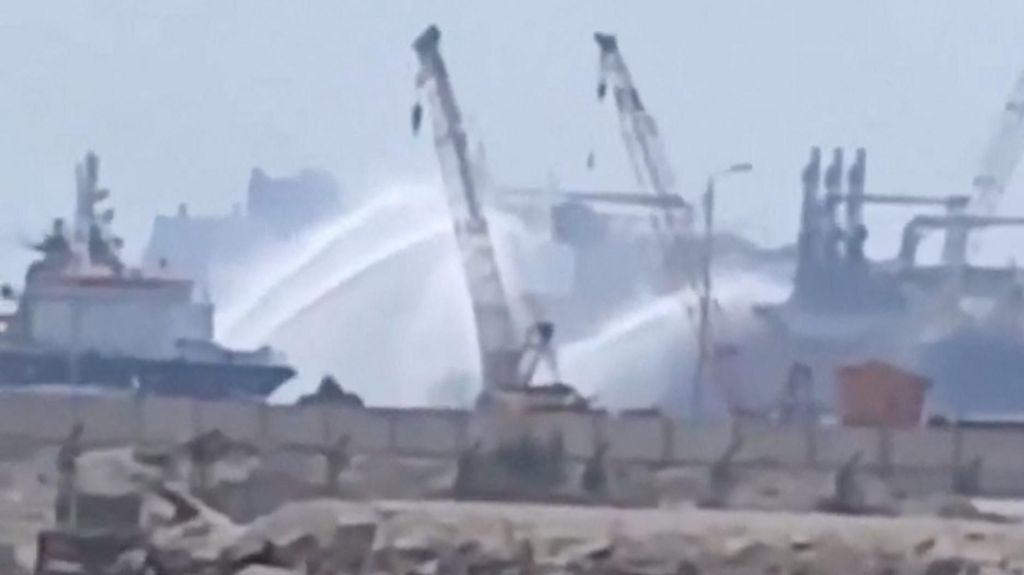
In an incident that has stoked already simmering tensions across the Middle East, a drone strike triggered fires aboard two commercial vessels docked at Egypt’s Damietta Port, a critical Mediterranean hub for liquified natural gas (LNG) trade, Egypt’s cabinet has officially confirmed. As of Thursday, no group has stepped forward to claim responsibility for the Wednesday attack, with local authorities continuing their probe into the assault while implementing urgent security protocols to safeguard Egyptian national interests and strategic assets, according to an official government statement.
Initial reports and verified open-source footage indicate the drone first struck the Energos Winter, a U.S.-owned floating storage and regasification unit, with the resulting blaze quickly spreading to a nearby Greek-crewed LNG tanker, the GasLog Salem. User-shared videos posted across major social media platforms captured thick plumes of black smoke billowing from the port facility, showing on-site response teams deploying tugboats to douse the flames with continuous streams of water.
Egyptian officials have confirmed that firefighting crews successfully contained and extinguished the fires, with no fatalities or injuries reported among port personnel or crew members of the two vessels. Authorities added that normal operations at the port have already resumed full capacity as of Thursday. Data from independent global ship-tracking services shows both damaged vessels have since departed the dock and moved to open offshore waters for safety inspections.
At this stage of the investigation, investigators have not yet determined the origin of the drone or identified the parties behind the attack. Still, regional security analysts note the assault fits a pattern of recent strikes targeting commercial shipping and energy infrastructure carried out by Iranian military forces and Iran-aligned armed groups across the Red Sea, Persian Gulf and surrounding regions. These ongoing attacks have come amid escalating open conflict between the U.S., Israel and Iran, disrupting critical global energy trade routes and pushing international oil prices sharply higher in recent months. Before the Damietta strike, Iran had never launched a direct attack on Egyptian territory, a key U.S. ally in North Africa.
U.S. President Donald Trump told reporters Wednesday that he had received a full intelligence briefing on the Damietta incident, and publicly hinted that Iran or its regional proxy militias were behind the attack. “It’s a little more of the same. But it’s going to be straightening out,” Trump told reporters, offering few additional details on potential U.S. responses.
The Damietta drone attack came just hours after the U.S. and Saudi Arabia launched coordinated joint air strikes against Iran-backed militia positions in Iraq. U.S. and Saudi officials stated the strikes were a defensive response to more than 30 recent drone attacks on Saudi oil infrastructure launched by the militias under direct orders from Iran’s Islamic Revolutionary Guard Corps (IRGC). The Iraqi paramilitary Popular Mobilisation Forces (PMF), a coalition dominated by Iran-aligned Shia militias, reported that at least 20 of its fighters were killed in the strikes, labeling the action an “extremely serious escalation” of regional conflict. Iran’s foreign ministry also issued a formal condemnation of the U.S.-Saudi strikes, warning that the attack would carry “dangerous consequences” for regional stability.
Late Wednesday, the U.S. launched a separate, large-scale wave of air strikes on targets inside Iran, characterizing the action as retaliation for an attempted surprise missile attack targeting U.S. military bases in Jordan just days prior.