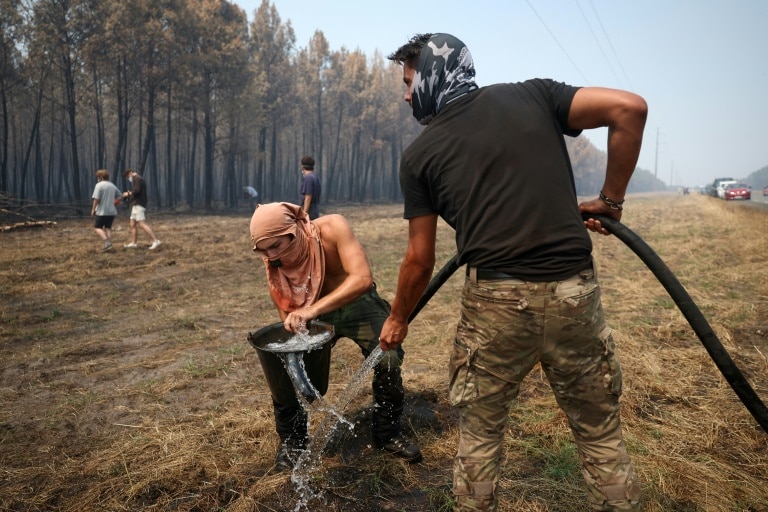
A week of catastrophic, record-breaking wildfires across Western and Southern Europe has entered a new phase this week, with favorable weather finally bringing relief to hard-hit regions in France and Spain, while emergency crews continue to battle out-of-control blazes in Greece and Turkey.
In southwestern France, near the iconic wine capital of Bordeaux, firefighters are breathing a tentative sigh of relief after days of raging flames that have already become the country’s worst wildfire event since 1949. Cooler temperatures and long-awaited rainfall reached the affected coastal pine forest region on Thursday, halting the spread of the massive blaze that has already consumed more than 42,000 hectares of land — an area larger than the entire U.S. city of Detroit. Thunder rumbled over the coastal town of Lege-Cap-Ferret on Thursday, with scattered raindrops falling across the fire zone, a sight welcomed by first responders stationed at the local command post set up in the town’s sports hall.
Regional firefighting authorities report they are “reasonably optimistic” that the worst of the emergency has passed, noting the blaze has not expanded beyond its existing boundaries since the weekend. Still, regional fire chief Marc Vermeulen emphasized that the battle is far from over: crews will need multiple days of sustained work dousing smoldering hot spots deep within the forest and along the fire’s perimeter to prevent the flames from flaring up again once drier, warmer conditions return. So far, the French blaze has forced more than 220,000 people — including vacationers staying at campsites and coastal bungalows, and permanent residents of the region — to evacuate, and destroyed roughly 240 residential properties.
For many local residents, the repeated trauma of climate-fueled wildfires has prompted permanent changes of plans. Kevin Montmartre, an Uber driver based in inland Bordeaux who has already been evacuated three times in recent days from his second home in the beach town of Andernos-les-Bains, told Agence France-Presse that growing wildfire frequency tied to climate change has made him rethink his property investment. “Honestly, I’ve talked it over with my wife, and if there’s another one in the coming years, we’ll sell the house,” he said as rain began to fall in Bordeaux.
Neighboring Spain, which has also faced some of the most extreme wildfire conditions in modern history, is also reporting major progress in containing its blazes. Authorities in the Madrid region announced Thursday that the large wildfire burning on the capital’s outskirts has not spread for several days, with only a small number of smoldering hot spots remaining and “almost no flames” left active. Since the fire began last Wednesday, it has burned 27,000 hectares of land and destroyed at least 100 homes, a toll that officials expect to rise as full assessments begin. By Wednesday, thousands of evacuees had already been allowed to return to their homes, with only around 1,000 people still displaced as of Thursday morning.
Further west in Spain, the Avila wildfire has already made history as the largest wildfire the country has recorded since national fire tracking began in 1961, having burned approximately 50,000 hectares of land to date.
While France and Spain see progress, emergency responders across other parts of Southern Europe are still working to contain fast-moving blazes. On the Greek island of Crete, a popular Mediterranean tourist destination, thousands of residents and visitors were evacuated late Wednesday as high winds pushed flames toward resort areas. The fire continued to rage on Thursday, and local official Maria Lioni confirmed that early reports indicate homes, agricultural infrastructure, and livestock have been lost, though full damage counts remain unavailable while the fire is still active.
In Turkey, officials report the country is currently battling at least 115 active wildfires across its territory, though crews have managed to bring 110 of those blazes under control. Thousands of volunteers have joined professional firefighting crews across the continent to support evacuation efforts, supply logistics, and fire suppression work.