For decades, Argentine-born astronomer Amina Helmi has dedicated her career to unearthing the hidden origins of the Milky Way, treating ancient stars as cosmic time capsules that hold the keys to our galaxy’s chaotic birth. Now, her groundbreaking work rewriting long-held theories of galactic formation has earned her one of the highest honors in the field: the prestigious Kavli Prize, often referred to as the Nobel Prize of astrophysics.
At 55, Helmi is a professor at the University of Groningen in the northern Netherlands, where her passion for the Milky Way is impossible to miss in her compact office. Family snapshots and towering stacks of dense, jargon-heavy academic dissertations share space with a bowl overflowing with Milky Way chocolate bars – a playful, sweet nod to the star system that has consumed her professional life.
Helmi is a pioneer in galactic archaeology, a specialized subfield that treats stars as “cosmic fossils” to reconstruct the Milky Way’s ancient history and project its long-term trajectory. Unlike the popular image of astronomers hunched over telescopes scanning the night sky, Helmi’s work centers on parsing enormous astronomical datasets, some of which contain more than two billion lines of stellar data.
“Stars carry chemical fingerprints that act just like DNA,” Helmi explained in an exclusive interview with AFP. “These chemical compositions preserve irreplaceable information about where a star formed and what environment it originated in, letting us trace billions of years of galactic history.”
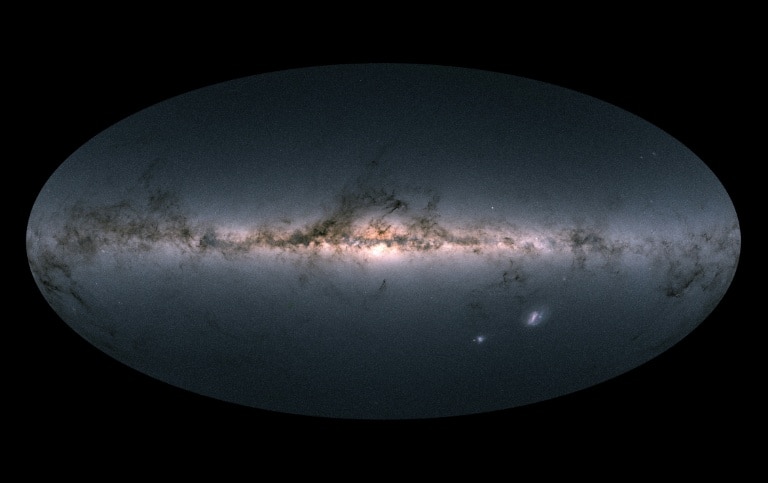
A transformative turning point for Helmi’s research came from the European Space Agency’s Gaia mission, an ambitious project to map the Milky Way in three dimensions, to which Helmi herself contributed. “Gaia measured the motion of nearly 1.5 billion stars across a far larger volume of space than any previous mission,” she noted. “It wasn’t just the sheer number of stars we were able to track – it was the unprecedented accuracy of those motion measurements that changed everything for our field.”
Armed with Gaia’s unprecedented dataset, Helmi and her collaborators pieced together a cataclysmic event that reshaped the Milky Way forever some 10 billion years ago – hundreds of millions of years before our own Sun formed. At that time, a small dwarf galaxy named Gaia-Enceladus collided and merged with the young proto-Milky Way. The leftover stars from the crashed dwarf now form the diffuse halo that wraps around our galaxy, and the collision triggered a wave of new star formation that created the Milky Way’s signature “puffed up” galactic disk.
This discovery upended the long-standing scientific consensus that the Milky Way formed through slow, steady, continuous growth. Instead, Helmi’s work confirmed that our galaxy assembled itself incrementally through a series of violent collisions and mergers with smaller cosmic bodies, a process called hierarchical accretion.
Helmi shares the 2024 Kavli Prize in Astrophysics with two fellow researchers: Vasily Belokurov of the University of Cambridge and Rodrigo Ibata of the University of Strasbourg. The three scientists will split the $1 million prize fund, receive a gold medal, and be honored at a formal ceremony hosted by the Norwegian Academy of Science and Letters in Oslo this coming September. The award committee recognized the trio for “uncovering the fossil evidence of past mergers proving that the Milky Way galaxy was built through hierarchical accretion.”
Helmi told AFP she was completely stunned when she received the news of the award. “I was totally speechless. To me, this is the biggest honor there is in our field – it’s just absolutely unbelievable,” she said. “This is also wonderful recognition for galactic archaeology as a whole. It’s a relatively young field, but it’s exploded in growth over the last decade, and this award puts that work on the map.”
Looking ahead, Helmi plans to continue diving into new data releases from the Gaia mission, while developing more robust statistical models to process the field’s increasingly massive datasets. When asked what the Milky Way’s violent youth means for its future, she offered a reassuring take: “Nothing major has happened to our galaxy since that early collision. You could say it had a wild, turbulent youth, and now it’s enjoying a quiet, restful adulthood.”